QUESTION IMAGE
Question
sc7.l16.2
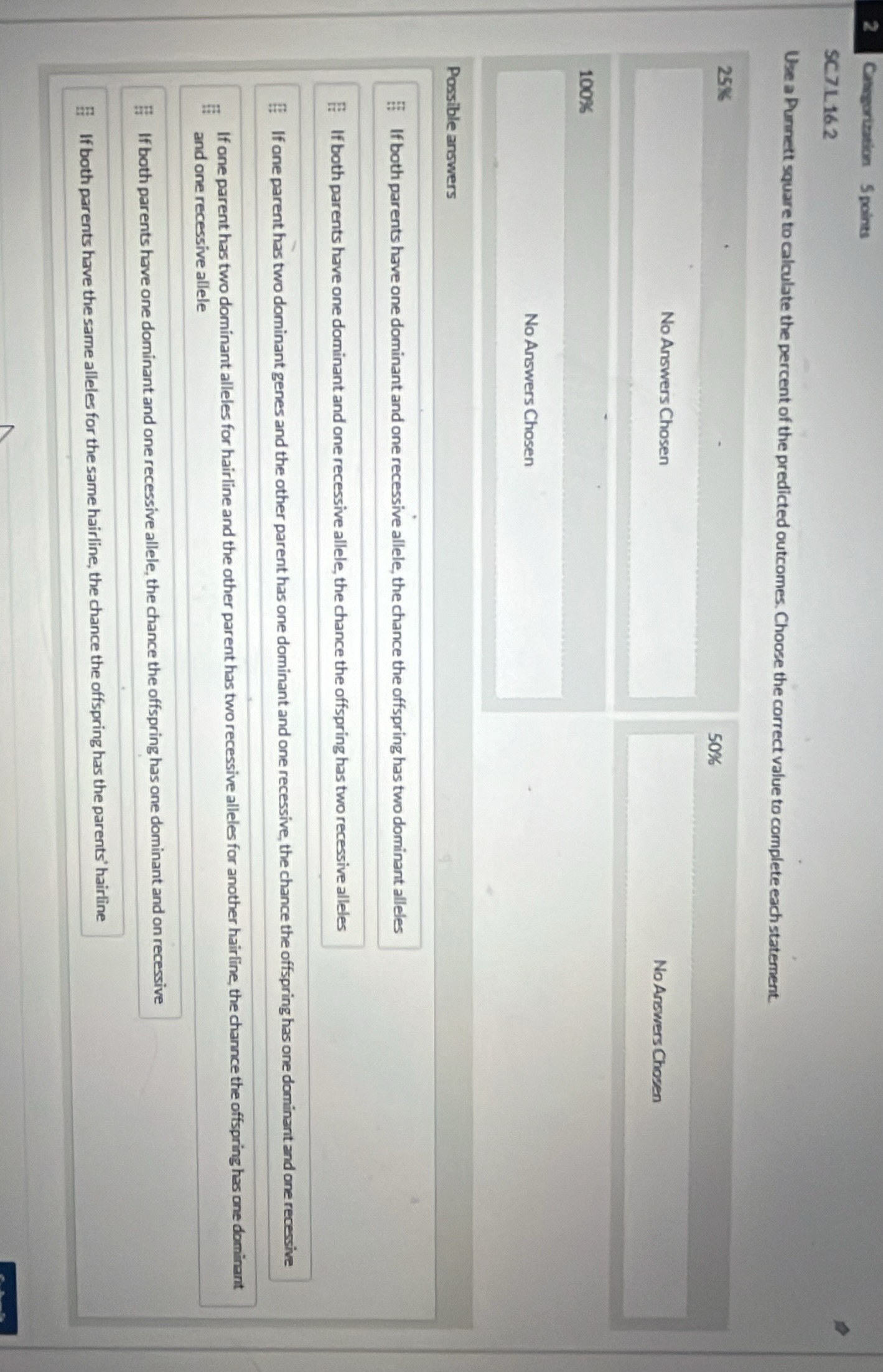
use a punnett square to calculate the percent of the predicted outcomes. choose the correct value to complete each statement.
25%
no answers chosen
50%
no answers chosen
100%
no answers chosen
possible answers
:: if both parents have one dominant and one recessive allele, the chance the offspring has two dominant alleles
:: if both parents have one dominant and one recessive allele, the chance the offspring has two recessive alleles
:: if one parent has two dominant genes and the other parent has one dominant and one recessive, the chance the offspring has one dominant and one recessive
:: if one parent has two dominant alleles for hairline and the other parent has two recessive alleles for another hairline, the chance the offspring has one dominant and one recessive allele
:: if both parents have one dominant and one recessive allele, the chance the offspring has one dominant and on recessive
:: if both parents have the same alleles for the same hairline, the chance the offspring has the parents hairline
To solve this problem, we analyze each statement about allele combinations and their corresponding probabilities using Punnett squares:
1. Statement: "If both parents have one dominant and one recessive allele, the chance the offspring has two dominant alleles"
Let the dominant allele be \( D \) and recessive be \( d \). Both parents have genotype \( Dd \). The Punnett square for \( Dd \times Dd \) is:
| \( D \) | \( d \) | |
|---|---|---|
| \( d \) | \( Dd \) | \( dd \) |
The probability of \( DD \) (two dominant alleles) is \( \frac{1}{4} = 25\% \).
2. Statement: "If both parents have one dominant and one recessive allele, the chance the offspring has two recessive alleles"
Using the same Punnett square (\( Dd \times Dd \)), the probability of \( dd \) (two recessive alleles) is \( \frac{1}{4} = 25\% \).
3. Statement: "If one parent has two dominant genes and the other parent has one dominant and one recessive, the chance the offspring has one dominant and one recessive"
Let the first parent be \( DD \) (two dominant) and the second be \( Dd \) (one dominant, one recessive). The Punnett square for \( DD \times Dd \) is:
| \( D \) | \( d \) | |
|---|---|---|
| \( D \) | \( DD \) | \( Dd \) |
The probability of \( Dd \) (one dominant, one recessive) is \( \frac{2}{4} = 50\% \).
4. Statement: "If one parent has two dominant alleles for hairline and the other parent has two recessive alleles for another hairline, the chance the offspring has one dominant and one recessive"
Let the first parent be \( DD \) (dominant) and the second be \( dd \) (recessive). The Punnett square for \( DD \times dd \) is:
| \( D \) | \( D \) | |
|---|---|---|
| \( d \) | \( Dd \) | \( Dd \) |
All offspring are \( Dd \) (one dominant, one recessive), so the probability is \( 100\% \).
5. Statement: "If both parents have one dominant and one recessive allele, the chance the offspring has one dominant and one recessive"
Using the \( Dd \times Dd \) Punnett square, the probability of \( Dd \) is \( \frac{2}{4} = 50\% \).
6. Statement: "If both parents have the same alleles for the same hairline, the chance the offspring has the parents’ hairline"
If both parents are homozygous (e.g., \( DD \times DD \) or \( dd \times dd \)) or heterozygous (e.g., \( Dd \times Dd \) for a trait where \( Dd \) shows the dominant phenotype), the offspring will inherit the parents’ phenotype. For example:
- \( DD \times DD \): All \( DD \) (100% same as parents).
- \( dd \times dd \): All \( dd \) (100% same as parents).
- \( Dd \times Dd \): \( DD \), \( Dd \), \( Dd \) show the dominant phenotype (same as parents), so \( \frac{3}{4} = 75\% \), but if the parents are \( Dd \) (heterozygous) and the trait is dominant, the offspring’s phenotype matches the parents’ in most cases. However, the most straightforward case is when parents are homozygous (e.g., \( DD \) or \( dd \)), giving \( 100\% \) chance.
Matching Percentages:
- \( 25\% \): Matches statements 1 and 2.
- \( 50\% \): Matches statements 3 and 5.
- \( 100\% \): Matches statements 4 and 6.
Example Assignment (e.g., for \( 25\% \)):
If we assign \( 25\% \) to "If both parents have one dominant and one recessive allele, the chance the offspring has two dominant alleles", the pairing is:
\( 25\% \) → "If both parents have one dominant and one recessive allele, the chance the offspring has two dominant alleles"
(Repeat for other percentages based on the same…

Snap & solve any problem in the app
Get step-by-step solutions on Sovi AI
Photo-based solutions with guided steps
Explore more problems and detailed explanations
To solve this problem, we analyze each statement about allele combinations and their corresponding probabilities using Punnett squares:
1. Statement: "If both parents have one dominant and one recessive allele, the chance the offspring has two dominant alleles"
Let the dominant allele be \( D \) and recessive be \( d \). Both parents have genotype \( Dd \). The Punnett square for \( Dd \times Dd \) is:
| \( D \) | \( d \) | |
|---|---|---|
| \( d \) | \( Dd \) | \( dd \) |
The probability of \( DD \) (two dominant alleles) is \( \frac{1}{4} = 25\% \).
2. Statement: "If both parents have one dominant and one recessive allele, the chance the offspring has two recessive alleles"
Using the same Punnett square (\( Dd \times Dd \)), the probability of \( dd \) (two recessive alleles) is \( \frac{1}{4} = 25\% \).
3. Statement: "If one parent has two dominant genes and the other parent has one dominant and one recessive, the chance the offspring has one dominant and one recessive"
Let the first parent be \( DD \) (two dominant) and the second be \( Dd \) (one dominant, one recessive). The Punnett square for \( DD \times Dd \) is:
| \( D \) | \( d \) | |
|---|---|---|
| \( D \) | \( DD \) | \( Dd \) |
The probability of \( Dd \) (one dominant, one recessive) is \( \frac{2}{4} = 50\% \).
4. Statement: "If one parent has two dominant alleles for hairline and the other parent has two recessive alleles for another hairline, the chance the offspring has one dominant and one recessive"
Let the first parent be \( DD \) (dominant) and the second be \( dd \) (recessive). The Punnett square for \( DD \times dd \) is:
| \( D \) | \( D \) | |
|---|---|---|
| \( d \) | \( Dd \) | \( Dd \) |
All offspring are \( Dd \) (one dominant, one recessive), so the probability is \( 100\% \).
5. Statement: "If both parents have one dominant and one recessive allele, the chance the offspring has one dominant and one recessive"
Using the \( Dd \times Dd \) Punnett square, the probability of \( Dd \) is \( \frac{2}{4} = 50\% \).
6. Statement: "If both parents have the same alleles for the same hairline, the chance the offspring has the parents’ hairline"
If both parents are homozygous (e.g., \( DD \times DD \) or \( dd \times dd \)) or heterozygous (e.g., \( Dd \times Dd \) for a trait where \( Dd \) shows the dominant phenotype), the offspring will inherit the parents’ phenotype. For example:
- \( DD \times DD \): All \( DD \) (100% same as parents).
- \( dd \times dd \): All \( dd \) (100% same as parents).
- \( Dd \times Dd \): \( DD \), \( Dd \), \( Dd \) show the dominant phenotype (same as parents), so \( \frac{3}{4} = 75\% \), but if the parents are \( Dd \) (heterozygous) and the trait is dominant, the offspring’s phenotype matches the parents’ in most cases. However, the most straightforward case is when parents are homozygous (e.g., \( DD \) or \( dd \)), giving \( 100\% \) chance.
Matching Percentages:
- \( 25\% \): Matches statements 1 and 2.
- \( 50\% \): Matches statements 3 and 5.
- \( 100\% \): Matches statements 4 and 6.
Example Assignment (e.g., for \( 25\% \)):
If we assign \( 25\% \) to "If both parents have one dominant and one recessive allele, the chance the offspring has two dominant alleles", the pairing is:
\( 25\% \) → "If both parents have one dominant and one recessive allele, the chance the offspring has two dominant alleles"
(Repeat for other percentages based on the same logic.)
Final Answer (Example for 25%):
\( 25\% \) → If both parents have one dominant and one recessive allele, the chance the offspring has two dominant alleles (or two recessive alleles, as both have 25% probability).
(Adjust based on the specific statement and percentage required.)