QUESTION IMAGE
Question
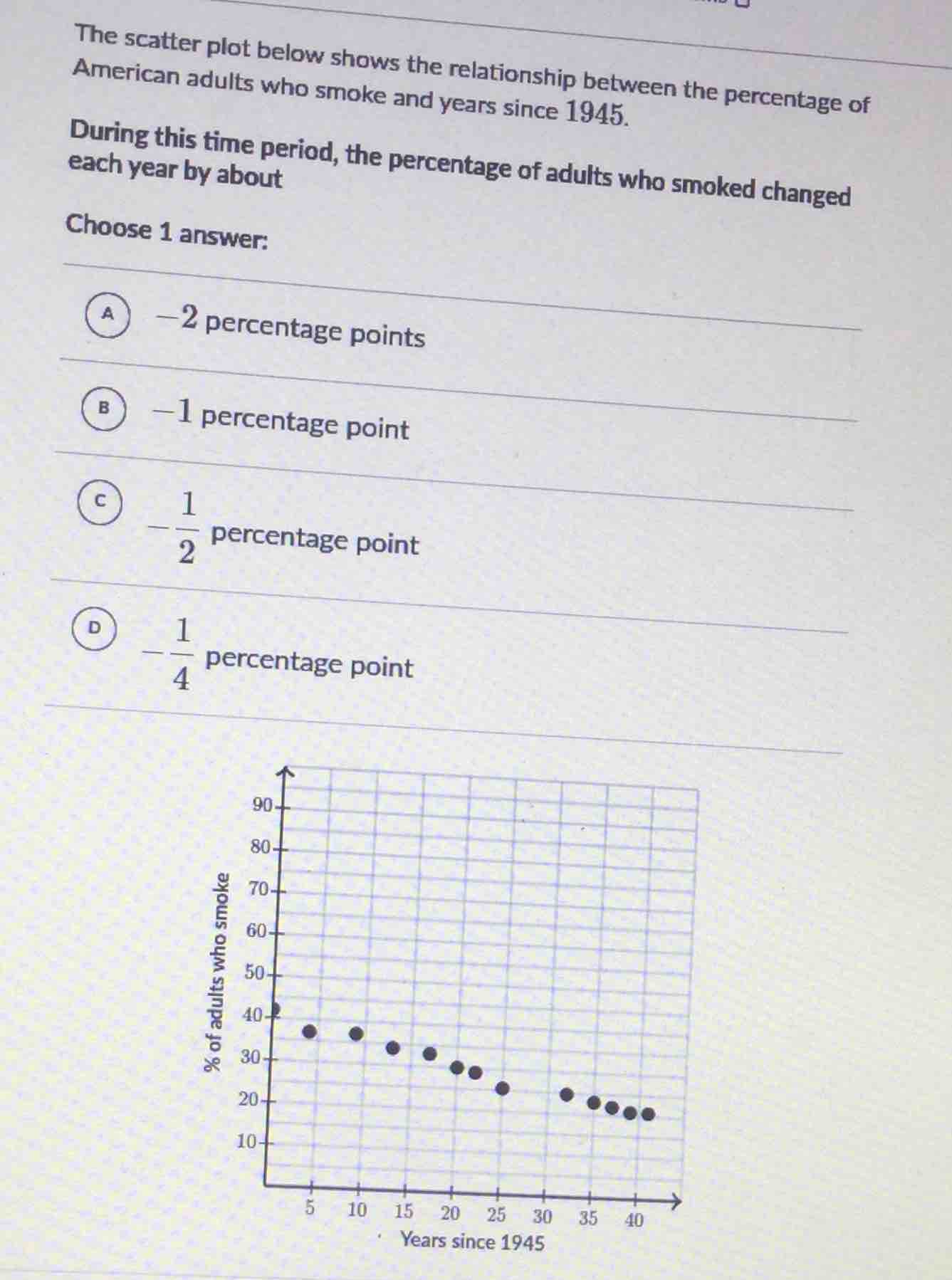
the scatter plot below shows the relationship between the percentage of american adults who smoke and years since 1945. during this time period, the percentage of adults who smoked changed each year by about choose 1 answer: a -2 percentage points b -1 percentage point c $-\frac{1}{2}$ percentage point d $-\frac{1}{4}$ percentage point scatter plot with x - axis years since 1945 (0 - 40) and y - axis % of adults who smoke (10 - 90), data points showing a downward trend
Step1: Identify two points
We can take two points from the scatter plot. Let's take the first point (0, 40) and the last point (40, 16) (approximate values from the plot).
Step2: Calculate the slope (rate of change)
The formula for slope (rate of change) is \( m=\frac{y_2 - y_1}{x_2 - x_1} \). Here, \( x_1 = 0 \), \( y_1 = 40 \), \( x_2 = 40 \), \( y_2 = 16 \).
So \( m=\frac{16 - 40}{40 - 0}=\frac{- 24}{40}=-\frac{3}{5}=- 0.6\) (approx). But looking at the options, the closest is \(-\frac{1}{2}=- 0.5\) or we can take another pair. Let's take (0, 40) and (25, 24). Then \( m=\frac{24 - 40}{25 - 0}=\frac{-16}{25}=- 0.64\). Wait, maybe a better way: the general trend, from year 0 (1945) to year 40, the percentage goes from about 40 to about 16. The change in y is \(16 - 40=-24\), change in x is \(40 - 0 = 40\). So per year change is \(\frac{-24}{40}=-0.6\), but the options have \(-\frac{1}{2}=-0.5\), \(-\frac{1}{4}=-0.25\), -1, -2. Wait, maybe the initial point is (0, 42) and final (40, 18). Then \(\frac{18 - 42}{40}=\frac{-24}{40}=-0.6\). But the option C is \(-\frac{1}{2}=-0.5\), which is close. Alternatively, maybe the intended points are (0, 40) and (20, 30). Then slope is \(\frac{30 - 40}{20 - 0}=\frac{-10}{20}=-\frac{1}{2}\). Ah, that makes sense. So using (0, 40) and (20, 30), the rate of change is \(\frac{30 - 40}{20 - 0}=-\frac{10}{20}=-\frac{1}{2}\). So the rate of change per year is about \(-\frac{1}{2}\) percentage points.

Snap & solve any problem in the app
Get step-by-step solutions on Sovi AI
Photo-based solutions with guided steps
Explore more problems and detailed explanations
C. \(-\dfrac{1}{2}\) percentage point