QUESTION IMAGE
Question
scatter plots practice
date
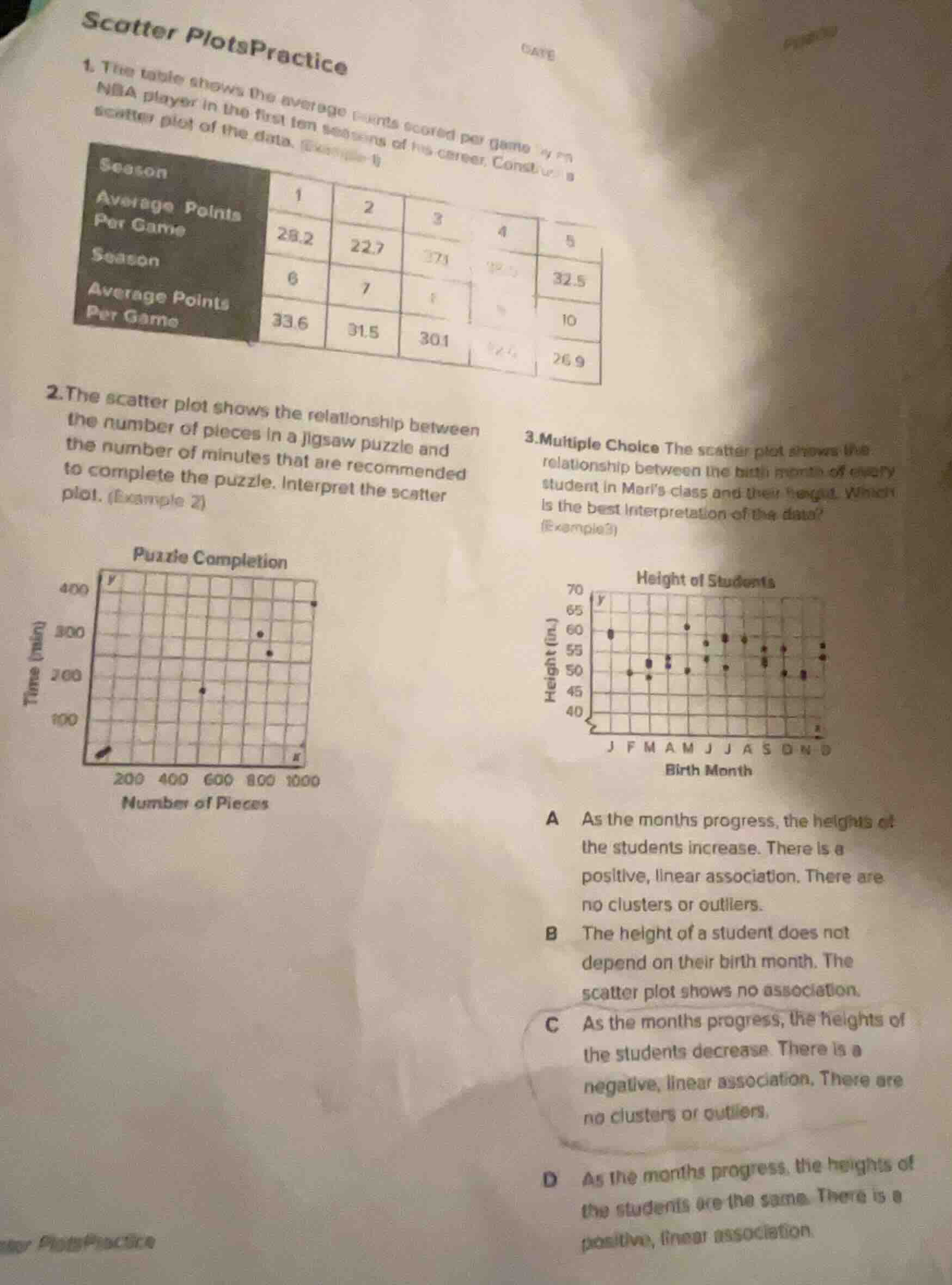
- the table shows the average points scored per game by an nba player in the first ten seasons of his career. construct a scatter plot of the data. (example 1)
| season | 1 | 2 | 3 | 4 | 5 |
|---|---|---|---|---|---|
| season | 6 | 7 | 8 | 9 | 10 |
| average points per game | 33.6 | 31.5 | 30.1 | 52.5 | 26.9 |
- the scatter plot shows the relationship between the number of pieces in a jigsaw puzzle and the number of minutes that are recommended to complete the puzzle. interpret the scatter plot. (example 2)
puzzle completion scatter plot: x - number of pieces (200, 400, 600, 800, 1000), y - time (min) (100, 200, 300, 400)
- multiple choice the scatter plot shows the relationship between the birth month of every student in mari’s class and their height. which is the best interpretation of the data? (example 3)
height of students scatter plot: x - birth month (j, f, m, a, m, j, j, a, s, o, n, d), y - height (in.) (40, 45, 50, 55, 60, 65, 70)
a as the months progress, the heights of the students increase. there is a positive, linear association. there are no clusters or outliers.
b the height of a student does not depend on their birth month. the scatter plot shows no association.
c as the months progress, the heights of the students decrease. there is a negative, linear association. there are no clusters or outliers.
d as the months progress, the heights of the students are the same. there is a positive, linear association.
Step1: Address Question 1
Define axes: x-axis = Season (1-10), y-axis = Avg Points (20-35). Plot each pair:
$(1,28.2), (2,22.7), (3,27.1), (4,29.0), (5,32.5), (6,33.6), (7,31.5), (8,30.1), (9,32.4), (10,26.9)$
Step2: Address Question 2
Analyze scatter plot trend: As x (number of pieces) increases, y (time) increases. Points follow an upward, linear pattern with no outliers.
Step3: Address Question 3
Evaluate scatter plot: Points are randomly spread; no upward/downward trend. No association between birth month and height.

Snap & solve any problem in the app
Get step-by-step solutions on Sovi AI
Photo-based solutions with guided steps
Explore more problems and detailed explanations
- Scatter plot: Plot the points (Season, Average Points Per Game) on a graph with Season (1 to 10) on the horizontal axis and Average Points Per Game (20 to 35 range) on the vertical axis. The plotted points are: (1, 28.2), (2, 22.7), (3, 27.1), (4, 29.0), (5, 32.5), (6, 33.6), (7, 31.5), (8, 30.1), (9, 32.4), (10, 26.9)
- The scatter plot shows a positive, linear association: as the number of puzzle pieces increases, the recommended time to complete the puzzle also increases, with points closely following an upward trend and no obvious outliers.
- B. The height of a student does not depend on their birth month. The scatter plot shows no association.