QUESTION IMAGE
Question
the scientific revolution and the enlightenment
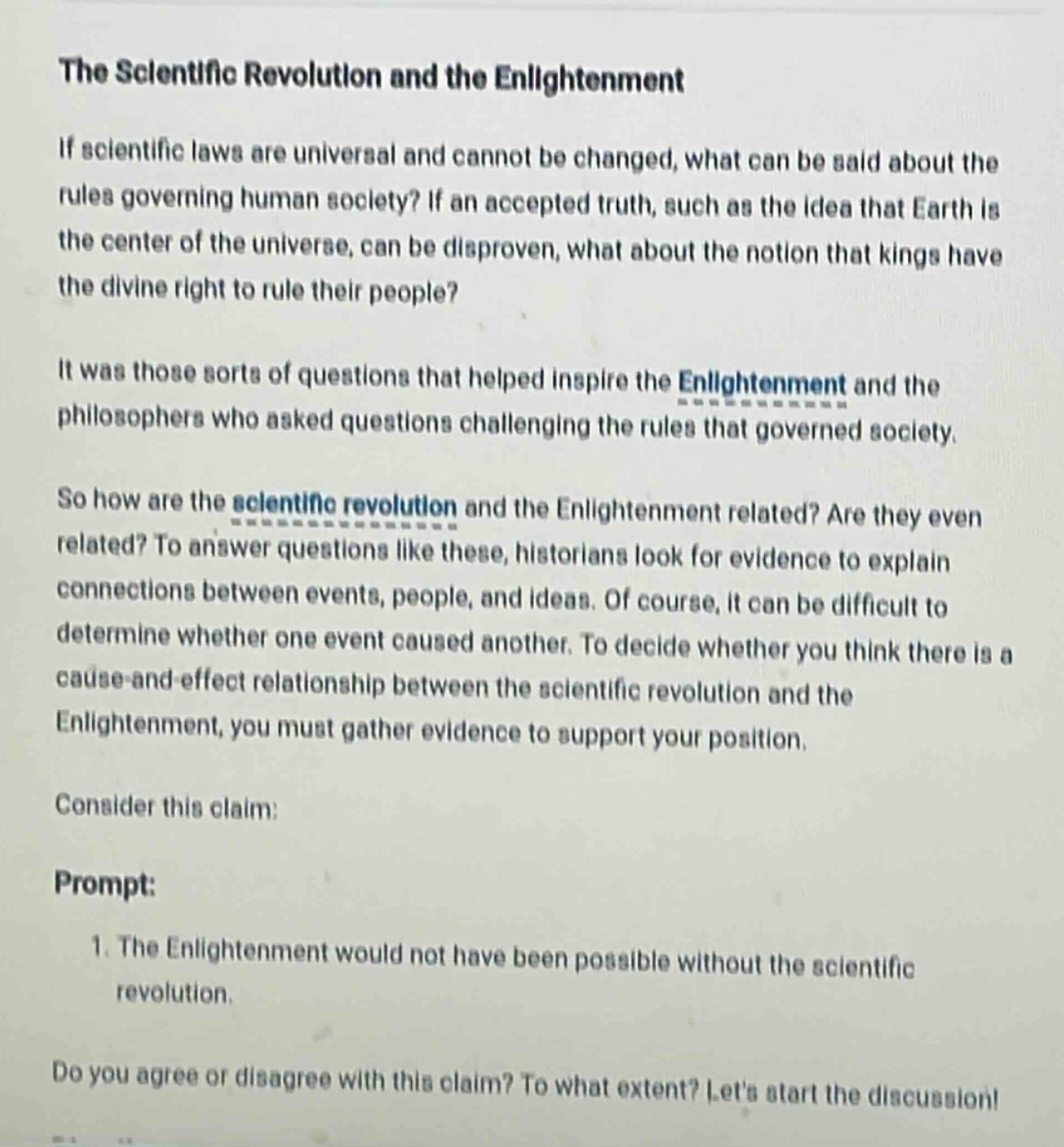
if scientific laws are universal and cannot be changed, what can be said about the rules governing human society? if an accepted truth, such as the idea that earth is the center of the universe, can be disproven, what about the notion that kings have the divine right to rule their people?
it was those sorts of questions that helped inspire the enlightenment and the philosophers who asked questions challenging the rules that governed society.
so how are the scientific revolution and the enlightenment related? are they even related? to answer questions like these, historians look for evidence to explain connections between events, people, and ideas. of course, it can be difficult to determine whether one event caused another. to decide whether you think there is a cause - and - effect relationship between the scientific revolution and the enlightenment, you must gather evidence to support your position.
consider this claim:
prompt:
- the enlightenment would not have been possible without the scientific revolution.
do you agree or disagree with this claim? to what extent? lets start the discussion!
To determine agreement with the claim, we analyze the relationship between the Scientific Revolution and the Enlightenment. The Scientific Revolution (e.g., Copernicus, Galileo) introduced a new way of thinking—using reason, observation, and challenging traditional beliefs (like geocentrism). The Enlightenment built on this: philosophers (e.g., Locke, Rousseau) applied scientific - like reasoning to society, questioning divine - right monarchy, advocating for natural rights, and social contracts. The Scientific Revolution’s emphasis on empirical evidence, rational inquiry, and challenging dogma provided the intellectual framework (methodology and confidence to question) that Enlightenment thinkers used to critique social/political systems. Without the Scientific Revolution’s shift in epistemology (how we know truth) and its success in overthrowing old scientific “truths,” Enlightenment thinkers may not have had the model or courage to challenge social “truths.” Thus, the Scientific Revolution was a crucial precursor, so the claim has merit.

Snap & solve any problem in the app
Get step-by-step solutions on Sovi AI
Photo-based solutions with guided steps
Explore more problems and detailed explanations
I agree with the claim that the Enlightenment would not have been possible without the Scientific Revolution, to a large extent.
The Scientific Revolution (spanning the 16th - 17th centuries) introduced a radical shift in thinking. Figures like Copernicus, Galileo, and Newton used empirical observation, mathematical reasoning, and experimentation to challenge long - held, dogmatic beliefs (such as the geocentric model of the universe). This established a new epistemological framework: knowledge should be based on reason, evidence, and the willingness to question authority (both religious and intellectual).
The Enlightenment (18th century) took this framework and applied it to human society. Enlightenment philosophers like John Locke, Jean - Jacques Rousseau, and Voltaire used the same spirit of rational inquiry and skepticism of traditional dogma to question the legitimacy of absolute monarchy (e.g., the divine right of kings), the power of the Catholic Church in secular affairs, and the lack of individual rights in society. For example, just as scientists had disproven the geocentric model, Enlightenment thinkers sought to “disprove” the idea that society should be governed by unchallenged, arbitrary authority.
The Scientific Revolution also provided concrete examples of how progress could be achieved through human reason. The success of scientific endeavors (like Newton’s laws of motion) showed that human beings, through their own intellectual efforts, could unlock the secrets of the natural world. This gave Enlightenment thinkers the confidence to believe that they could also “unlock” the secrets of a just and rational social order. Without the intellectual foundation, the methodological example, and the cultural shift towards reason and evidence - based thinking that the Scientific Revolution provided, the Enlightenment’s core ideas of challenging traditional social and political structures, and advocating for individual rights, popular sovereignty, and secularism would have lacked a crucial source of inspiration and legitimacy.