QUESTION IMAGE
Question
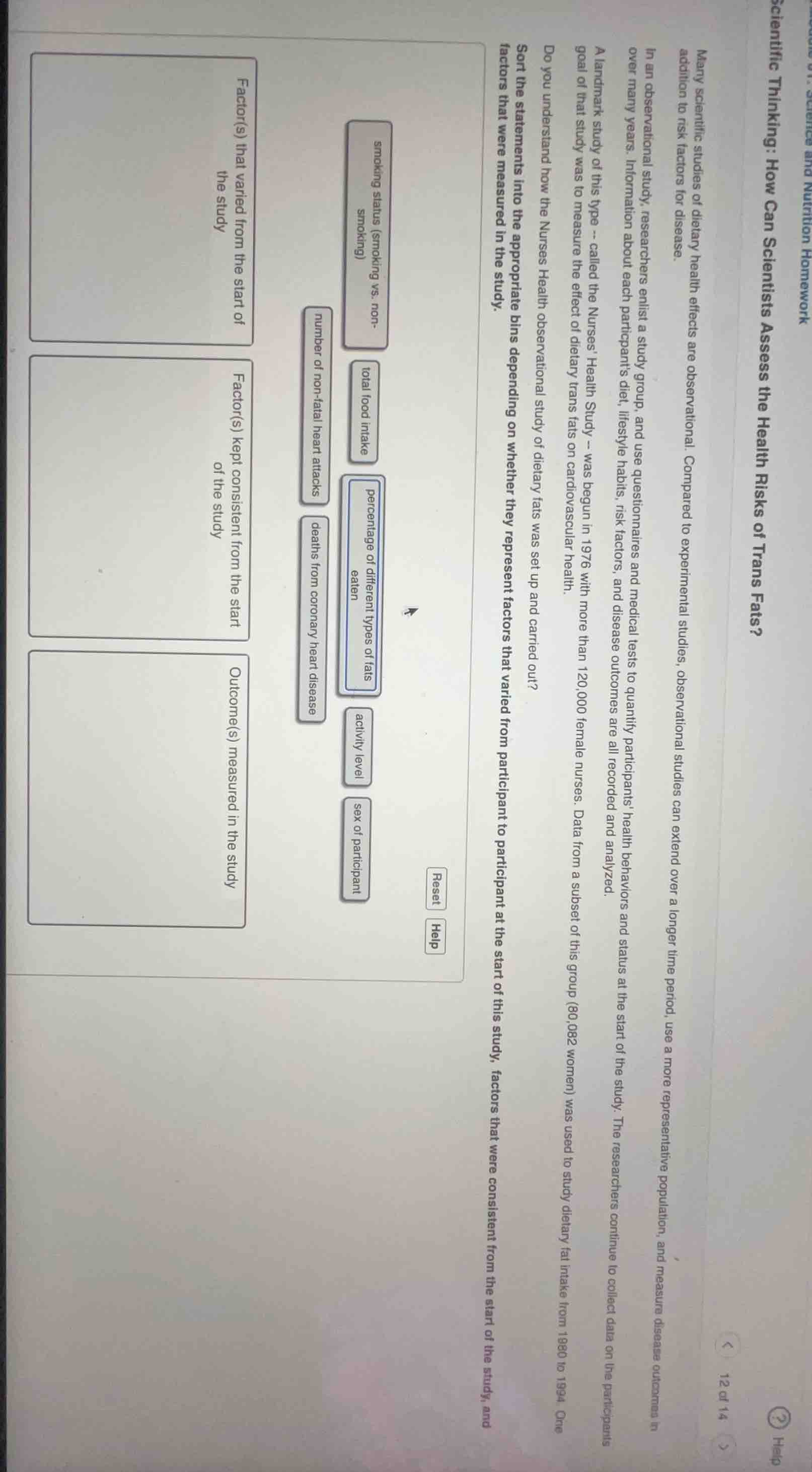
scientific thinking: how can scientists assess the health risks of trans fats? many scientific studies of dietary health effects are observational. compared to experimental studies, observational studies can extend over a longer time period, use a more representative population, and measure disease outcomes in an observational study, researchers enlist a study group, and use questionnaires and medical tests to quantify participants health behaviors and status at the start of the study. information about each participants diet, lifestyle habits, risk factors, and disease outcomes are all recorded and analyzed. a landmark study of this type -- called the nurses health study -- was begun in 1976 with more than 120,000 female nurses. data from a subset of this group (80,082 women) was used to study dietary fat intake from 1980 to 1994. one goal of that study was to measure the effect of dietary trans fats on cardiovascular health. do you understand how the nurses health observational study of dietary fats was set up and carried out? sort the statements into the appropriate bins depending on whether they represent factors that varied from participant to participant at the start of this study, factors that were consistent from the start of the study, and factors that were measured in the study. factor(s) that varied from the start of the study factor(s) kept consistent from the start of the study outcome(s) measured in the study smoking status (smoking vs. non - smoking) total food intake percentage of different types of fats eaten number of non - fatal heart attacks deaths from coronary heart disease activity level sex of participant reset help
To solve this, we analyze each category:
1. Factor(s) that varied from the start:
These are factors differing between participants initially.
- Smoking status (smoking vs. non - smoking)
- Total food intake
- Percentage of different fats eaten
- Activity level
- (Note: Sex of participant is consistent as all are female nurses, so it's not in this category.)
2. Factor(s) kept consistent from the start:
This is a factor same for all participants.
- Sex of participant (all are female nurses, so sex is consistent).
3. Outcome(s) measured in the study:
These are the results measured over time.
- Number of non - fatal heart attacks
- Deaths from coronary heart disease
Final Sorting:
- Factor(s) that varied from the start: smoking status (smoking vs. non - smoking), total food intake, percentage of different types of fats eaten, activity level
- Factor(s) kept consistent from the start: sex of participant
- Outcome(s) measured in the study: number of non - fatal heart attacks, deaths from coronary heart disease
(If you need to drag and drop:
- Drag "smoking status (smoking vs. non - smoking)", "total food intake", "percentage of different types of fats eaten", "activity level" to "Factor(s) that varied from the start".
- Drag "sex of participant" to "Factor(s) kept consistent from the start".
- Drag "number of non - fatal heart attacks", "deaths from coronary heart disease" to "Outcome(s) measured in the study".)

Snap & solve any problem in the app
Get step-by-step solutions on Sovi AI
Photo-based solutions with guided steps
Explore more problems and detailed explanations
To solve this, we analyze each category:
1. Factor(s) that varied from the start:
These are factors differing between participants initially.
- Smoking status (smoking vs. non - smoking)
- Total food intake
- Percentage of different fats eaten
- Activity level
- (Note: Sex of participant is consistent as all are female nurses, so it's not in this category.)
2. Factor(s) kept consistent from the start:
This is a factor same for all participants.
- Sex of participant (all are female nurses, so sex is consistent).
3. Outcome(s) measured in the study:
These are the results measured over time.
- Number of non - fatal heart attacks
- Deaths from coronary heart disease
Final Sorting:
- Factor(s) that varied from the start: smoking status (smoking vs. non - smoking), total food intake, percentage of different types of fats eaten, activity level
- Factor(s) kept consistent from the start: sex of participant
- Outcome(s) measured in the study: number of non - fatal heart attacks, deaths from coronary heart disease
(If you need to drag and drop:
- Drag "smoking status (smoking vs. non - smoking)", "total food intake", "percentage of different types of fats eaten", "activity level" to "Factor(s) that varied from the start".
- Drag "sex of participant" to "Factor(s) kept consistent from the start".
- Drag "number of non - fatal heart attacks", "deaths from coronary heart disease" to "Outcome(s) measured in the study".)