QUESTION IMAGE
Question
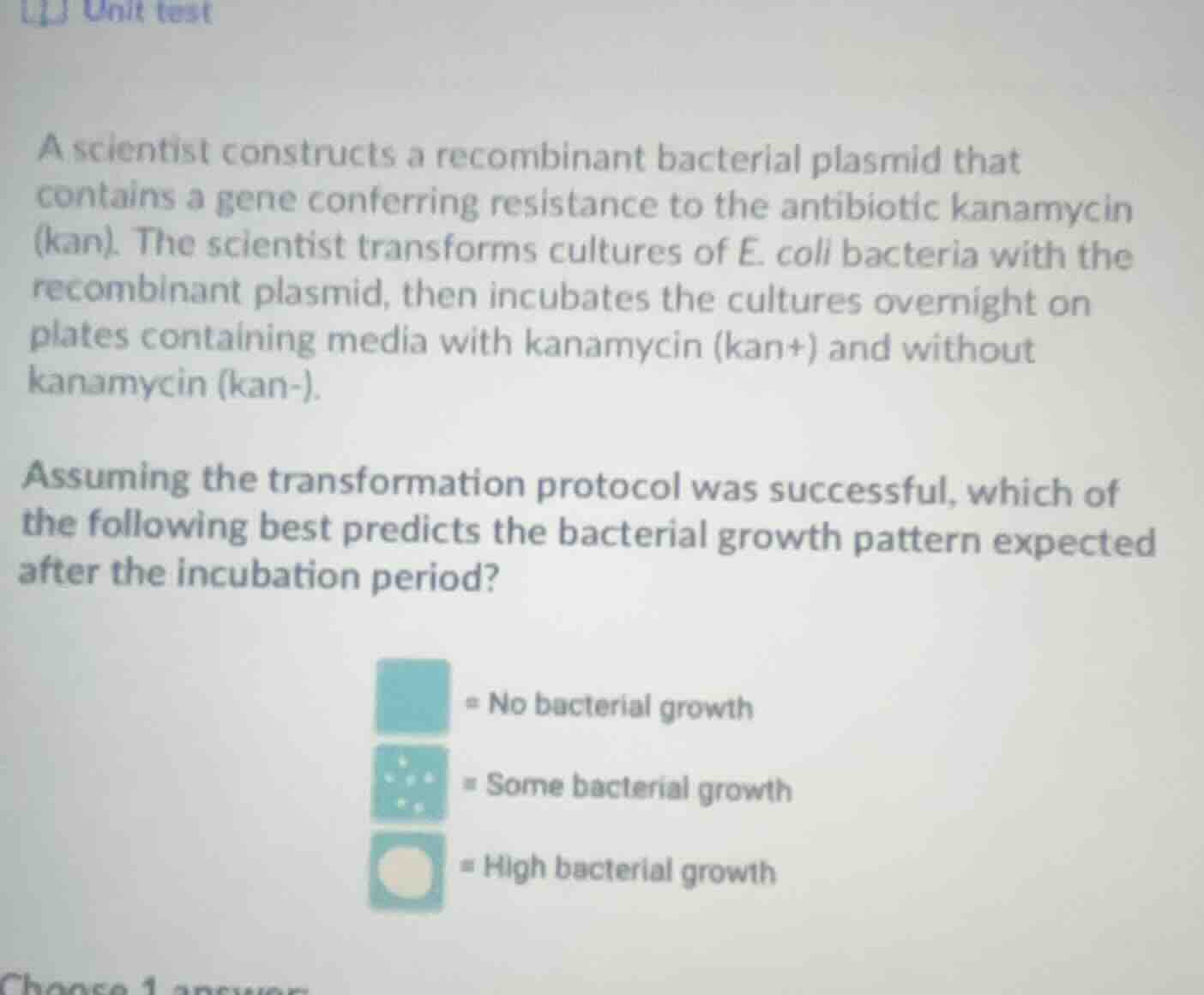
a scientist constructs a recombinant bacterial plasmid that contains a gene conferring resistance to the antibiotic kanamycin (kan). the scientist transforms cultures of e. coli bacteria with the recombinant plasmid, then incubates the cultures overnight on plates containing media with kanamycin (kan+) and without kanamycin (kan-). assuming the transformation protocol was successful, which of the following best predicts the bacterial growth pattern expected after the incubation period? = no bacterial growth = some bacterial growth = high bacterial growth choose 1 answer
Brief Explanations
- On the kan- (no kanamycin) plate: Both transformed E. coli (with the plasmid) and non-transformed E. coli (without the plasmid) can grow freely, since there is no antibiotic to kill them. This leads to high bacterial growth.
- On the kan+ (with kanamycin) plate: Only the E. coli that successfully took up the recombinant plasmid (carrying the kanamycin resistance gene) can survive and grow. Transformation efficiency is never 100%, so only a subset of the original bacterial culture will grow, resulting in some bacterial growth.

Snap & solve any problem in the app
Get step-by-step solutions on Sovi AI
Photo-based solutions with guided steps
Explore more problems and detailed explanations
- kan- plate: High bacterial growth
- kan+ plate: Some bacterial growth