QUESTION IMAGE
Question
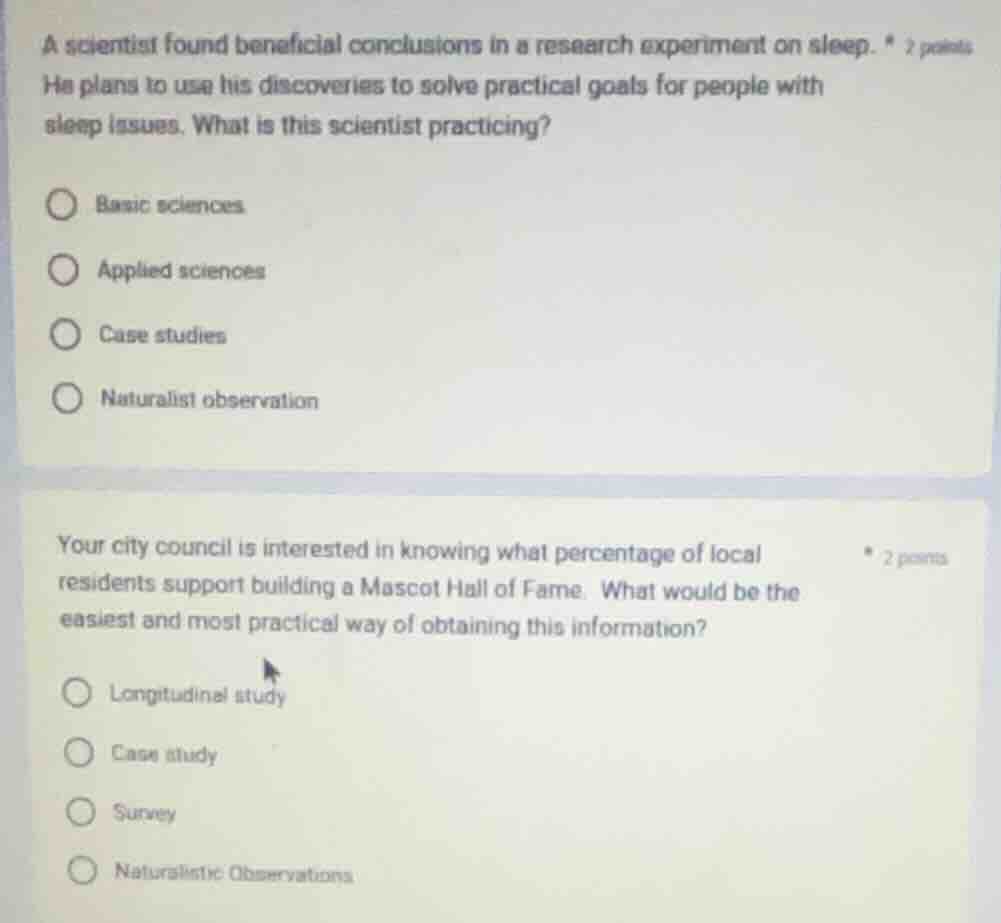
a scientist found beneficial conclusions in a research experiment on sleep. he plans to use his discoveries to solve practical goals for people with sleep issues. what is this scientist practicing?
basic sciences
applied sciences
case studies
naturalist observation
your city council is interested in knowing what percentage of local residents support building a mascot hall of fame. what would be the easiest and most practical way of obtaining this information?
longitudinal study
case study
survey
naturalistic observations
For the first question: Applied sciences use scientific findings to solve real-world practical problems, which matches the scientist's goal of using sleep research to help people with sleep issues. Basic sciences focus on fundamental knowledge without immediate practical application; case studies analyze specific individual cases; naturalist observation involves observing subjects in their natural setting, none of which fit the description.
For the second question: A survey is a straightforward, practical method to gather data on the opinions (support percentage) of a large group of local residents efficiently. A longitudinal study tracks subjects over time, a case study focuses on a single entity, and naturalistic observation watches behavior in natural settings, none of which are suitable for quickly obtaining this population-wide opinion data.

Snap & solve any problem in the app
Get step-by-step solutions on Sovi AI
Photo-based solutions with guided steps
Explore more problems and detailed explanations
- Applied sciences
- Survey