QUESTION IMAGE
Question
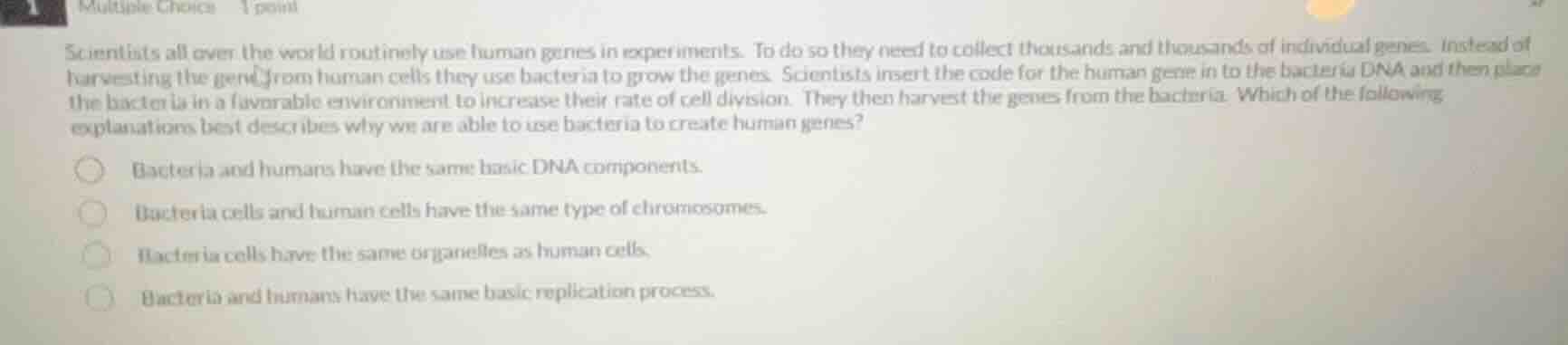
scientists all over the world routinely use human genes in experiments. to do so they need to collect thousands and thousands of individual genes. instead of harvesting the gene from human cells they use bacteria to grow the genes. scientists insert the code for the human gene in to the bacteria dna and then place the bacteria in a favorable environment to increase their rate of cell division. they then harvest the genes from the bacteria. which of the following explanations best describes why we are able to use bacteria to create human genes?
- bacteria and humans have the same basic dna components.
- bacteria cells and human cells have the same type of chromosomes.
- bacteria cells have the same organelles as human cells.
- bacteria and humans have the same basic replication process.
To determine the correct answer, we analyze each option:
- Option 1: Bacteria (prokaryotes) and humans (eukaryotes) have DNA composed of the same basic components (nucleotides: adenine, thymine, cytosine, guanine). This allows bacteria to transcribe and translate human genes inserted into their DNA, as the genetic code is universal in terms of the basic building blocks.
- Option 2: Bacteria are prokaryotes with a single circular chromosome, while human cells are eukaryotes with linear chromosomes in the nucleus, so they do not have the same type of chromosomes. Eliminate this.
- Option 3: Bacteria lack membrane - bound organelles like those in human eukaryotic cells (e.g., mitochondria, endoplasmic reticulum). So this is incorrect.
- Option 4: Bacteria use binary fission for replication, and humans use mitosis (and meiosis for gametes). The basic replication processes are different. So this is incorrect.

Snap & solve any problem in the app
Get step-by-step solutions on Sovi AI
Photo-based solutions with guided steps
Explore more problems and detailed explanations
A. Bacteria and humans have the same basic DNA components.