QUESTION IMAGE
Question
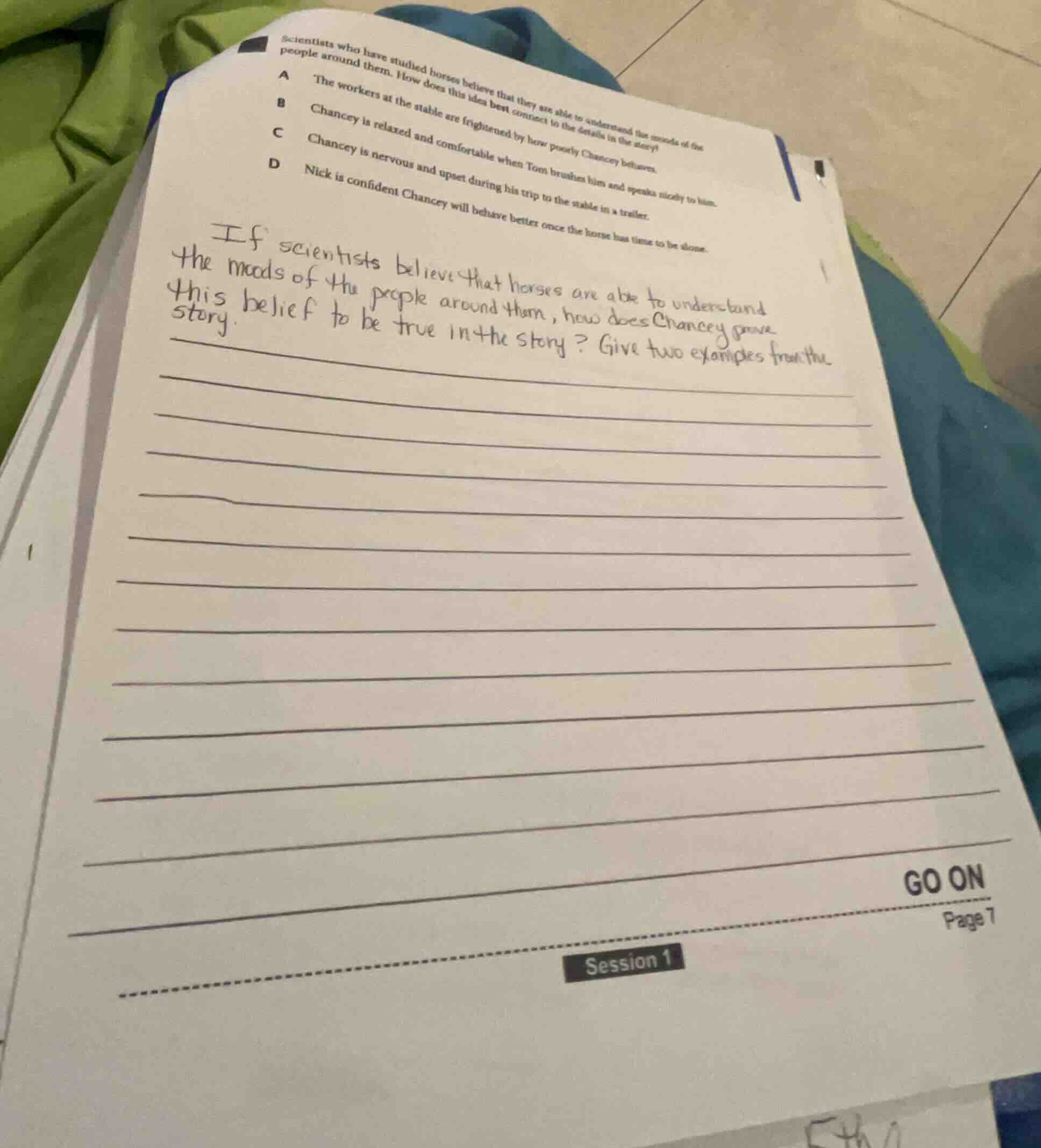
scientists who have studied horses believe that they are able to understand the moods of the people around them. how does this idea best connect to the details in the story?
a the workers at the stable are frightened by how poorly chancey behaves.
b chancey is relaxed and comfortable when tom brushes him and speaks nicely to him.
c chancey is nervous and upset during his trip to the stable in a trailer.
d nick is confident chancey will behave better once the horse has time to be alone.
if scientists believe that horses are able to understand the moods of the people around them, how does chancey prove this belief to be true in the story? give two examples from the story.
To answer this, we analyze how Chancey's behavior reflects understanding people's moods. First, when Tom brushes and speaks nicely (positive mood), Chancey is relaxed (Option B/C? Wait, Option C: "Chancey is relaxed and comfortable when Tom brushes him and speaks nicely to him" – this shows Chancey responds to Tom's kind mood. Second, if workers are frightened by poor behavior (Option A: workers' fear from Chancey's poor behavior implies Chancey reacts to their negative mood? Wait, the question is how Chancey proves he understands people's moods. Let's pick two examples: 1) When Tom is kind (speaking nicely, brushing), Chancey relaxes (shows he gets Tom's positive mood). 2) If Chancey behaves poorly, workers are frightened (so Chancey's behavior changes with workers' or others' moods, or when Nick is confident (Option D: Nick's confidence in Chancey behaving better – maybe Chancey picks up Nick's positive expectation). Wait, the written question is to give two examples from the story (the multiple-choice options are clues). Let's use the options as story details:
Example 1: From Option C: Chancey is relaxed and comfortable when Tom brushes him and speaks nicely to him. This shows Chancey understands Tom’s kind mood (positive interaction, so Chancey responds with relaxation).
Example 2: From Option A: The workers at the stable are frightened by how poorly Chancey behaves. This implies Chancey’s behavior (poor) is a response to the workers’ mood? Or maybe when workers are negative, Chancey acts out. Alternatively, Option D: Nick is confident Chancey will behave better once the horse has time to be alone – Nick’s confidence (positive mood) makes Chancey respond (though indirect). But better to use direct interactions. So two examples:
- When Tom brushes him and speaks nicely (positive mood from Tom), Chancey is relaxed (shows he understands Tom’s good mood).
- When the workers are frightened (maybe their negative mood or reaction), Chancey behaves poorly (or his behavior causes their fear, showing he responds to their mood). Wait, the key is Chancey understanding others' moods. So first example: Tom’s kind actions (nice speech, brushing) → Chancey relaxed (understands Tom’s positive mood). Second example: If Chancey is nervous during trailer trip (Option D? No, Option D is Nick’s confidence). Wait, Option C is direct: Tom’s nice treatment → Chancey relaxed. Another example: Maybe when workers are scared (Option A), Chancey’s poor behavior is a response to their fear (or vice versa – he acts poorly, making them scared, so he understands their mood? Or he picks up their fear and acts out). Alternatively, Option D: Nick’s confidence (positive mood) leads Chancey to behave better (Chancey understands Nick’s belief).
So two examples:
- Chancey relaxes when Tom is kind (Tom’s positive mood → Chancey’s relaxed response, proving he understands Tom’s mood).
- Nick is confident Chancey will behave better (Nick’s positive expectation → Chancey may respond to Nick’s confidence, showing he understands Nick’s mood/expectation).
Or using Option A and C:
- Chancey’s poor behavior frightens workers (so he understands their fear or his behavior is linked to their mood).
- Chancey relaxes with Tom’s kind actions (understands Tom’s kind mood).

Snap & solve any problem in the app
Get step-by-step solutions on Sovi AI
Photo-based solutions with guided steps
Explore more problems and detailed explanations
To prove he understands people’s moods, two examples from the story are:
- When Tom brushes him and speaks nicely to him (showing a kind, positive mood), Chancey is relaxed and comfortable (responding to Tom’s good mood, as in Option C).
- When Chancey behaves poorly, the workers at the stable are frightened (his behavior reflects or responds to the workers’ negative mood or reaction, as in Option A).
(Note: The exact story details are from the multiple - choice options provided, where these interactions show Chancey’s understanding of others’ moods through his behavioral responses.)