QUESTION IMAGE
Question
(score for question 3: ___ of 10 points)
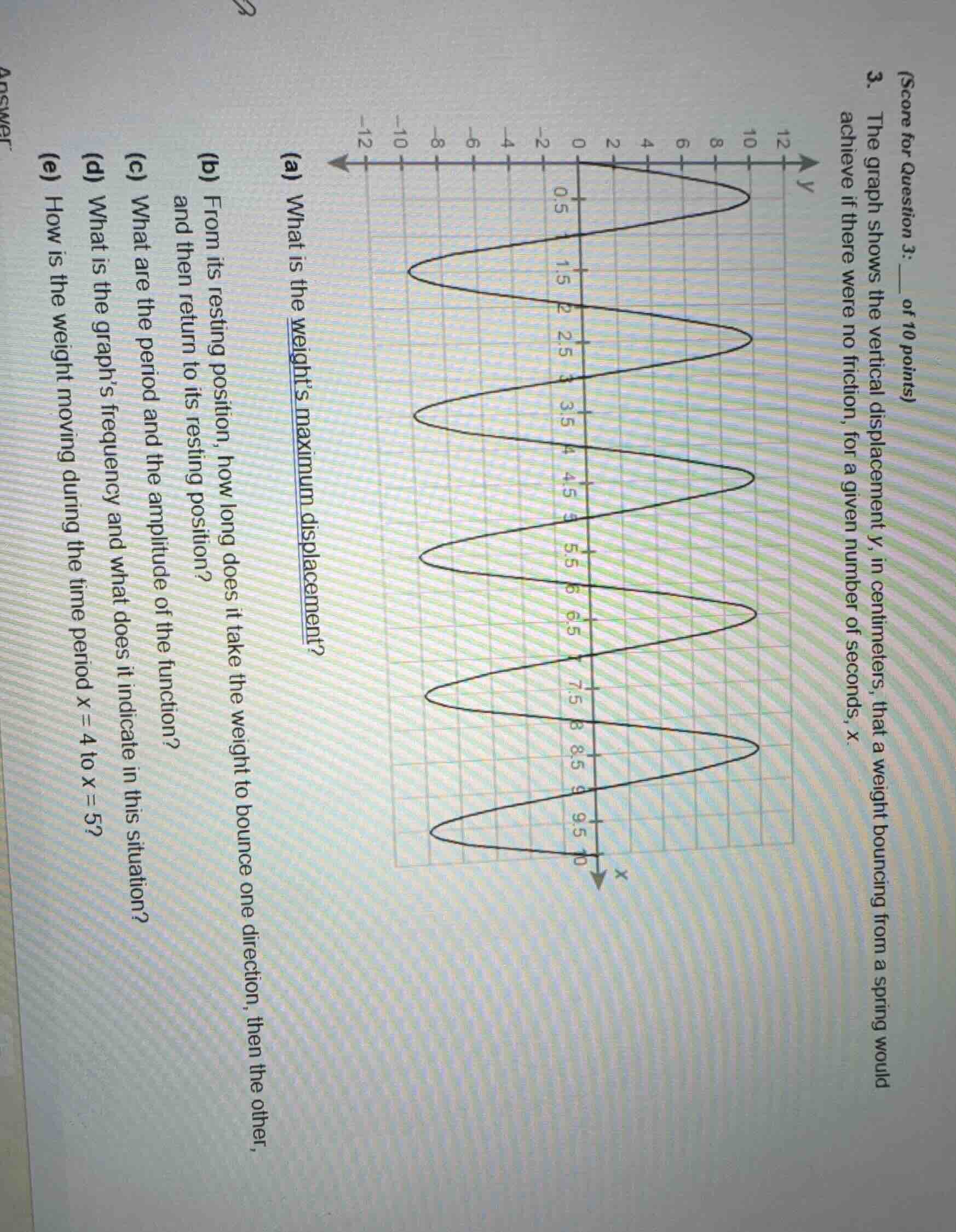
- the graph shows the vertical displacement, y, in centimeters, that a weight bouncing from a spring would achieve if there were no friction, for a given number of seconds, x.
(a) what is the weight’s maximum displacement?
(b) from its resting position, how long does it take the weight to bounce one direction, then the other, and then return to its resting position?
(c) what are the period and the amplitude of the function?
(d) what is the graph’s frequency and what does it indicate in this situation?
(e) how is the weight moving during the time period x = 4 to x = 5?
Part (a)
Step1: Identify maximum displacement
The maximum displacement is the maximum value of \( y \) (vertical displacement) from the resting position ( \( y = 0 \) ). From the graph, the peak of the wave reaches \( y = 10 \) (or looking at the grid, the highest point is at \( y = 10 \) cm? Wait, no, looking at the y - axis, the topmost point is at \( y = 10 \)? Wait, the y - axis has marks: 0, 2, 4, 6, 8, 10, 12. Wait, the graph's peaks: let's check the first peak. Wait, maybe I misread. Wait, the resting position is \( y = 0 \). The maximum displacement is the amplitude? Wait, no, maximum displacement from rest is the amplitude. Wait, looking at the graph, the first peak (from the left, the first upward peak) is at \( y = 10 \)? Wait, no, the y - axis is labeled with 0, 2, 4, 6, 8, 10, 12. Wait, the graph's peaks: let's see, the first peak (when x is around 1) is at y = 10? Wait, no, maybe the grid: each square is 1 unit? Wait, the x - axis is in seconds, y - axis in cm. The maximum value of y (displacement) from 0 is 10? Wait, no, looking at the graph, the highest point (maximum displacement) is 10 cm? Wait, no, the y - axis has 0, 2, 4, 6, 8, 10, 12. The graph's peak is at y = 10? Wait, maybe the maximum displacement is 10 cm? Wait, no, let's check the first peak: when x is 1, y is 10? Wait, maybe the amplitude is 10? Wait, no, maybe I made a mistake. Wait, the resting position is y = 0. The maximum displacement is the maximum y - value, which is 10 cm? Wait, no, looking at the graph, the first peak (the topmost point) is at y = 10? Wait, maybe the answer is 10 cm? Wait, no, let's look again. The y - axis: 0, 2, 4, 6, 8, 10, 12. The graph's peaks: the first peak (from the origin, moving right) is at y = 10? Wait, maybe the maximum displacement is 10 cm.
Step1: Analyze the motion
From resting position (y = 0), bouncing one direction (say up), then the other (down), and back to rest. This is one full cycle? Wait, no: from rest, go to maximum displacement (one direction), then to minimum (other direction), then back to rest. Wait, but the question says "bounce one direction, then the other, and then return to resting position". So from rest (y = 0), move to maximum (one direction), then to minimum (other direction), then back to rest. How long does that take? Looking at the graph, the period (time for one full cycle) – wait, no, the time to go from rest, to one direction, then the other, then back to rest. Let's look at the x - axis (time in seconds). Let's see the first time it starts at rest (x = 0, y = 0), then goes up to maximum (x = 1, y = 10), then down to minimum (x = 3, y = - 10), then back to rest (x = 4, y = 0)? Wait, no, the graph at x = 0 is y = 0, then at x = 2, y = 0? Wait, maybe the period is 4 seconds? Wait, no, let's check the time between two consecutive rest positions (y = 0) moving in the same direction. From x = 0 (rest, moving up), then x = 4 (rest, moving up again). So the time to go from rest, to one direction, then the other, then back to rest: from x = 0 to x = 4? Wait, no, from x = 0 (rest), go up to x = 1 (max), down to x = 3 (min), back to x = 4 (rest). So the time is 4 seconds? Wait, no, let's count the x - axis. Each unit is 1 second? The distance between two consecutive peaks (or troughs) – wait, the graph has a period (time for one full cycle) of 4 seconds? Wait, from x = 0 to x = 4, the graph completes one full cycle (from 0, up, down, back to 0). So the time to bounce one direction, then the other, then return to rest is 4 seconds? Wait, no, the question is "from its resting position, how long does it take the weight to bounce one direction, then the other, and then return to its resting position?" So that's one full cycle. Looking at the graph, the time between x = 0 (rest) and x = 4 (rest, same direction) is 4 seconds. So the time is 4 seconds.
Step1: Find the period
The period is the time for one full cycle (from rest, to max, to min, to rest). From the graph, the distance between two consecutive resting positions (y = 0) with the same motion direction (e.g., x = 0, moving up; x = 4, moving up) is 4 seconds. So period \( T = 4 \) seconds.
Step2: Find the amplitude
Amplitude is the maximum displacement from rest, which we found in part (a) as 10 cm? Wait, no, wait in part (a) maybe I was wrong. Wait, looking at the graph, the first peak (y - value) is 10? Wait, no, the y - axis: 0, 2, 4, 6, 8, 10, 12. The graph's peak is at y = 10? Wait, no, maybe the amplitude is 10 cm? Wait, no, let's check the graph again. The first peak (when x = 1) is at y = 10, then the next peak (x = 5) is at y = 10? Wait, no, maybe the amplitude is 10 cm. So period \( T = 4 \) seconds, amplitude \( A = 10 \) cm.

Snap & solve any problem in the app
Get step-by-step solutions on Sovi AI
Photo-based solutions with guided steps
Explore more problems and detailed explanations
The weight’s maximum displacement is \( \boldsymbol{10} \) centimeters.