QUESTION IMAGE
Question
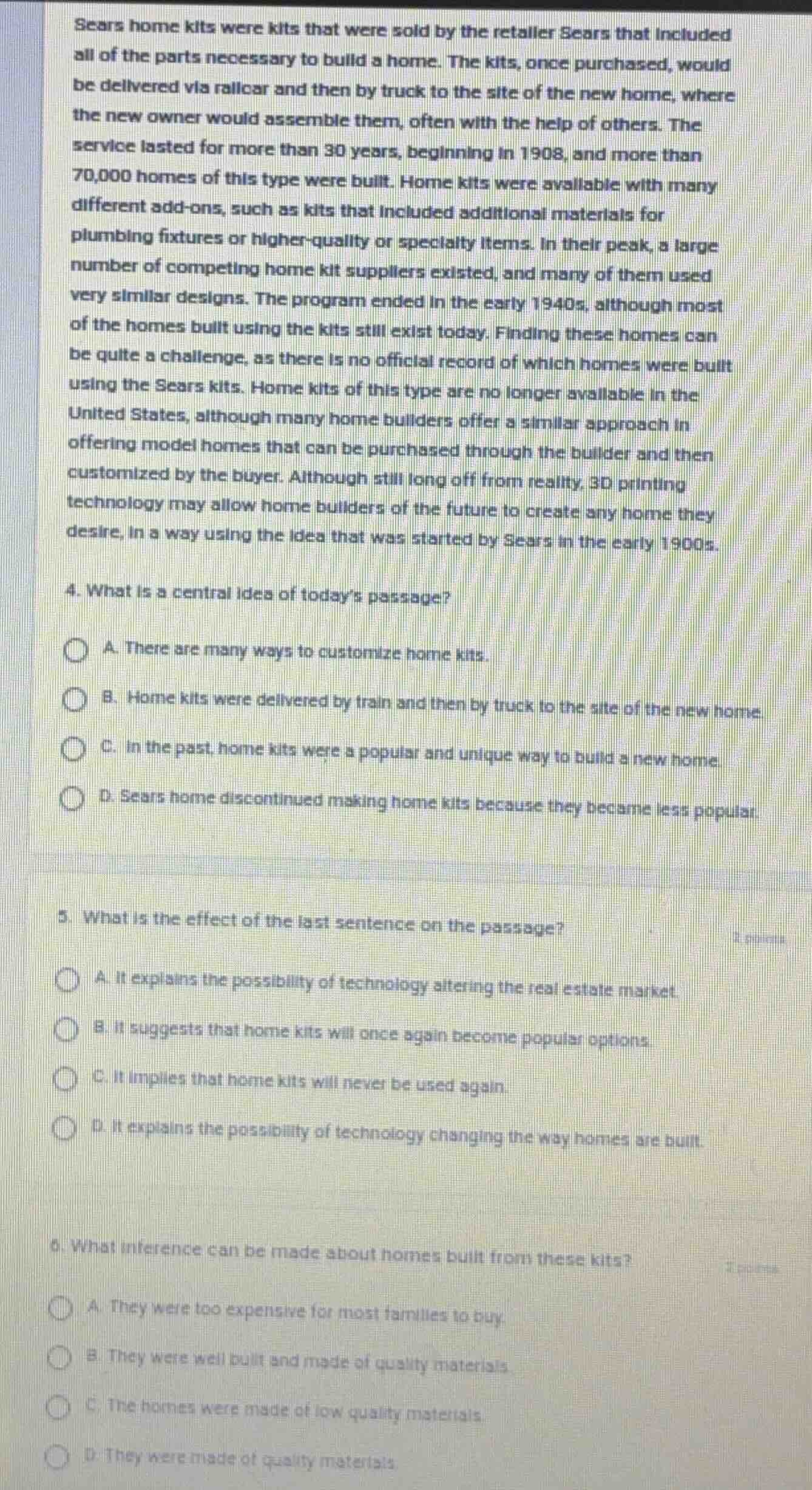
sears home kits were kits that were sold by the retailer sears that included all of the parts necessary to build a home. the kits, once purchased, would be delivered via railcar and then by truck to the site of the new home, where the new owner would assemble them, often with the help of others. the service lasted for more than 30 years, beginning in 1908, and more than 70,000 homes of this type were built. home kits were available with many different add - ons, such as kits that included additional materials for plumbing fixtures or higher - quality or specialty items. in their peak, a large number of competing home kit suppliers existed, and many of them used very similar designs. the program ended in the early 1940s, although most of the homes built using the kits still exist today. finding these homes can be quite a challenge, as there is no official record of which homes were built using the sears kits. home kits of this type are no longer available in the united states, although many home builders offer a similar approach in offering model homes that can be purchased through the builder and then customized by the buyer. although still long off from reality, 3d printing technology may allow home builders of the future to create any home they desire, in a way using the idea that was started by sears in the early 1900s.
- what is a central idea of todays passage?
a. there are many ways to customize home kits.
b. home kits were delivered by train and then by truck to the site of the new home.
c. in the past, home kits were a popular and unique way to build a new home.
d. sears home discontinued making home kits because they became less popular.
- what is the effect of the last sentence on the passage?
a. it explains the possibility of technology altering the real estate market.
b. it suggests that home kits will once again become popular options.
c. it implies that home kits will never be used again.
d. it explains the possibility of technology changing the way homes are built.
- what inference can be made about homes built from these kits?
a. they were too expensive for most families to buy.
b. they were well built and made of quality materials.
c. the homes were made of low quality materials.
d. they were made of quality materials.
For Question 4:
- Option A is a minor detail, not the central idea.
- Option B is just a delivery detail, not the main focus.
- Option C matches the text: the passage covers Sears home kits' popularity (over 70,000 built, 30+ year service) and their unique home-building model, plus their legacy.
- Option D is incorrect; the text does not state the program ended due to declining popularity.
For Question 5:
- Option A is too broad; the sentence focuses on home building, not the entire real estate market.
- Option B is incorrect; it does not suggest home kits will return, only that 3D printing adapts the custom home idea.
- Option C is wrong; it does not say home kits will never be used again.
- Option D is correct: the last sentence links 3D printing to Sears' original idea, explaining how future tech could change home construction.
For Question 6:
- Option A is unsupported; no cost information is given.
- Option B is correct: the text notes "most of the homes built using the kits still exist today," which implies they were well-constructed with quality materials.
- Option C is the opposite of the implication from the homes' longevity.
- Option D is less complete than B, as it does not include the key point of being well-built, which is inferred from the homes still existing.

Snap & solve any problem in the app
Get step-by-step solutions on Sovi AI
Photo-based solutions with guided steps
Explore more problems and detailed explanations
- C. In the past, home kits were a popular and unique way to build a new home.
- D. It explains the possibility of technology changing the way homes are built.
- B. They were well built and made of quality materials.