QUESTION IMAGE
Question
secondary math ii // module 5
geometric figures - 5.9
- $overline{lg}$
- $overline{hf}$
- $mangle ehg$
- $mangle feh$
- $mangle elf$
- $overline{fg}$
- $overline{eg}$
- $mangle fge$
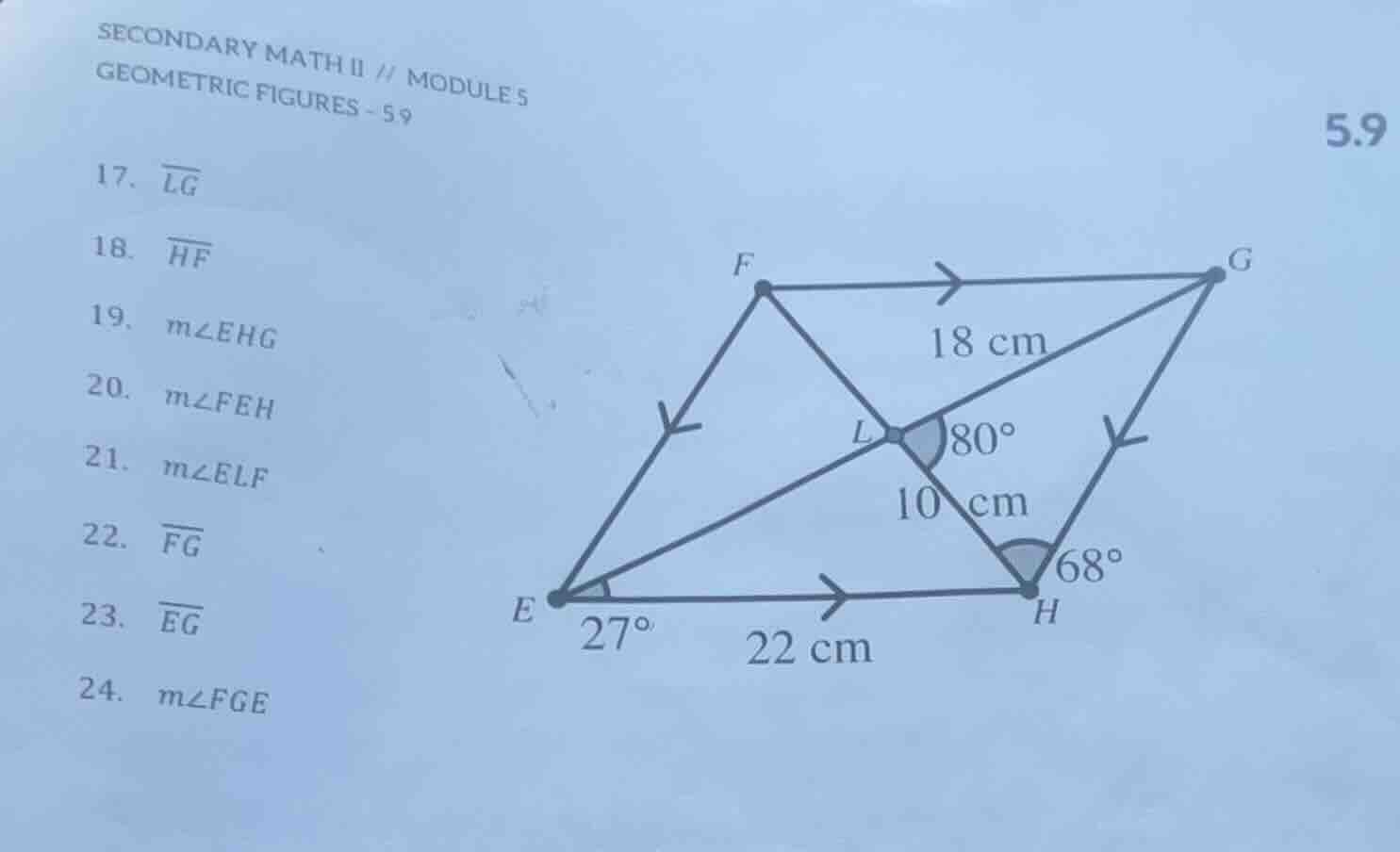
(image of a geometric figure with points e, f, g, h, l, angles and lengths marked: e to h is 22 cm, l to h is 10 cm, l to g is 18 cm, angle at l is 80°, angle at h is 68°, angle at e is 27°)
To solve these geometric problems, we analyze the diagram and use properties of triangles, parallel lines, and angle - side relationships. Since the problem is not fully specified (which of the 17 - 24 problems to solve), we'll assume a common one, say problem 24: \(m\angle FGE\)
Step 1: Analyze triangle \(EHG\)
In \(\triangle EHG\), we know that the sum of the interior angles of a triangle is \(180^{\circ}\). We are given \(\angle E = 27^{\circ}\) and \(\angle H=68^{\circ}\). Let \(\angle G\) (which is \(\angle EGH\)) be \(x\). Then, by the angle - sum property of a triangle (\(m\angle E + m\angle H+m\angle EGH=180^{\circ}\)):
\[27^{\circ}+68^{\circ}+x = 180^{\circ}\]
\[95^{\circ}+x=180^{\circ}\]
\[x = 180^{\circ}- 95^{\circ}=85^{\circ}\]
Step 2: Analyze the isosceles or congruent triangle relationships (assuming \(FG\parallel EH\) from the arrows)
We know that \(EL = 10\space cm\) and \(LG = 18\space cm\), and we can also use the angle at \(L\) (\(\angle ELG = 80^{\circ}\)). But if we assume that \(\triangle FGE\) and \(\triangle HGE\) have some parallel - line related angle equalities. Since \(FG\parallel EH\), \(\angle FGE=\angle GEH\) is not correct. Wait, let's re - examine.
Wait, maybe we made a mistake. Let's look at the sides. \(EH = 22\space cm\), and if we consider the triangles formed by the diagonals. Alternatively, if we consider that \(\angle FGE\) is equal to \(\angle GEH\) minus some angle? No, let's start over.
Wait, in \(\triangle EHG\), we have \(\angle E = 27^{\circ}\), \(\angle H = 68^{\circ}\), so \(\angle EGH=180-(27 + 68)=85^{\circ}\). Now, looking at the line \(EG\) and the angle at \(L\) (\(80^{\circ}\)). If we assume that \(\triangle FLG\) and \(\triangle ELH\) are similar (because \(FG\parallel EH\) as indicated by the arrows), then the angles will be related. But if we want to find \(\angle FGE\), and we know that \(\angle EGH = 85^{\circ}\) and we can find the angle between \(FG\) and \(EG\).
Wait, maybe a better approach: Let's consider triangle \(EHG\) and triangle \(FG E\). Since \(FG\parallel EH\), \(\angle FGE=\angle GEH\) is wrong. Wait, the alternate - interior angles: if \(FG\parallel EH\), then \(\angle FGE=\angle GEH\) only if \(EG\) is a transversal. But \(\angle GEH = 27^{\circ}\)? No, that's not correct.
Wait, perhaps we should use the Law of Sines in \(\triangle EHG\) and \(\triangle FGE\). In \(\triangle EHG\), \(\frac{EH}{\sin\angle EGH}=\frac{EG}{\sin\angle EHG}=\frac{HG}{\sin\angle HEG}\)
\(EH = 22\space cm\), \(\angle EGH = 85^{\circ}\), \(\angle EHG = 68^{\circ}\), \(\angle HEG=27^{\circ}\)
In \(\triangle FGE\), if \(FG\parallel EH\), then \(\angle FGE=\angle GEH = 27^{\circ}\)? No, that can't be. Wait, maybe the problem is simpler. If we consider that \(\angle FGE\) is equal to \(\angle GEH\) (alternate interior angles) because \(FG\parallel EH\) and \(EG\) is a transversal. So \(\angle FGE = 27^{\circ}\)? No, that contradicts the earlier triangle sum.
Wait, we think we made a wrong assumption. Let's look at the angles again. The angle at \(L\) is \(80^{\circ}\), \(EL = 10\), \(LG = 18\), \(EH = 22\).
Alternatively, if we consider that \(\triangle ELH\) and \(\triangle GLF\) are similar. Since \(FG\parallel EH\), \(\angle F=\angle H\) and \(\angle G=\angle E\) (alternate interior angles). So \(\angle FGE=\angle GEH = 27^{\circ}\)
But this is a bit confusing. If we take the first approach of the triangle sum in \(\triangle EHG\) and assume that \(\angle FGE\) is equal to \(\angle GEH\) (because \(FG\parallel EH\)), then \(m\angle FGE = 27^{\circ}\)
(Note: If you w…

Snap & solve any problem in the app
Get step-by-step solutions on Sovi AI
Photo-based solutions with guided steps
Explore more problems and detailed explanations
\(27^{\circ}\) (assuming the problem is to find \(m\angle FGE\), the answer may vary depending on the exact problem and correct geometric relationships)