QUESTION IMAGE
Question
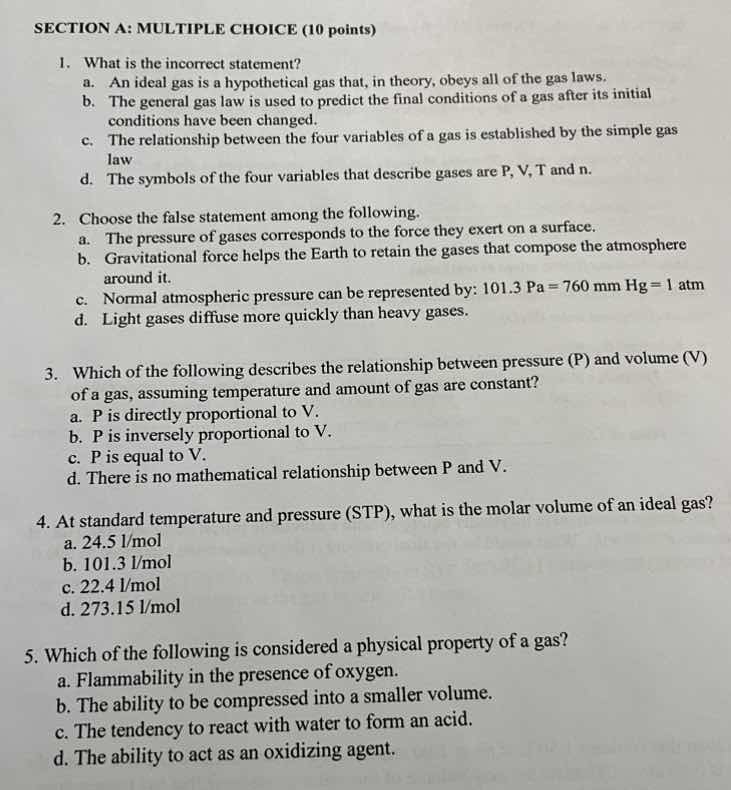
section a: multiple choice (10 points)
- what is the incorrect statement?
a. an ideal gas is a hypothetical gas that, in theory, obeys all of the gas laws.
b. the general gas law is used to predict the final conditions of a gas after its initial conditions have been changed.
c. the relationship between the four variables of a gas is established by the simple gas law
d. the symbols of the four variables that describe gases are p, v, t and n.
- choose the false statement among the following.
a. the pressure of gases corresponds to the force they exert on a surface.
b. gravitational force helps the earth to retain the gases that compose the atmosphere around it.
c. normal atmospheric pressure can be represented by: 101.3 pa = 760 mm hg = 1 atm
d. light gases diffuse more quickly than heavy gases.
- which of the following describes the relationship between pressure (p) and volume (v) of a gas, assuming temperature and amount of gas are constant?
a. p is directly proportional to v.
b. p is inversely proportional to v.
c. p is equal to v.
d. there is no mathematical relationship between p and v.
- at standard temperature and pressure (stp), what is the molar volume of an ideal gas?
a. 24.5 l/mol
b. 101.3 l/mol
c. 22.4 l/mol
d. 273.15 l/mol
- which of the following is considered a physical property of a gas?
a. flammability in the presence of oxygen.
b. the ability to be compressed into a smaller volume.
c. the tendency to react with water to form an acid.
d. the ability to act as an oxidizing agent.
- For question 1: The simple gas law (like Boyle's, Charles's) relates only two gas variables at a time, while the ideal gas law connects all four (P, V, T, n). So statement c is incorrect.
- For question 2: Normal atmospheric pressure is 101325 Pa (not 101.3 Pa), while 760 mm Hg and 1 atm are correct equivalents. So statement c is false.
- For question 3: Boyle's Law states that at constant temperature and moles of gas, pressure and volume are inversely proportional.
- For question 4: By definition, the molar volume of any ideal gas at STP (0°C, 1 atm) is 22.4 L/mol.
- For question 5: Physical properties do not involve a change in chemical composition. Compressibility is a physical property, while flammability, reactivity, and oxidizing ability are chemical properties.

Snap & solve any problem in the app
Get step-by-step solutions on Sovi AI
Photo-based solutions with guided steps
Explore more problems and detailed explanations
- c. The relationship between the four variables of a gas is established by the simple gas law
- c. Normal atmospheric pressure can be represented by: 101.3 Pa = 760 mm Hg = 1 atm
- b. P is inversely proportional to V.
- c. 22.4 l/mol
- b. The ability to be compressed into a smaller volume.