QUESTION IMAGE
Question
section 5 (pages 515-519) date
the impact of
the new deal
before you read
in the last section, you learned about american culture
during the depression.
in this section; you will read about the legacy of the
new deal.
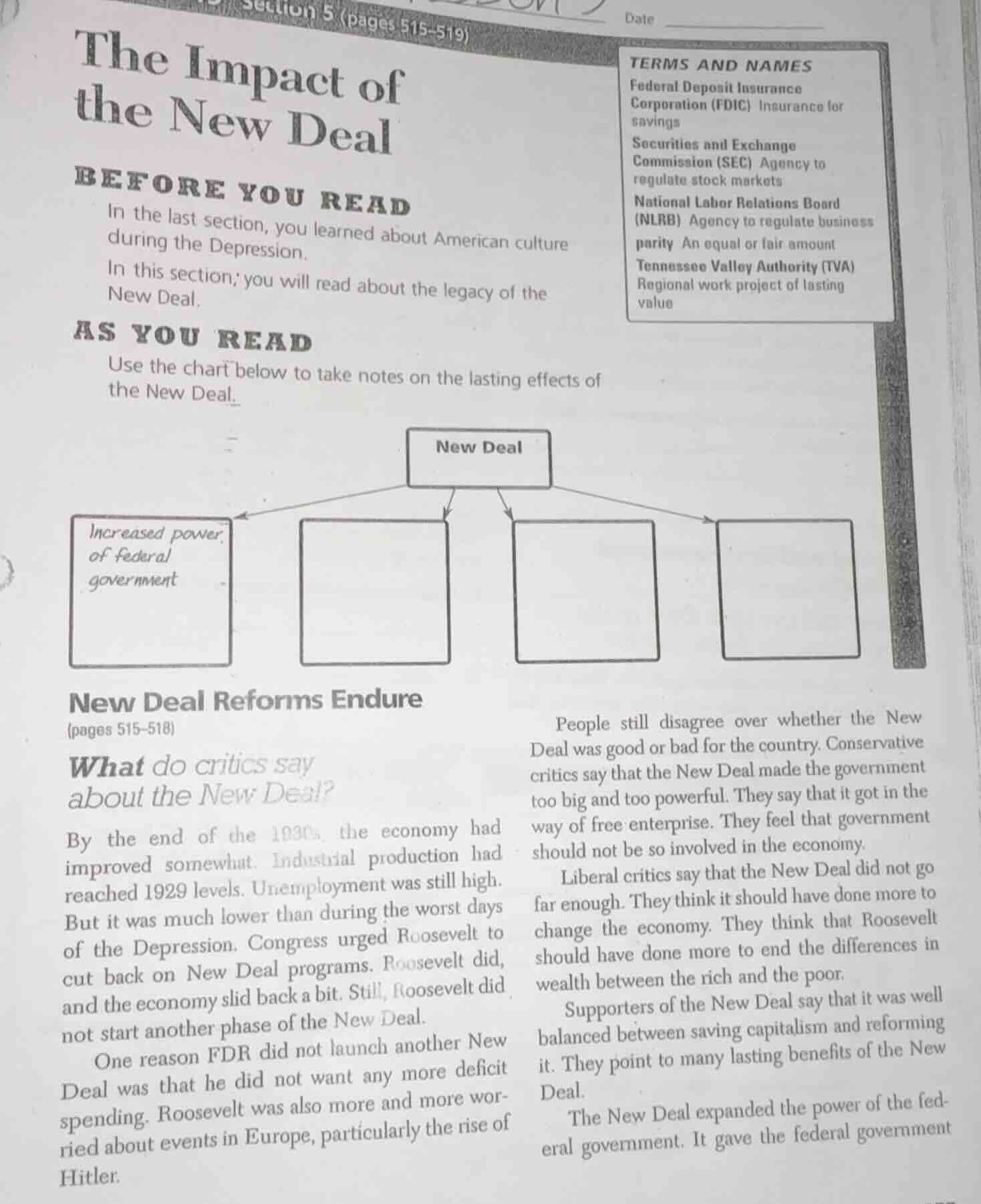
as you read
use the chart below to take notes on the lasting effects of
the new deal.
terms and names
federal deposit insurance
corporation (fdic) insurance for
savings
securities and exchange
commission (sec) agency to
regulate stock markets
national labor relations board
(nlrb) agency to regulate business
parity an equal or fair amount
tennessee valley authority (tva)
regional work project of lasting
value
new deal reforms endure
(pages 515-518)
what do critics say
about the new deal?
by the end of the 1930s, the economy had
improved somewhat. industrial production had
reached 1929 levels. unemployment was still high.
but it was much lower than during the worst days
of the depression. congress urged roosevelt to
cut back on new deal programs. roosevelt did,
and the economy slid back a bit. still, roosevelt did
not start another phase of the new deal.
one reason fdr did not launch another new
deal was that he did not want any more deficit
spending. roosevelt was also more and more wor-
ried about events in europe, particularly the rise of
hitler.
people still disagree over whether the new
deal was good or bad for the country. conservative
critics say that the new deal made the government
too big and too powerful. they say that it got in the
way of free enterprise. they feel that government
should not be so involved in the economy.
liberal critics say that the new deal did not go
far enough. they think it should have done more to
change the economy. they think that roosevelt
should have done more to end the differences in
wealth between the rich and the poor.
supporters of the new deal say that it was well
balanced between saving capitalism and reforming
it. they point to many lasting benefits of the new
deal.
the new deal expanded the power of the fed-
eral government. it gave the federal government
To fill in the chart about the lasting effects of the New Deal, we can extract the following key points from the text:
1. First Empty Box (after "Increased power of federal government")
From the text, we know that the New Deal created lasting government agencies (like FDIC, SEC, NLRB, TVA) that still exist or have influenced modern governance. Also, it established a precedent for government intervention in the economy (e.g., regulating business, labor, and financial markets). A suitable note could be: "Creation of lasting federal agencies (FDIC, SEC, NLRB, TVA)" or "Expanded government role in economy (regulation of business, labor, finance)".
2. Second Empty Box
The text mentions the New Deal’s impact on economic policy, including deficit spending (even though FDR later cut back, the idea of government using spending to combat economic downturns became a lasting concept). Additionally, it introduced social safety net ideas (though not fully realized, it set the stage for future programs like Social Security, which is part of the New Deal’s legacy). A note: "Established deficit spending as economic tool" or "Laid groundwork for social safety net (e.g., future Social Security - related reforms)".
3. Third Empty Box
Supporters argue the New Deal balanced saving and reforming capitalism. It also addressed regional development (TVA transformed the Tennessee Valley). Another angle: it changed public expectations (people now expect government to address economic crises). A note: "Balanced capitalism (saved + reformed it)" or "Regional development (TVA’s lasting infrastructure/electricity)" or "Changed public’s view of government’s economic role".
These points reflect the long - term impacts of the New Deal as described in the text, covering government power, economic policy, and societal expectations.

Snap & solve any problem in the app
Get step-by-step solutions on Sovi AI
Photo-based solutions with guided steps
Explore more problems and detailed explanations
To fill in the chart about the lasting effects of the New Deal, we can extract the following key points from the text:
1. First Empty Box (after "Increased power of federal government")
From the text, we know that the New Deal created lasting government agencies (like FDIC, SEC, NLRB, TVA) that still exist or have influenced modern governance. Also, it established a precedent for government intervention in the economy (e.g., regulating business, labor, and financial markets). A suitable note could be: "Creation of lasting federal agencies (FDIC, SEC, NLRB, TVA)" or "Expanded government role in economy (regulation of business, labor, finance)".
2. Second Empty Box
The text mentions the New Deal’s impact on economic policy, including deficit spending (even though FDR later cut back, the idea of government using spending to combat economic downturns became a lasting concept). Additionally, it introduced social safety net ideas (though not fully realized, it set the stage for future programs like Social Security, which is part of the New Deal’s legacy). A note: "Established deficit spending as economic tool" or "Laid groundwork for social safety net (e.g., future Social Security - related reforms)".
3. Third Empty Box
Supporters argue the New Deal balanced saving and reforming capitalism. It also addressed regional development (TVA transformed the Tennessee Valley). Another angle: it changed public expectations (people now expect government to address economic crises). A note: "Balanced capitalism (saved + reformed it)" or "Regional development (TVA’s lasting infrastructure/electricity)" or "Changed public’s view of government’s economic role".
These points reflect the long - term impacts of the New Deal as described in the text, covering government power, economic policy, and societal expectations.