QUESTION IMAGE
Question
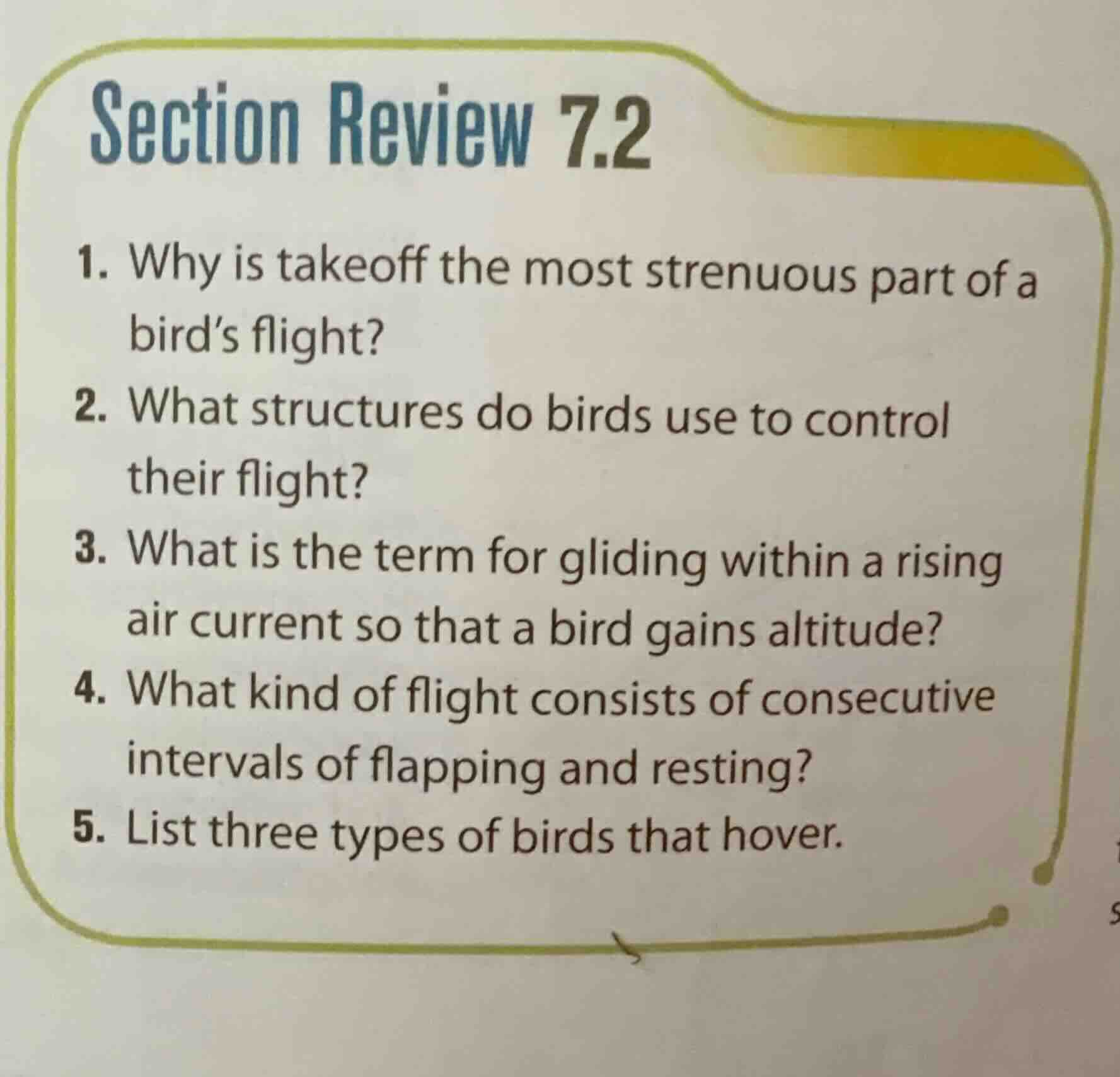
section review 7.2
- why is takeoff the most strenuous part of a bird’s flight?
- what structures do birds use to control their flight?
- what is the term for gliding within a rising air current so that a bird gains altitude?
- what kind of flight consists of consecutive intervals of flapping and resting?
- list three types of birds that hover.
Question 1
During takeoff, a bird must generate enough lift to overcome its weight and accelerate upward. This requires strong muscle contractions (flapping) to create sufficient upward force, using more energy than gliding or cruising.
Birds use wings (for lift/thrust), tail (for steering/stability), and feathers (adjustable for control: e.g., primary/secondary feathers, wing slots, alula for lift/control during flight maneuvers).
Soaring (specifically "thermalling" or "soaring on thermals") is gliding in rising air currents (thermals) to gain altitude with minimal flapping, using the upward air movement.

Snap & solve any problem in the app
Get step-by-step solutions on Sovi AI
Photo-based solutions with guided steps
Explore more problems and detailed explanations
Takeoff is strenuous because a bird must generate enough lift (via flapping) to overcome its weight and accelerate upward, requiring high energy/effort.