QUESTION IMAGE
Question
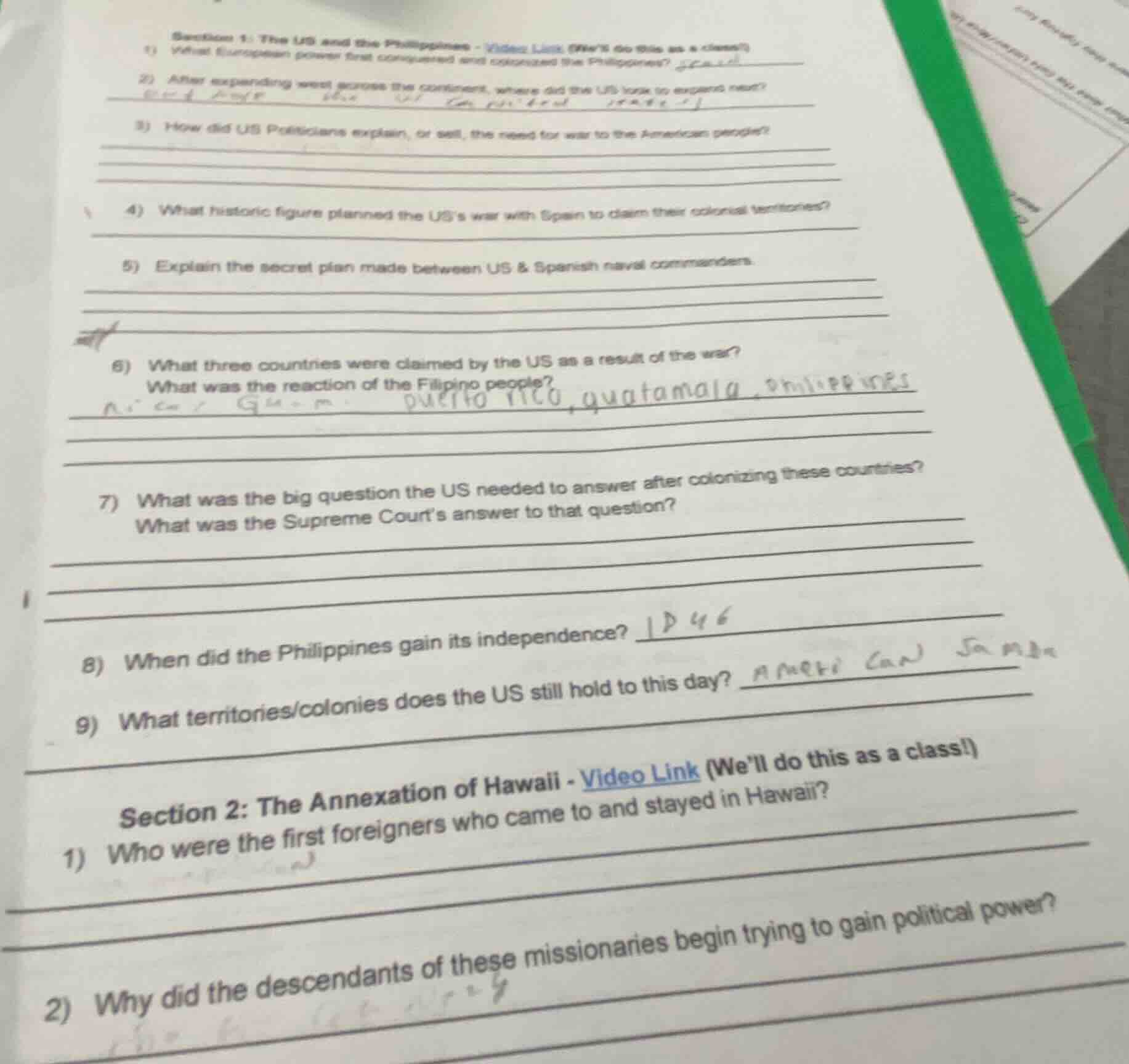
section 1: the us and the philippines - video link (well do this as a class!)1) what european power first conquered and colonized the philippines?2) after expanding west across the continent, where did the us look to expand next?3) how did us politicians explain, or sell, the need for war to the american people?4) what historic figure planned the uss war with spain to claim their colonial territories?5) explain the secret plan made between us & spanish naval commanders.6) what three countries were claimed by the us as a result of the war?what was the reaction of the filipino people?7) what was the big question the us needed to answer after colonizing these countries?what was the supreme courts answer to that question?8) when did the philippines gain its independence?9) what territories/colonies does the us still hold to this day?section 2: the annexation of hawaii - video link (well do this as a class!)1) who were the first foreigners who came to and stayed in hawaii?2) why did the descendants of these missionaries begin trying to gain political power?
Section 1: The US and the Philippines
- The first European power to colonize the Philippines was Spain, which arrived in 1521 under Magellan and established long-term control.
- After expanding west across North America, the US turned to overseas/imperial expansion in the Pacific and Caribbean.
- US politicians framed the war using yellow journalism (exaggerating Spanish atrocities) and framed it as a mission to "civilize" and free oppressed peoples (like Cubans/Philippines), while also citing the sinking of the USS Maine.
- Theodore Roosevelt (as Assistant Secretary of the Navy) was a key figure who pushed for and planned elements of the US war with Spain to seize colonial territories.
- The secret plan was that Spanish naval commanders in the Philippines would surrender to the US quickly, avoiding a bloody battle, in exchange for the US guaranteeing Spanish officers' safety and allowing them to return home with honor.
- The US claimed Puerto Rico, Guam, and the Philippines. Filipino people launched a guerrilla war against US occupation, as they had fought Spain expecting independence, not a new colonial ruler.
- The big question was: Do the US Constitution's rights apply to people in conquered territories? The Supreme Court's Insular Cases ruled that the Constitution does not fully apply to these territories, allowing the US to rule them without granting full citizenship rights.
- The Philippines gained full independence on July 4, 1946, via the Treaty of Manila.
- US-held territories today include Puerto Rico, Guam, the Northern Mariana Islands, the US Virgin Islands, and American Samoa.
Section 2: The Annexation of Hawaii
- The first foreign settlers to stay in Hawaii were American Protestant missionaries, arriving in the 1820s.
- The descendants of these missionaries (who had become wealthy sugar plantation owners) sought political power to protect their economic interests, including avoiding US tariffs on Hawaiian sugar and securing control over land and labor policies.

Snap & solve any problem in the app
Get step-by-step solutions on Sovi AI
Photo-based solutions with guided steps
Explore more problems and detailed explanations
Section 1: The US and the Philippines
- Spain
- Overseas/imperial expansion (Pacific/Caribbean)
- Used yellow journalism, "civilizing" mission, USS Maine incident
- Theodore Roosevelt
- Spanish commanders would surrender quickly; US guaranteed their safety/honorable return
- Puerto Rico, Guam, the Philippines; Filipino people fought a guerrilla war against US occupation
- Do Constitutional rights apply to colonial subjects?; No (via Insular Cases)
- July 4, 1946
- Puerto Rico, Guam, Northern Mariana Islands, US Virgin Islands, American Samoa
Section 2: The Annexation of Hawaii
- American Protestant missionaries
- To protect their wealthy sugar plantation economic interests (avoid tariffs, control policies)