QUESTION IMAGE
Question
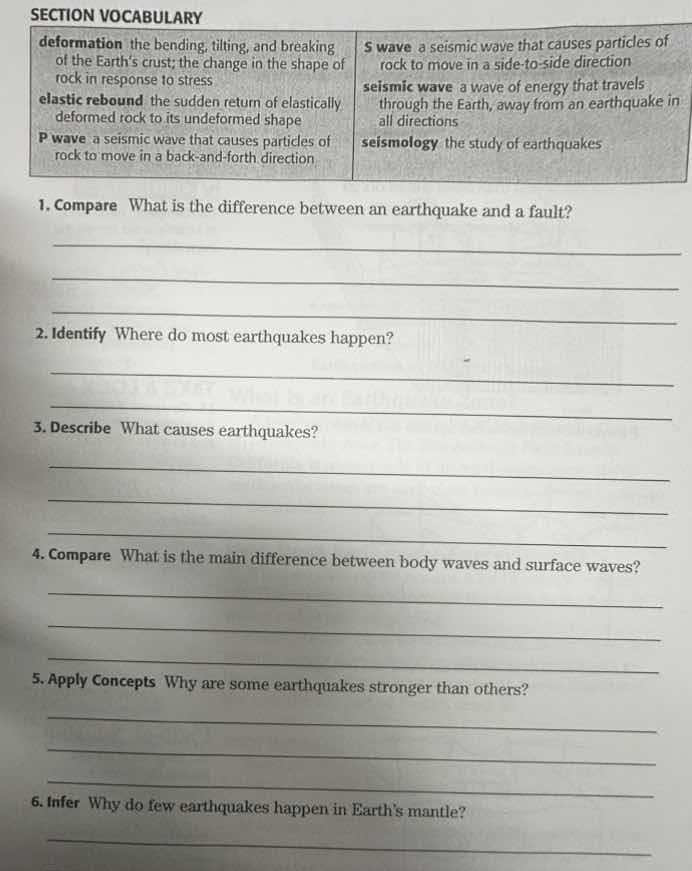
section vocabularydeformation the bending, tilting, and breaking of the earths crust; the change in the shape of rock in response to stresselastic rebound the sudden return of elastically deformed rock to its undeformed shapep wave a seismic wave that causes particles of rock to move in a back-and-forth directions wave a seismic wave that causes particles of rock to move in a side-to-side directionseismic wave a wave of energy that travels through the earth, away from an earthquake in all directionsseismology the study of earthquakes1. compare what is the difference between an earthquake and a fault?2. identify where do most earthquakes happen?3. describe what causes earthquakes?4. compare what is the main difference between body waves and surface waves?5. apply concepts why are some earthquakes stronger than others?6. infer why do few earthquakes happen in earths mantle?
- A fault is a fracture/zone between rock blocks; an earthquake is the sudden release of energy along a fault that causes shaking.
- Most earthquakes occur along tectonic plate boundaries, where plates interact (collide, slide, pull apart).
- Earthquakes form when built-up stress in rock (from tectonic plate movement) exceeds the rock's strength, causing sudden elastic rebound along faults, releasing energy as seismic waves.
- Body waves travel through the Earth's interior (P and S waves), while surface waves only travel along the Earth's surface and cause more intense ground shaking.
- Earthquake strength depends on the amount of stress released, the area of the fault that slips, and the depth of the slip—larger slip areas, greater stress, and shallower depth create stronger earthquakes.
- The mantle is under high pressure, making rock more ductile (it deforms slowly instead of breaking suddenly), so sudden slip and energy release (earthquakes) are rare.

Snap & solve any problem in the app
Get step-by-step solutions on Sovi AI
Photo-based solutions with guided steps
Explore more problems and detailed explanations
- A fault is a fracture/weak zone in Earth's crust where rock blocks can move past each other. An earthquake is the sudden, violent release of energy along a fault that causes ground shaking and seismic waves.
- Most earthquakes happen along the boundaries of Earth's tectonic plates.
- Earthquakes are caused by the sudden elastic rebound of rock that has been deformed by built-up stress from tectonic plate movement. When the stress exceeds the rock's strength, the rock breaks along a fault, releasing energy as seismic waves.
- Body waves travel through the interior of the Earth (including P and S waves), while surface waves only travel along the Earth's surface and are responsible for most of the damage during an earthquake.
- Some earthquakes are stronger than others because they involve a larger area of a fault slipping, a greater amount of built-up stress being released, or shallower slip depth (shallower earthquakes transfer more energy to the surface).
- Few earthquakes happen in Earth's mantle because the mantle rock is under high pressure, making it ductile (it deforms slowly instead of breaking suddenly), so sudden, energy-releasing slip (like in earthquakes) is uncommon.