QUESTION IMAGE
Question
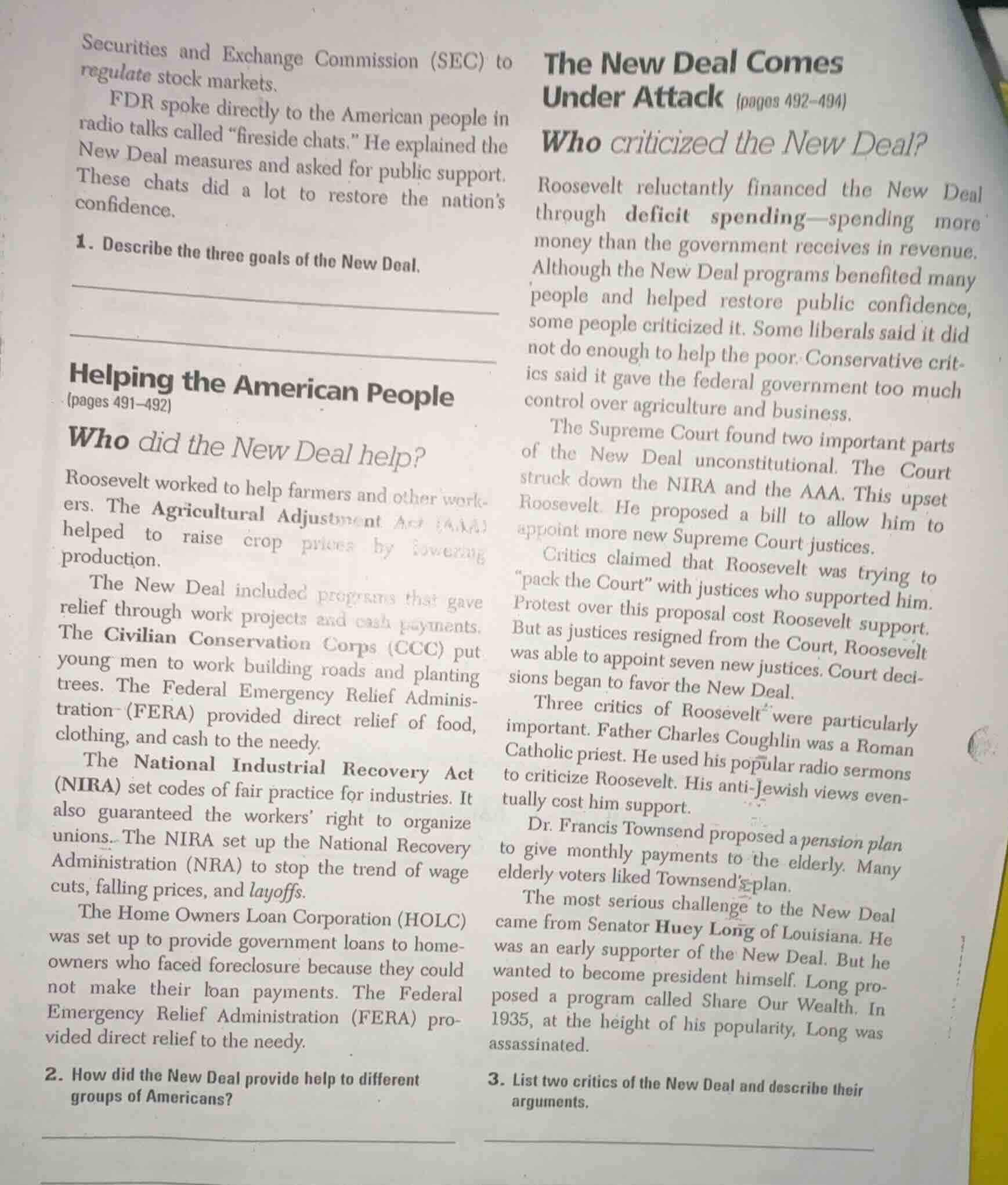
securities and exchange commission (sec) to regulate stock markets.
fdr spoke directly to the american people in radio talks called “fireside chats.” he explained the new deal measures and asked for public support. these chats did a lot to restore the nation’s confidence.
- describe the three goals of the new deal.
helping the american people
(pages 491–492)
who did the new deal help?
roosevelt worked to help farmers and other work - ers. the agricultural adjustment act (aaa) helped to raise crop prices by lowering production.
the new deal included programs that gave relief through work projects and cash payments. the civilian conservation corps (ccc) put young men to work building roads and planting trees. the federal emergency relief administration (fera) provided direct relief of food, clothing, and cash to the needy.
the national industrial recovery act (nira) set codes of fair practice for industries. it also guaranteed the workers’ right to organize unions. the nira set up the national recovery administration (nra) to stop the trend of wage cuts, falling prices, and layoffs.
the home owners loan corporation (holc) was set up to provide government loans to home - owners who faced foreclosure because they could not make their loan payments. the federal emergency relief administration (fera) provided direct relief to the needy.
- how did the new deal provide help to different groups of americans?
the new deal comes under attack (pages 492–494)
who criticized the new deal?
roosevelt reluctantly financed the new deal through deficit spending—spending more money than the government receives in revenue. although the new deal programs benefited many people and helped restore public confidence, some people criticized it. some liberals said it did not do enough to help the poor. conservative critics said it gave the federal government too much control over agriculture and business.
the supreme court found two important parts of the new deal unconstitutional. the court struck down the nira and the aaa. this upset roosevelt. he proposed a bill to allow him to appoint more new supreme court justices.
critics claimed that roosevelt was trying to “pack the court” with justices who supported him. protest over this proposal cost roosevelt support. but as justices resigned from the court, roosevelt was able to appoint seven new justices. court decisions began to favor the new deal.
three critics of roosevelt were particularly important. father charles coughlin was a roman catholic priest. he used his popular radio sermons to criticize roosevelt. his anti - jewish views eventually cost him support.
dr. francis townsend proposed a pension plan to give monthly payments to the elderly. many elderly voters liked townsend’s plan.
the most serious challenge to the new deal came from senator huey long of louisiana. he was an early supporter of the new deal. but he wanted to become president himself. long proposed a program called share our wealth. in 1935, at the height of his popularity, long was assassinated.
- list two critics of the new deal and describe their arguments.
Question 1: Describe the three goals of the New Deal.
The New Deal had three main goals, often referred to as the "Three R's": Relief, Recovery, and Reform. Relief aimed to provide immediate assistance to the unemployed and those in need (e.g., through programs like the Federal Emergency Relief Administration (FERA) and the Civilian Conservation Corps (CCC)). Recovery was focused on helping industries, agriculture, and the economy to recover from the Great Depression (e.g., the National Industrial Recovery Act (NIRA) and the Agricultural Adjustment Act (AAA) were designed for this). Reform was intended to prevent future economic crises by creating regulatory bodies and laws (such as the Securities and Exchange Commission (SEC) to regulate stock markets and measures to protect workers' rights and banking reforms).
- Farmers: The Agricultural Adjustment Act (AAA) helped raise crop prices by lowering production (reducing supply to increase demand - based prices).
- Workers/Youth: The Civilian Conservation Corps (CCC) provided jobs (e.g., building roads, planting trees) for young men. The National Industrial Recovery Act (NIRA) set fair practice codes for industries and guaranteed workers’ right to organize unions, while also addressing wage cuts, falling prices, and layoffs.
- Needy/Unemployed: The Federal Emergency Relief Administration (FERA) provided direct relief (food, clothing, cash) to those in need.
- Homeowners: The Home Owners Loan Corporation (HOLC) provided government loans to homeowners facing foreclosure (to help them keep their homes).
- Elderly/General Workers: Programs like the Social Security Act (implied by broader New Deal goals, though not fully detailed here) and labor reforms (e.g., NIRA) supported long - term stability for these groups.
- Liberals (e.g., those who wanted more radical change): Argued the New Deal did not do enough to help the poor. They believed the measures were insufficient to address the depth of poverty and inequality, and that more direct and extensive support for the poorest Americans was needed.
- Conservatives: Claimed the New Deal gave the federal government too much control over agriculture and business. They saw the government's intervention (e.g., AAA's control over farm production, NIRA's industry regulations) as an overreach of power that undermined free - market principles.
- Father Charles Coughlin (a Roman Catholic priest): Used popular radio sermons to criticize Roosevelt. He also had anti - Jewish views, which eventually cost him support.
- Dr. Francis Townsend: Proposed a pension plan for the elderly (popular with elderly voters) and likely criticized the New Deal for not having a more comprehensive plan for the elderly initially.
- Senator Huey Long (before his assassination): Initially supported the New Deal but later proposed "Share Our Wealth" as a more radical alternative, criticizing the New Deal for not redistributing wealth enough (he wanted to become president and saw the New Deal as insufficiently ambitious).
(We will choose two, for example, Conservatives and Father Charles Coughlin)

Snap & solve any problem in the app
Get step-by-step solutions on Sovi AI
Photo-based solutions with guided steps
Explore more problems and detailed explanations
The three goals of the New Deal (the "Three R's") are:
- Relief: Provide immediate assistance to the unemployed and needy (e.g., through work projects, cash payments, and food/clothing relief).
- Recovery: Help industries, agriculture, and the economy recover from the Great Depression (e.g., by setting fair practice codes for industries, raising crop prices, and stabilizing wages/prices).
- Reform: Prevent future economic crises by creating regulations (e.g., SEC to regulate stock markets, labor rights protections, and banking reforms).