QUESTION IMAGE
Question
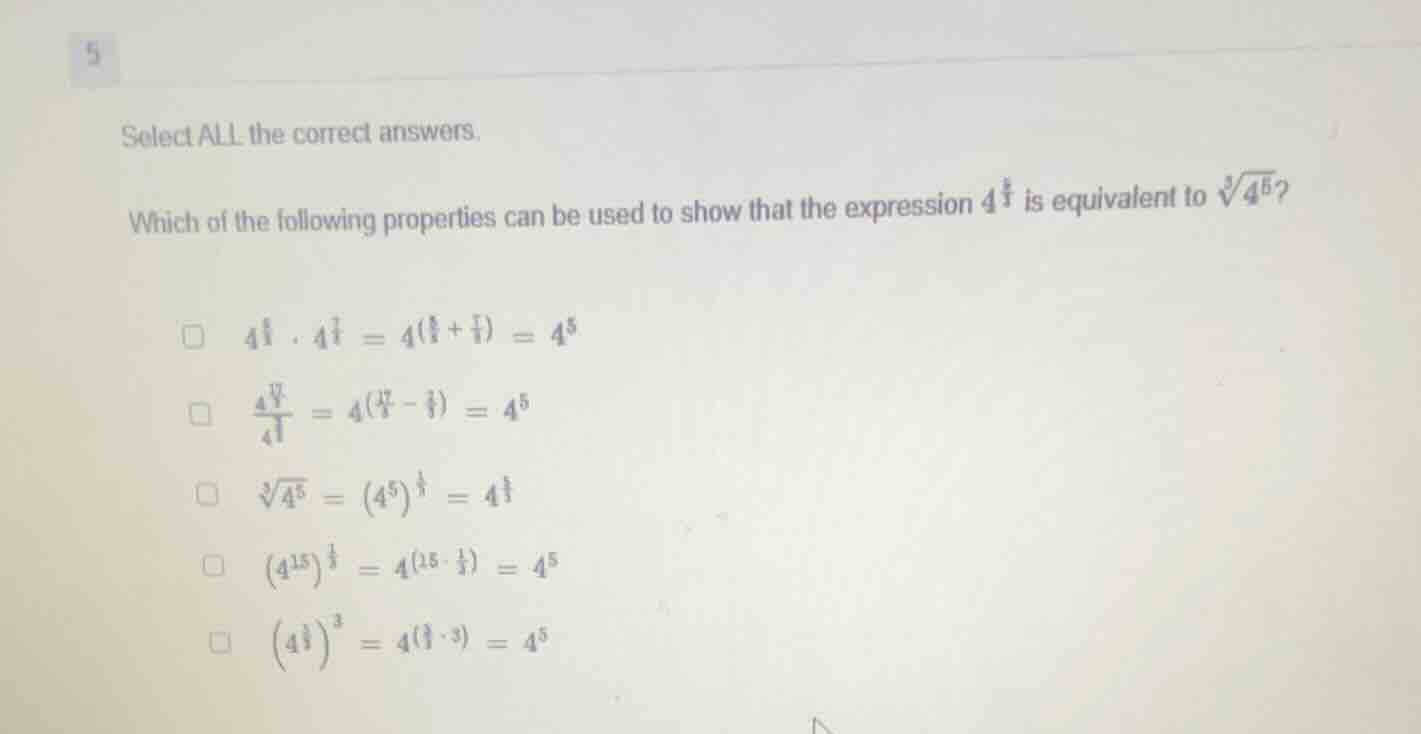
select all the correct answers. which of the following properties can be used to show that the expression $4^{\frac{5}{3}}$ is equivalent to $\sqrt3{4^5}$? $\square$ $4^{\frac{8}{3}} \cdot 4^{\frac{7}{3}} = 4^{(\frac{8}{3} + \frac{7}{3})} = 4^5$ $\square$ $\frac{4^{\frac{17}{3}}}{4^{\frac{2}{3}}} = 4^{(\frac{17}{3} - \frac{2}{3})} = 4^5$ $\square$ $\sqrt3{4^5} = (4^5)^{\frac{1}{3}} = 4^{\frac{5}{3}}$ $\square$ $(4^{1.5})^{\frac{1}{3}} = 4^{(1.5 \cdot \frac{1}{3})} = 4^{5}$ $\square$ $(4^{\frac{5}{9}})^3 = 4^{(\frac{5}{9} \cdot 3)} = 4^5$
Step1: Recall rational exponent rule
The rule states that $a^{\frac{m}{n}} = \sqrt[n]{a^m}$, which can be rewritten as $\sqrt[n]{a^m}=(a^m)^{\frac{1}{n}}=a^{\frac{m}{n}}$.
Step2: Match to the problem
We need to connect $4^{\frac{5}{3}}$ and $\sqrt[3]{4^5}$. The property $\sqrt[3]{4^5} = (4^5)^{\frac{1}{3}} = 4^{\frac{5}{3}}$ directly applies this rule.
Step3: Analyze other options
- The first option uses product of exponents, not root-exponent conversion.
- The second option uses quotient of exponents, not relevant here.
- The fourth option manipulates a different exponent base, not the target equivalence.
- The fifth option raises the rational exponent to a power, which reverses the direction and does not show the given equivalence.

Snap & solve any problem in the app
Get step-by-step solutions on Sovi AI
Photo-based solutions with guided steps
Explore more problems and detailed explanations
$\sqrt[4]{4^5} = (4^5)^{\frac{1}{3}} = 4^{\frac{5}{3}}$