QUESTION IMAGE
Question
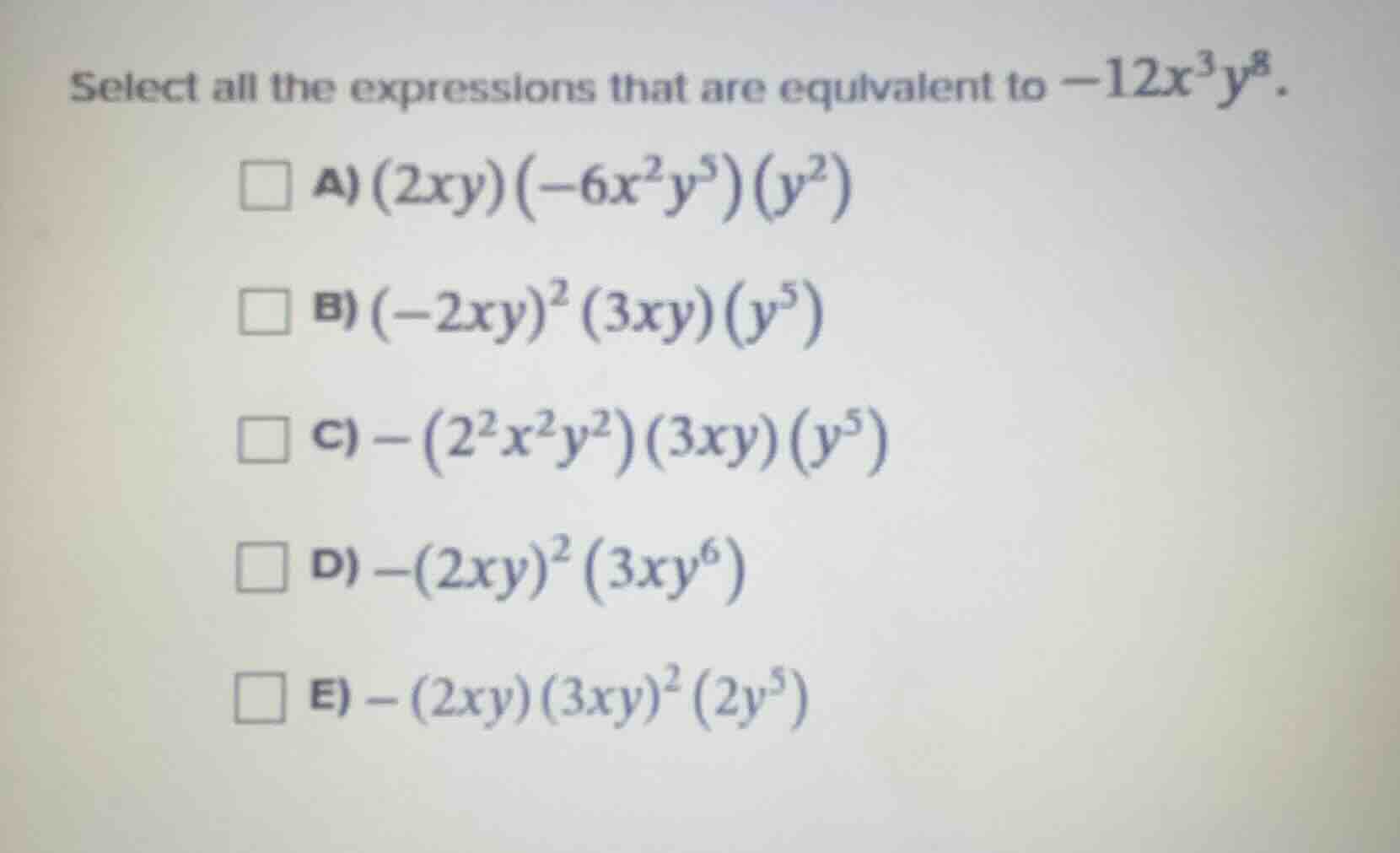
select all the expressions that are equivalent to $-12x^{3}y^{8}$.
a) $(2xy)(-6x^{2}y^{5})(y^{2})$
b) $(-2xy)^{2}(3xy)(y^{5})$
c) $-(2^{2}x^{2}y^{2})(3xy)(y^{5})$
d) $-(2xy)^{2}(3xy^{6})$
e) $-(2xy)(3xy)^{2}(2y^{5})$
for Option A:
Step1: Multiply coefficients
Multiply the coefficients: \(2\times(-6) = -12\)
Step2: Multiply \(x\) terms
For \(x\) terms: \(x\times x^{2}=x^{1 + 2}=x^{3}\)
Step3: Multiply \(y\) terms
For \(y\) terms: \(y\times y^{5}\times y^{2}=y^{1+5 + 2}=y^{8}\)
Combining these, we get \((2xy)(-6x^{2}y^{5})(y^{2})=-12x^{3}y^{8}\), so A is equivalent.
for Option B:
Step1: Simplify \((-2xy)^{2}\)
\((-2xy)^{2}=(-2)^{2}x^{2}y^{2}=4x^{2}y^{2}\)
Step2: Multiply coefficients
Multiply coefficients: \(4\times3 = 12\)
Step3: Multiply \(x\) terms
For \(x\) terms: \(x^{2}\times x\times x=x^{2 + 1+1}=x^{4}\) (Wait, original \(x\) terms: \(x^{2}\) from \((-2xy)^2\), \(x\) from \(3xy\), and no additional \(x\) from \(y^{5}\), so \(x^{2}\times x=x^{3}\)? Wait, no: \((-2xy)^2 = 4x^{2}y^{2}\), then multiply by \(3xy\): \(4\times3 = 12\), \(x^{2}\times x=x^{3}\), \(y^{2}\times y = y^{3}\), then multiply by \(y^{5}\): \(y^{3}\times y^{5}=y^{8}\). But the coefficient is \(12\) (positive), while the original is \(- 12\). So \((-2xy)^{2}(3xy)(y^{5}) = 12x^{3}y^{8}
eq-12x^{3}y^{8}\), so B is not equivalent.
for Option C:
Step1: Simplify \(2^{2}\)
\(2^{2}=4\), so the expression is \(-(4x^{2}y^{2})(3xy)(y^{5})\)
Step2: Multiply coefficients
Multiply coefficients: \(-4\times3=-12\)
Step3: Multiply \(x\) terms
For \(x\) terms: \(x^{2}\times x=x^{3}\)
Step4: Multiply \(y\) terms
For \(y\) terms: \(y^{2}\times y\times y^{5}=y^{2 + 1+5}=y^{8}\)
Combining these, we get \(-(2^{2}x^{2}y^{2})(3xy)(y^{5})=-12x^{3}y^{8}\), so C is equivalent.
for Option D:
Step1: Simplify \((2xy)^{2}\)
\((2xy)^{2}=4x^{2}y^{2}\)
Step2: Multiply coefficients
Multiply coefficients: \(-4\times3=-12\)
Step3: Multiply \(x\) terms
For \(x\) terms: \(x^{2}\times x=x^{3}\)
Step4: Multiply \(y\) terms
For \(y\) terms: \(y^{2}\times y^{6}=y^{8}\)
Combining these, we get \(-(2xy)^{2}(3xy^{6})=-12x^{3}y^{8}\), so D is equivalent.

Snap & solve any problem in the app
Get step-by-step solutions on Sovi AI
Photo-based solutions with guided steps
Explore more problems and detailed explanations
A. \((2xy)(-6x^{2}y^{5})(y^{2})\)
C. \(-(2^{2}x^{2}y^{2})(3xy)(y^{5})\)
D. \(-(2xy)^{2}(3xy^{6})\)