QUESTION IMAGE
Question
select the correct answer from each drop - down menu.
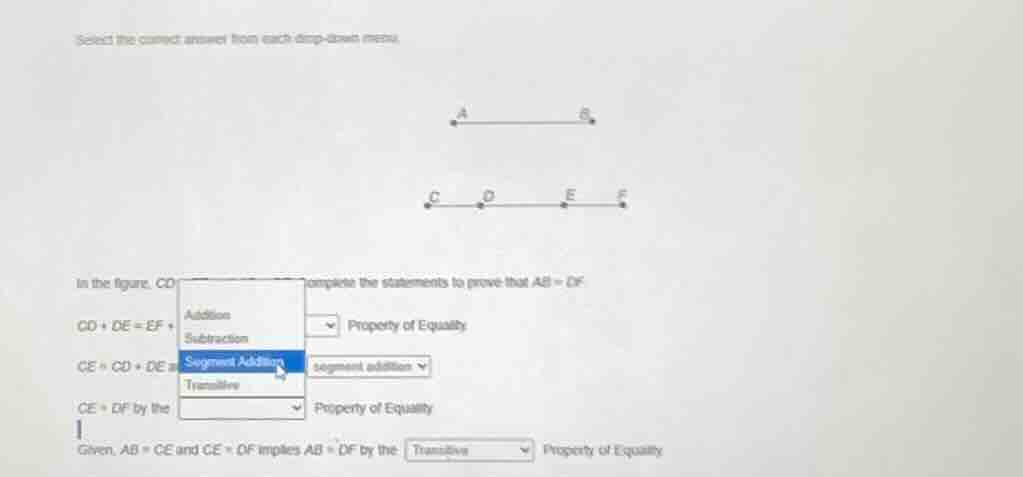
in the figure, cd
cd + de = ef +
ce = cd + de
ce = df by the
given, ab = ce and ce = df implies ab = df by the
property of equality
property of equality
property of equality
Step1: Identify equality setup
To relate segments, start with given: $AB = CE$, need to show $CE = DF$. First, use segment addition for $CE$ and $DF$: $CE = CD + DE$, $DF = DE + EF$.
Step2: Match segment equality
Given $CD = EF$, use Addition Property of Equality: add $DE$ to both sides:
$CD + DE = EF + DE$
Step3: Apply Segment Addition
By Segment Addition Postulate, $CD + DE = CE$ and $DE + EF = DF$.
Step4: Use Transitive Property
Substitute into the equality: $CE = DF$ by the Transitive Property of Equality (since $CD+DE=CE$, $EF+DE=DF$, and $CD+DE=EF+DE$).
Step5: Final transitive step
Given $AB = CE$ and $CE = DF$, $AB = DF$ by the Transitive Property of Equality.

Snap & solve any problem in the app
Get step-by-step solutions on Sovi AI
Photo-based solutions with guided steps
Explore more problems and detailed explanations
- $CD + DE = EF + DE$: Addition Property of Equality
- $CE = CD + DE$: Segment Addition Postulate
- $CE = DF$: Transitive Property of Equality
- $AB = CE$ and $CE = DF$ implies $AB = DF$: Transitive Property of Equality