QUESTION IMAGE
Question
select the correct answer from each drop - down menu
given: ( cd = ef ), ( ab = ce )
prove: ( ab = df )
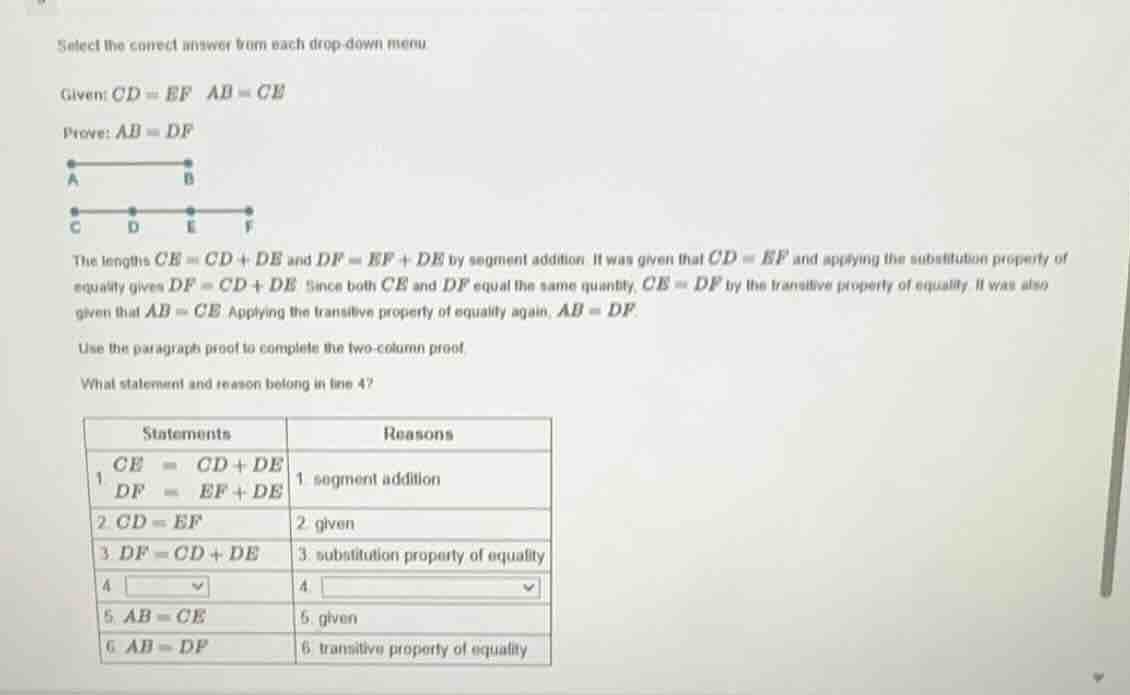
there is a diagram with two line segments. the upper segment has endpoints a and b. the lower segment has endpoints c, d, e, f in order.
the lengths ( ce = cd + de ) and ( df = ef + de ) by segment addition. it was given that ( cd = ef ) and applying the substitution property of equality gives ( df = cd + de ). since both ( ce ) and ( df ) equal the same quantity, ( ce = df ) by the transitive property of equality. it was also given that ( ab = ce ). applying the transitive property of equality again, ( ab = df ).
use the paragraph proof to complete the two - column proof.
what statement and reason belong in line 4?
| statements | reasons |
|---|---|
| 2. ( cd = ef ) | 2. given |
| 3. ( df = cd + de ) | 3. substitution property of equality |
| 4. drop - down for statement | 4. drop - down for reason |
| 5. ( ab = ce ) | 5. given |
| 6. ( ab = df ) | 6. transitive property of equality |
Step1: Map paragraph proof to table
From the given paragraph proof, after step 3 ($DF=CD+DE$), we establish that $CE=DF$ using the transitive property (since $CE=CD+DE$ and $DF=CD+DE$).
Step2: Identify line 4 content
This matches the missing line 4: the statement is $CE=DF$, and the reason is the transitive property of equality.

Snap & solve any problem in the app
Get step-by-step solutions on Sovi AI
Photo-based solutions with guided steps
Explore more problems and detailed explanations
Statement: $CE = DF$
Reason: transitive property of equality