QUESTION IMAGE
Question
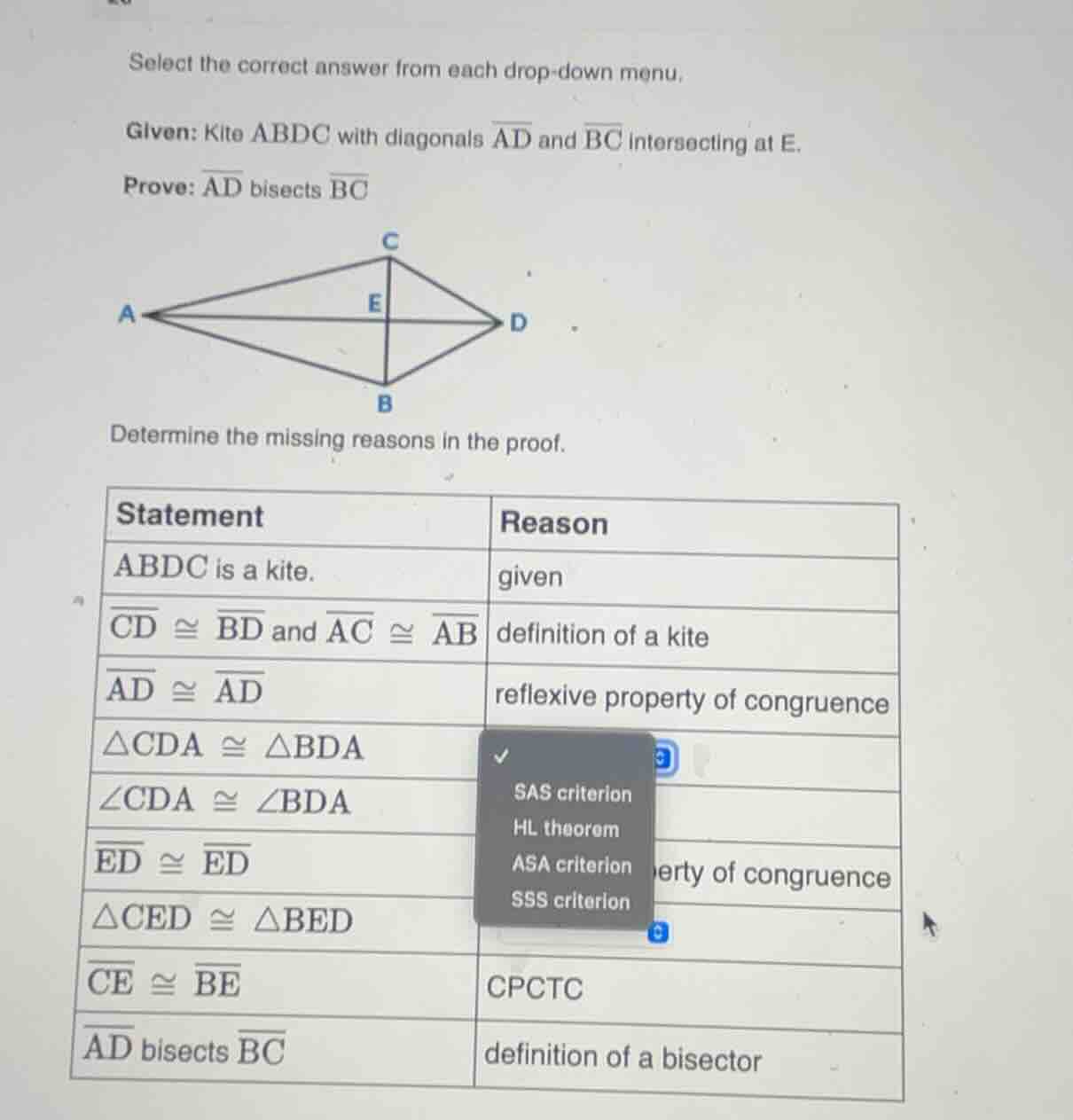
select the correct answer from each drop - down menu. given: kite abdc with diagonals $overline{ad}$ and $overline{bc}$ intersecting at e. prove: $overline{ad}$ bisects $overline{bc}$ determine the missing reasons in the proof.
| statement | reason |
|---|---|
| $overline{cd} \cong \overline{bd}$ and $overline{ac} \cong \overline{ab}$ | definition of a kite |
| $overline{ad} \cong \overline{ad}$ | reflexive property of congruence |
| $\triangle cda \cong \triangle bda$ | |
| $\angle cda \cong \angle bda$ | |
| $overline{ed} \cong \overline{ed}$ | reflexive property of congruence |
| $\triangle ced \cong \triangle bed$ | |
| $overline{ce} \cong \overline{be}$ | cpctc |
| $overline{ad}$ bisects $overline{bc}$ | definition of a bisector |
(the drop - down options for the reasons of $\triangle cda \cong \triangle bda$ and $\triangle ced \cong \triangle bed$ include sas criterion, hl theorem, asa criterion, sss criterion)
Brief Explanations
- For $\triangle CDA \cong \triangle BDA$: We have three pairs of congruent sides: $\overline{CD} \cong \overline{BD}$, $\overline{AC} \cong \overline{AB}$, and $\overline{AD} \cong \overline{AD}$. The congruence rule that uses three pairs of congruent sides is the SSS criterion.
- For $\triangle CED \cong \triangle BED$: We have $\overline{CD} \cong \overline{BD}$, $\angle CDA \cong \angle BDA$, and $\overline{ED} \cong \overline{ED}$. This is two sides and the included angle, so we use the SAS criterion.

Snap & solve any problem in the app
Get step-by-step solutions on Sovi AI
Photo-based solutions with guided steps
Explore more problems and detailed explanations
- For $\triangle CDA \cong \triangle BDA$: SSS criterion
- For $\triangle CED \cong \triangle BED$: SAS criterion