QUESTION IMAGE
Question
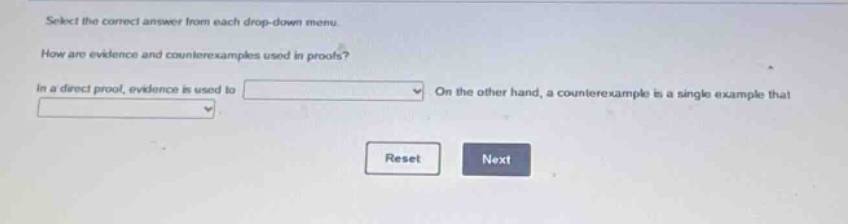
select the correct answer from each drop - down menu. how are evidence and counterexamples used in proofs? in a direct proof, evidence is used to drop - down menu on the other hand, a counterexample is a single example that drop - down menu reset next
In a direct proof, evidence (like logical deductions, axioms, or previously proven theorems) is used to show that a statement is true for all cases. A counterexample is a single example that shows a statement is false (by providing a case where the statement doesn't hold). For the first dropdown (how evidence is used in direct proof), the typical use is to "show the statement is true for all cases" (or similar phrasing about proving the statement holds universally). For the second part about counterexample, it's to "disprove a universal statement" (since a counterexample provides a case that violates a claim that something is true for all, thus disproving the universal claim).

Snap & solve any problem in the app
Get step-by-step solutions on Sovi AI
Photo-based solutions with guided steps
Explore more problems and detailed explanations
First dropdown (example option): show the statement is true for all cases
Second part (example option): disproves a universal statement
(Note: The exact answer options in the dropdowns would depend on the provided choices, but the above explains the correct concepts. If the dropdowns had options like "prove the statement is true" (for the first) and "shows a statement is false" (for the second), those would be correct.)