QUESTION IMAGE
Question
select the correct answer from each drop - down menu.
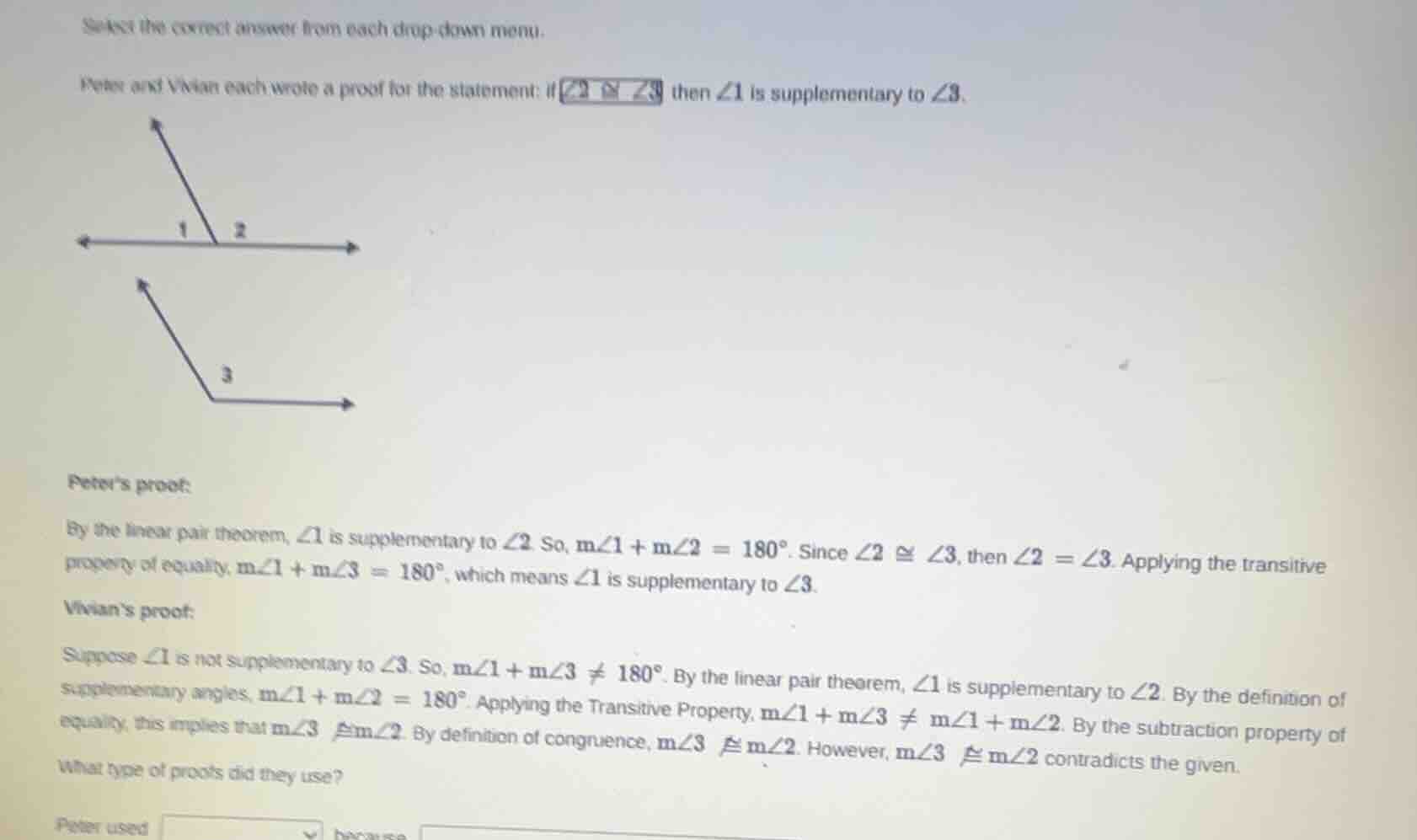
peter and vivian each wrote a proof for the statement: if \\(\angle 2\cong\angle 3\\) then \\(\angle 1\\) is supplementary to \\(\angle 3\\).
there are two angle - related figures here, one with \\(\angle 1\\) and \\(\angle 2\\) forming a linear pair, and the other with \\(\angle 3\\)
peter’s proof:
by the linear pair theorem, \\(\angle 1\\) is supplementary to \\(\angle 2\\). so, \\(m\angle 1 + m\angle 2=180^{\circ}\\). since \\(\angle 2\cong\angle 3\\), then \\(\angle 2 = \angle 3\\). applying the transitive property of equality, \\(m\angle 1 + m\angle 3 = 180^{\circ}\\), which means \\(\angle 1\\) is supplementary to \\(\angle 3\\).
vivian’s proof:
suppose \\(\angle 1\\) is not supplementary to \\(\angle 3\\). so, \\(m\angle 1 + m\angle 3\
eq180^{\circ}\\). by the linear pair theorem, \\(\angle 1\\) is supplementary to \\(\angle 2\\). by the definition of supplementary angles, \\(m\angle 1 + m\angle 2 = 180^{\circ}\\). applying the transitive property, \\(m\angle 1 + m\angle 3\
eq m\angle 1 + m\angle 2\\). by the subtraction property of equality, this implies that \\(m\angle 3\
eq m\angle 2\\). by definition of congruence, \\(m\angle 3\
cong m\angle 2\\). however, \\(m\angle 3\
cong m\angle 2\\) contradicts the given.
what type of proofs did they use?
peter used drop - down menu because
To determine the type of proof Peter used, we analyze his reasoning:
Step 1: Identify the Proof Structure
Peter starts with a known theorem (linear pair theorem: \( \angle 1 \) is supplementary to \( \angle 2 \), so \( m\angle 1 + m\angle 2 = 180^\circ \)). He then uses the given \( \angle 2 \cong \angle 3 \) (implying \( m\angle 2 = m\angle 3 \)) and applies the transitive property of equality to substitute \( m\angle 3 \) for \( m\angle 2 \) in the equation \( m\angle 1 + m\angle 2 = 180^\circ \), resulting in \( m\angle 1 + m\angle 3 = 180^\circ \).
Step 2: Classify the Proof Type
This is a direct proof because Peter starts with known facts (linear pair theorem, definition of congruent angles) and uses logical deductions (substitution via transitive property) to directly reach the conclusion that \( \angle 1 \) is supplementary to \( \angle 3 \).
For Vivian’s Proof (if needed):
Vivian assumes the opposite of the conclusion ( \( \angle 1 \) is not supplementary to \( \angle 3 \)) and shows this leads to a contradiction (conflicting with \( \angle 2 \cong \angle 3 \)). This is a proof by contradiction (indirect proof).
Final Answer for Peter’s Proof Type:
Peter used a direct proof because he started with known theorems and definitions, then used logical deductions (substitution, transitive property) to directly derive the conclusion.
(Note: If the dropdown options include "direct proof" or similar, that is the correct choice. For example, if options are "direct proof", "proof by contradiction", etc., select "direct proof".)

Snap & solve any problem in the app
Get step-by-step solutions on Sovi AI
Photo-based solutions with guided steps
Explore more problems and detailed explanations
To determine the type of proof Peter used, we analyze his reasoning:
Step 1: Identify the Proof Structure
Peter starts with a known theorem (linear pair theorem: \( \angle 1 \) is supplementary to \( \angle 2 \), so \( m\angle 1 + m\angle 2 = 180^\circ \)). He then uses the given \( \angle 2 \cong \angle 3 \) (implying \( m\angle 2 = m\angle 3 \)) and applies the transitive property of equality to substitute \( m\angle 3 \) for \( m\angle 2 \) in the equation \( m\angle 1 + m\angle 2 = 180^\circ \), resulting in \( m\angle 1 + m\angle 3 = 180^\circ \).
Step 2: Classify the Proof Type
This is a direct proof because Peter starts with known facts (linear pair theorem, definition of congruent angles) and uses logical deductions (substitution via transitive property) to directly reach the conclusion that \( \angle 1 \) is supplementary to \( \angle 3 \).
For Vivian’s Proof (if needed):
Vivian assumes the opposite of the conclusion ( \( \angle 1 \) is not supplementary to \( \angle 3 \)) and shows this leads to a contradiction (conflicting with \( \angle 2 \cong \angle 3 \)). This is a proof by contradiction (indirect proof).
Final Answer for Peter’s Proof Type:
Peter used a direct proof because he started with known theorems and definitions, then used logical deductions (substitution, transitive property) to directly derive the conclusion.
(Note: If the dropdown options include "direct proof" or similar, that is the correct choice. For example, if options are "direct proof", "proof by contradiction", etc., select "direct proof".)