QUESTION IMAGE
Question
select the correct answer.
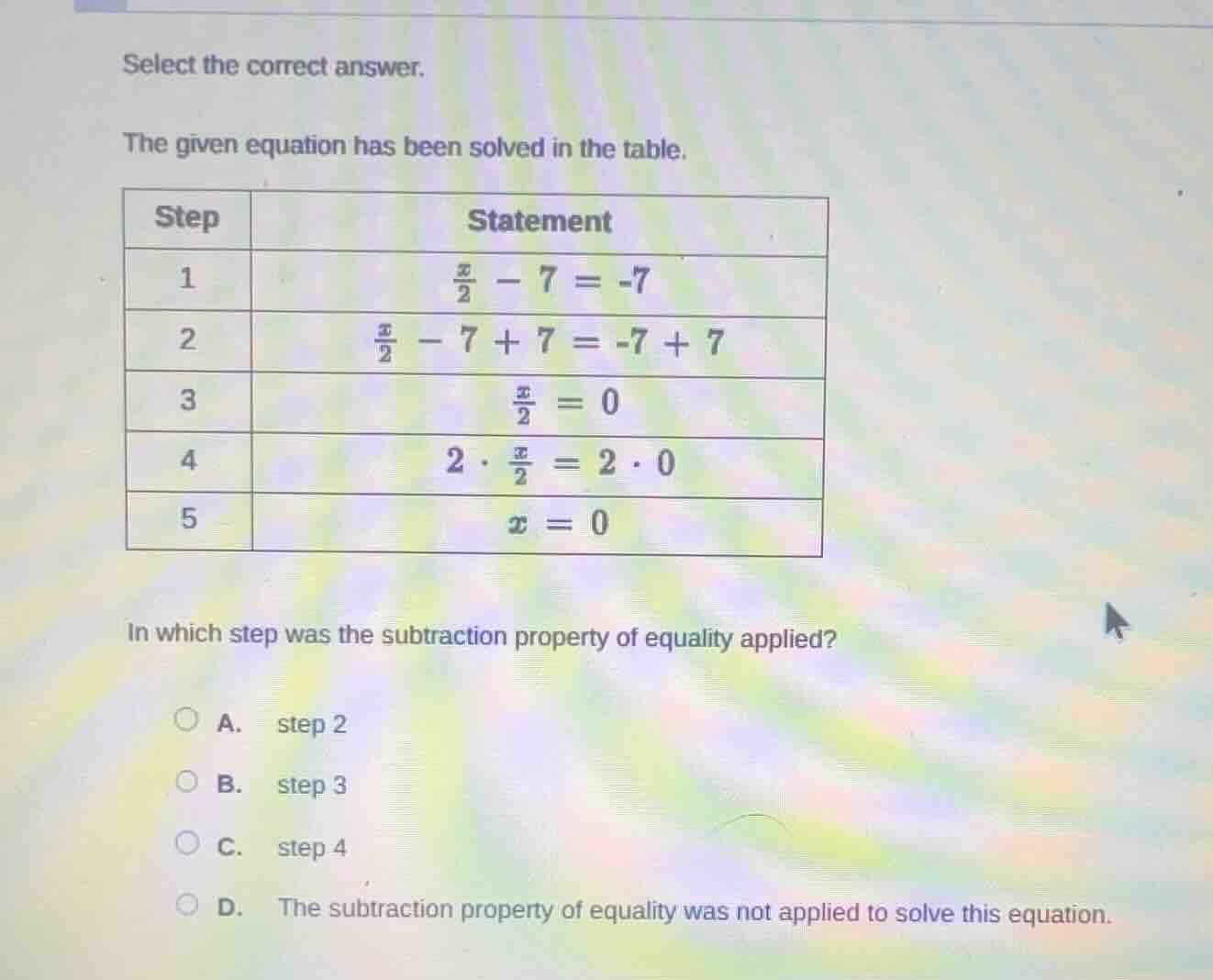
the given equation has been solved in the table.
| step | statement |
|---|---|
| 2 | \\(\frac{x}{2} - 7 + 7 = -7 + 7\\) |
| 3 | \\(\frac{x}{2} = 0\\) |
| 4 | \\(2 \cdot \frac{x}{2} = 2 \cdot 0\\) |
| 5 | \\(x = 0\\) |
in which step was the subtraction property of equality applied?
a. step 2
b. step 3
c. step 4
d. the subtraction property of equality was not applied to solve this equation.
Step1: Recall the subtraction property of equality
The subtraction property of equality states that if \(a = b\), then \(a - c = b - c\) for any real number \(c\). Similarly, the addition property of equality is if \(a = b\), then \(a + c = b + c\).
Step2: Analyze each step
- Step 2: \(\frac{x}{2}-7 + 7=-7 + 7\) uses the addition property of equality (adding 7 to both sides).
- Step 3: Is the result of simplifying step 2, no property of equality is applied here (just arithmetic simplification).
- Step 4: \(2\cdot\frac{x}{2}=2\cdot0\) uses the multiplication property of equality (multiplying both sides by 2).
- Now, check if subtraction property is applied: In step 2, we add 7, step 4 we multiply by 2. There is no step where we subtract a number from both sides. So the subtraction property of equality was not applied.

Snap & solve any problem in the app
Get step-by-step solutions on Sovi AI
Photo-based solutions with guided steps
Explore more problems and detailed explanations
D. The subtraction property of equality was not applied to solve this equation.