QUESTION IMAGE
Question
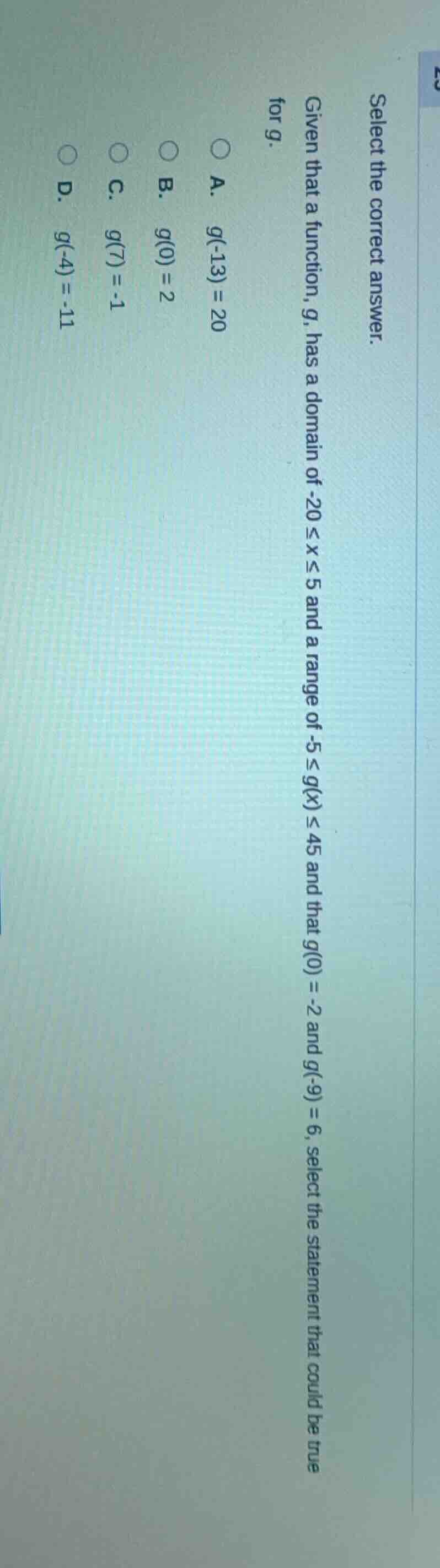
select the correct answer. given that a function, g, has a domain of -20 ≤ x ≤ 5 and a range of -5 ≤ g(x) ≤ 45 and that g(0) = -2 and g(-9) = 6, select the statement that could be true for g. a. g(-13) = 20 b. g(0) = 2 c. g(7) = -1 d. g(-4) = -11
Step1: Analyze Domain Restriction
The domain of function \( g \) is \( -20 \leq x \leq 5 \). So, \( x \)-values must lie within this interval.
- For option A: \( x = -13 \), check if \( -20 \leq -13 \leq 5 \). Yes, \( -13 \) is in the domain. But we also need to check the range. The range is \( -5 \leq g(x) \leq 45 \), and \( 20 \) is in the range. However, we need to check other options too.
- For option B: Given \( g(0) = -2 \) (from the problem statement), so \( g(0) = 2 \) is false.
- For option C: \( x = 7 \), check if \( -20 \leq 7 \leq 5 \). No, \( 7 > 5 \), so \( 7 \) is not in the domain. Thus, \( g(7) \) is undefined.
- For option D: \( x = -4 \), check if \( -20 \leq -4 \leq 5 \). Yes, \( -4 \) is in the domain. The range is \( -5 \leq g(x) \leq 45 \), and \( -11 < -5 \), so \( g(-4) = -11 \) is outside the range.
Step2: Analyze Range and Domain for Each Option
- Option A: \( x = -13 \) (in domain), \( g(-13) = 20 \) (20 is in range \( -5 \leq 20 \leq 45 \)). But wait, the problem states \( g(0) = -2 \) and \( g(-9) = 6 \), but there's no contradiction here in terms of domain and range. Wait, no—wait, the problem says "select the statement that could be true". Wait, but let's re - check option D: \( g(-4)=-11 \), but the range is \( -5 \leq g(x) \leq 45 \), so \( -11 \) is less than \( -5 \), so it's out of range. Option C: \( x = 7 \) is out of domain. Option B: \( g(0) \) is given as \( -2 \), so \( g(0)=2 \) is false. Option A: \( x=-13 \) is in domain (\( -20 \leq -13 \leq 5 \)), and \( 20 \) is in range (\( -5 \leq 20 \leq 45 \)). Wait, but wait, maybe I made a mistake. Wait, the problem says "select the statement that could be true". Wait, but let's check again:
Wait, the domain is \( -20 \leq x \leq 5 \), so:
- Option A: \( x = -13 \) (valid domain), \( g(-13)=20 \) (20 is in range \( -5 \leq 20 \leq 45 \))—possible.
- Option B: \( g(0) \) is given as \( -2 \), so \( g(0)=2 \) is false.
- Option C: \( x = 7 \) is outside domain (\( 7>5 \)), so invalid.
- Option D: \( g(-4)=-11 \), but \( -11 < -5 \), outside range, so invalid.
Wait, but wait, the problem says "select the correct answer". Wait, maybe I misread the range. The range is \( -5 \leq g(x) \leq 45 \). So for option D, \( -11 \) is less than \( -5 \), so it's out of range. Option A: \( 20 \) is in range. But wait, the problem states \( g(0) = -2 \) and \( g(-9)=6 \), but there's no information that contradicts \( g(-13)=20 \) in terms of domain and range. But wait, let's check the domain again for option A: \( -20 \leq -13 \leq 5 \), yes. Range: \( -5 \leq 20 \leq 45 \), yes. Option D: \( x=-4 \) is in domain, but \( -11 \) is out of range. Option C: \( x = 7 \) out of domain. Option B: \( g(0) \) is given as \( -2 \), so \( g(0)=2 \) is false. So the only option with \( x \) in domain and \( g(x) \) in range is Option A? Wait, no—wait, the problem says "select the statement that could be true". Wait, maybe I made a mistake. Wait, the range is \( -5 \leq g(x) \leq 45 \). So \( g(-4)=-11 \) is out of range. \( g(7) \): \( x = 7 \) out of domain. \( g(0)=2 \) is false (given \( g(0)=-2 \)). \( g(-13)=20 \): \( x=-13 \) in domain, \( 20 \) in range. So Option A could be true.
Wait, but wait, the original problem says "Given that a function, \( g \), has a domain of \( -20 \leq x \leq 5 \) and a range of \( -5 \leq g(x) \leq 45 \) and that \( g(0)=-2 \) and \( g(-9)=6 \), select the statement that could be true for \( g \)."
So:
- Option A: \( x=-13 \) (in domain), \( g(-13)=20 \) (20 is in range). This is possible.
- Option B: \( g(0)=2 \), but…

Snap & solve any problem in the app
Get step-by-step solutions on Sovi AI
Photo-based solutions with guided steps
Explore more problems and detailed explanations
A. \( g(-13) = 20 \)