QUESTION IMAGE
Question
select the correct answer.
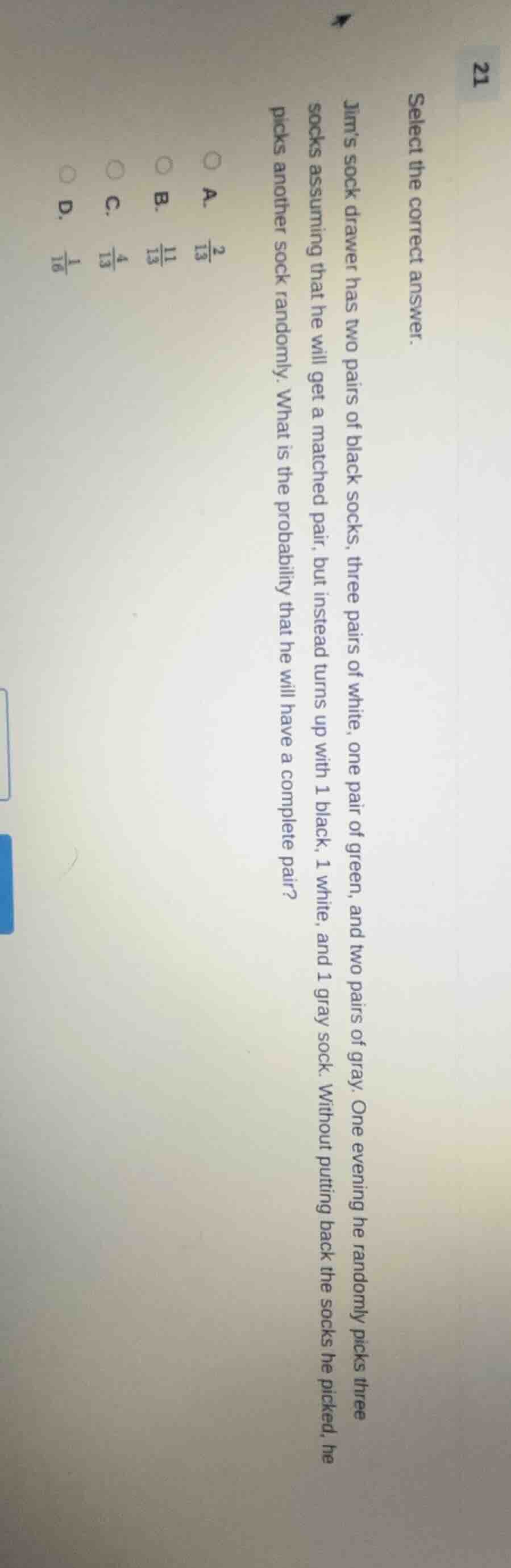
jims sock drawer has two pairs of black socks, three pairs of white, one pair of green, and two pairs of gray. one evening he randomly picks three socks assuming that he will get a matched pair, but instead turns up with 1 black, 1 white, and 1 gray sock. without putting back the socks he picked, he picks another sock randomly. what is the probability that he will have a complete pair?
a. $\frac{2}{13}$
b. $\frac{11}{13}$
c. $\frac{4}{13}$
d. $\frac{1}{16}$
Step1: Calculate total number of socks initially
A pair has 2 socks. So:
- Black: \(2\times2 = 4\)
- White: \(3\times2 = 6\)
- Green: \(1\times2 = 2\)
- Gray: \(2\times2 = 4\)
Total initial socks: \(4 + 6 + 2 + 4 = 16\). After picking 3, remaining socks: \(16 - 3 = 13\).
Step2: Determine socks needed for a pair
He has 1 black, 1 white, 1 gray. To form a pair, he needs one more of black, white, or gray.
- Remaining black: \(4 - 1 = 3\)
- Remaining white: \(6 - 1 = 5\)
- Remaining gray: \(4 - 1 = 3\)
- Green: \(2\) (no green picked yet, but we need to match black, white, or gray)
Wait, correction: Wait, he picked 1 black, 1 white, 1 gray. So to form a pair, he needs either another black, another white, or another gray.
Number of socks that can form a pair: Remaining black (4 - 1 = 3) + Remaining white (6 - 1 = 5) + Remaining gray (4 - 1 = 3) = \(3 + 5 + 3 = 11\)? Wait no, wait total remaining socks after picking 3 is 13. Wait, initial total socks: 2 pairs black (4), 3 pairs white (6), 1 pair green (2), 2 pairs gray (4). Total: 4 + 6 + 2 + 4 = 16. After picking 3 (1 black, 1 white, 1 gray), remaining socks: 16 - 3 = 13. Now, the socks that can form a pair with the picked ones: for black, there are 4 - 1 = 3 left; for white, 6 - 1 = 5 left; for gray, 4 - 1 = 3 left. So total favorable socks: 3 + 5 + 3 = 11? Wait but the options include 11/13 (option B). Wait, let's recheck.
Wait, the problem says: "he randomly picks three socks assuming that he will get a matched pair, but instead turns up with 1 black, 1 white, and 1 gray sock. Without putting back the socks he picked, he picks another sock randomly. What is the probability that he will have a complete pair?"
So after picking 1 black, 1 white, 1 gray, the remaining socks are 16 - 3 = 13. Now, to form a pair, he needs either a black (to pair with the black), white (to pair with white), or gray (to pair with gray). The number of black socks left: 4 - 1 = 3. White left: 6 - 1 = 5. Gray left: 4 - 1 = 3. Green left: 2 (but green can't pair with black, white, or gray). So total favorable socks: 3 (black) + 5 (white) + 3 (gray) = 11. So probability is 11/13? Wait but option B is 11/13. Wait but let's check again.
Wait, initial black socks: 4 (2 pairs). After picking 1, 3 left. White: 6 (3 pairs), after picking 1, 5 left. Gray: 4 (2 pairs), after picking 1, 3 left. Green: 2 (no green picked). So remaining socks: 3 (black) + 5 (white) + 2 (green) + 3 (gray) = 13. The favorable socks (to form a pair with the picked black, white, or gray) are 3 + 5 + 3 = 11. So probability is 11/13. So option B.
Wait, but let's re-express:
Total remaining socks: 16 - 3 = 13.
Number of socks that can form a pair with the existing 1 black, 1 white, 1 gray:
- Black: 4 - 1 = 3 (so picking any of these 3 will pair with the black)
- White: 6 - 1 = 5 (picking any of these 5 will pair with the white)
- Gray: 4 - 1 = 3 (picking any of these 3 will pair with the gray)
Total favorable: 3 + 5 + 3 = 11.
Thus, probability is 11/13.

Snap & solve any problem in the app
Get step-by-step solutions on Sovi AI
Photo-based solutions with guided steps
Explore more problems and detailed explanations
B. \(\frac{11}{13}\)