QUESTION IMAGE
Question
select the correct answer.
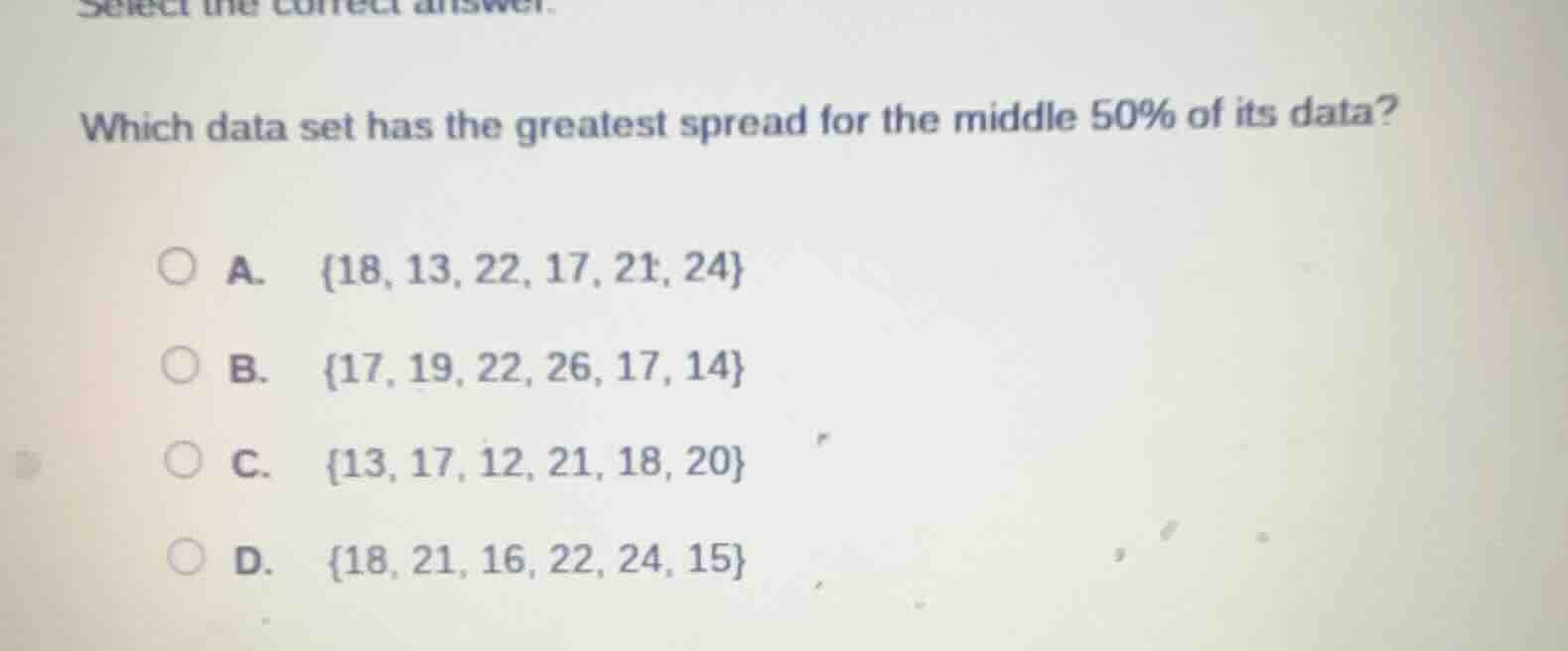
which data set has the greatest spread for the middle 50% of its data?
a. {18, 13, 22, 17, 21, 24}
b. {17, 19, 22, 26, 17, 14}
c. {13, 17, 12, 21, 18, 20}
d. {18, 21, 16, 22, 24, 15}
Step1: Recall IQR formula
The spread of the middle 50% of data is the interquartile range (IQR), calculated as \( \text{IQR} = Q_3 - Q_1 \), where \( Q_1 \) is the first quartile and \( Q_3 \) is the third quartile. For a data set with \( n = 6 \) (even number of observations), we first order the data, then find \( Q_1 \) (median of the lower half) and \( Q_3 \) (median of the upper half).
Step2: Process Option A
Data set A: \( \{13, 17, 18, 21, 22, 24\} \) (ordered).
Lower half: \( \{13, 17, 18\} \), median \( Q_1 = 17 \).
Upper half: \( \{21, 22, 24\} \), median \( Q_3 = 22 \).
\( \text{IQR}_A = 22 - 17 = 5 \).
Step3: Process Option B
Data set B: \( \{14, 17, 17, 19, 22, 26\} \) (ordered).
Lower half: \( \{14, 17, 17\} \), median \( Q_1 = 17 \).
Upper half: \( \{19, 22, 26\} \), median \( Q_3 = 22 \).
\( \text{IQR}_B = 22 - 17 = 5 \).
Step4: Process Option C
Data set C: \( \{12, 13, 17, 18, 20, 21\} \) (ordered).
Lower half: \( \{12, 13, 17\} \), median \( Q_1 = 13 \).
Upper half: \( \{18, 20, 21\} \), median \( Q_3 = 20 \).
\( \text{IQR}_C = 20 - 13 = 7 \). Wait, correction: Wait, lower half for \( n=6 \): positions 1 - 3 (12,13,17), median \( Q_1 = 13 \)? No, median of 3 numbers is the 2nd term? Wait, no: for lower half (first 3 numbers: 12,13,17), the median is the middle number, which is 13? Wait, no, 3 numbers: median is the 2nd term? Wait, no, median of \( \{a,b,c\} \) is \( b \). So \( Q_1 = 13 \)? Wait, no, wait ordered data: 12,13,17,18,20,21. Lower half: first 3: 12,13,17. Median of lower half: 13. Upper half: last 3: 18,20,21. Median of upper half: 20. So \( \text{IQR}_C = 20 - 13 = 7 \)? Wait, no, wait, let's re - check. Wait, no, for \( n = 6 \), the lower half is the first 3 values, upper half is the last 3. So for C: ordered [12,13,17,18,20,21]. \( Q_1 \): median of [12,13,17] is 13. \( Q_3 \): median of [18,20,21] is 20. So IQR = 20 - 13 = 7? Wait, but let's check again. Wait, maybe I made a mistake. Wait, let's re - order all data sets properly.
Wait, re - processing Option C:
Original data: \( \{13, 17, 12, 21, 18, 20\} \) → ordered: \( 12, 13, 17, 18, 20, 21 \). Correct. Lower half: first 3: 12,13,17. Median (Q1) is 13. Upper half: last 3: 18,20,21. Median (Q3) is 20. So IQR = 20 - 13 = 7.
Wait, but let's check Option D:
Data set D: \( \{15, 16, 18, 21, 22, 24\} \) (ordered).
Lower half: \( \{15, 16, 18\} \), median \( Q_1 = 16 \).
Upper half: \( \{21, 22, 24\} \), median \( Q_3 = 22 \).
\( \text{IQR}_D = 22 - 16 = 6 \).
Wait, earlier calculation for Option C: Wait, no, wait, in Option C, the ordered data is 12,13,17,18,20,21. The lower half is the first three numbers: 12,13,17. The median of these three is the second number, 13 (since for three numbers, the median is the middle one: position (3 + 1)/2 = 2nd term). The upper half is the last three numbers: 18,20,21. Median is 20 (second term of these three). So IQR = 20 - 13 = 7.
Option A: ordered [13,17,18,21,22,24]. Lower half: 13,17,18. Median Q1 = 17. Upper half: 21,22,24. Median Q3 = 22. IQR = 5.
Option B: ordered [14,17,17,19,22,26]. Lower half:14,17,17. Median Q1 = 17. Upper half:19,22,26. Median Q3 = 22. IQR = 5.
Option D: ordered [15,16,18,21,22,24]. Lower half:15,16,18. Median Q1 = 16. Upper half:21,22,24. Median Q3 = 22. IQR = 6.
So Option C has IQR = 7, which is the largest. Wait, but let's re - check Option C again. Wait, the original data for C is {13,17,12,21,18,20}. Ordered: 12,13,17,18,20,21. Correct. Lower half: 12,13,17. Q1 is the median of lower half: (13 + 17)/2? Wait, no! Wait, when n is even in the half - set? Wait, no…

Snap & solve any problem in the app
Get step-by-step solutions on Sovi AI
Photo-based solutions with guided steps
Explore more problems and detailed explanations
C. \( \{13, 17, 12, 21, 18, 20\} \)