QUESTION IMAGE
Question
select the correct text in the passage.
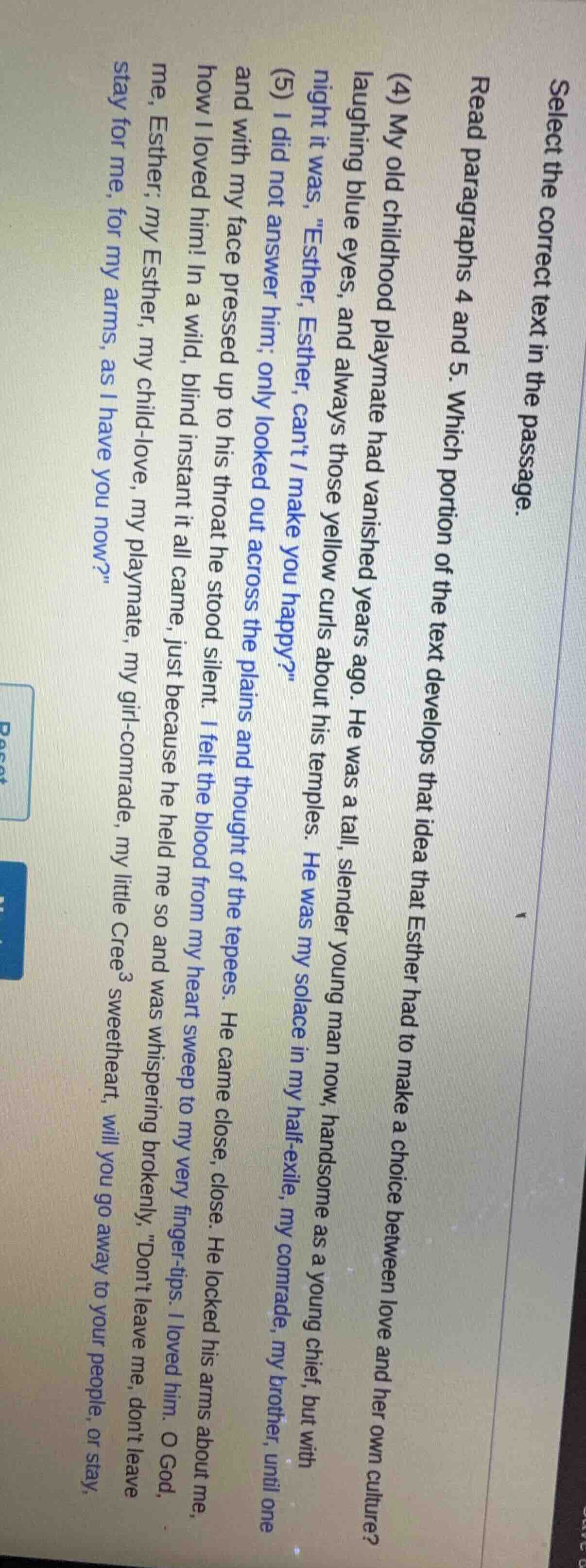
read paragraphs 4 and 5. which portion of the text develops that idea that esther had to make a choice between love and her own culture?
(4) my old childhood playmate had vanished years ago. he was a tall, slender young man now, handsome as a young chief, but with laughing blue eyes, and always those yellow curls about his temples. he was my solace in my half - exile, my comrade, my brother, until one night it was, \esther, esther, cant i make you happy?\
(5) i did not answer him; only looked out across the plains and thought of the tepees. he came close, close. he locked his arms about me, and with my face pressed up to his throat he stood silent. i felt the blood from my heart sweep to my very finger - tips. i loved him. o god, how i loved him! in a wild, blind instant it all came, just because he held me so and was whispering brokenly, \dont leave me, dont leave me, esther; my esther, my child - love, my playmate, my girl - comrade, my little cree sweetheart, will you go away to your people, or stay for me, for my arms, as i have you now?\
To solve this, we analyze the text:
Paragraph 4:
Describes Esther’s childhood playmate (now a young man) and his role as her “solace,” “comrade,” “brother” – setting up a relationship.
Paragraph 5:
Shows the emotional conflict: the man’s closeness, Esther’s love, and the question “will you go away to your people, or stay for me” – directly presenting her choice between her love (and his people? Or staying with him) and her own cultural ties (implied by “your people” vs. staying with him, her “Cree sweetheart”).
The portion developing Esther’s choice is Paragraph 5 (the text from “I did not answer him; only looked out across the plains...” to “will you go away to your people, or stay for me, for my arms, as I have you now?”), as it contains the direct conflict and the choice - related question.

Snap & solve any problem in the app
Get step-by-step solutions on Sovi AI
Photo-based solutions with guided steps
Explore more problems and detailed explanations
The portion of the text (Paragraph 5: "I did not answer him; only looked out across the plains and with my face pressed up to his throat he stood silent. I felt the blood from my heart sweep to my very finger - tips. I loved him. O God, me, Esther; my Esther, my child - love, my playmate, my girl - comrade, my little Cree sweetheart, will you go away to your people, or stay for me, for my arms, as I have you now?") develops the idea that Esther had to make a choice between love and her own culture.