QUESTION IMAGE
Question
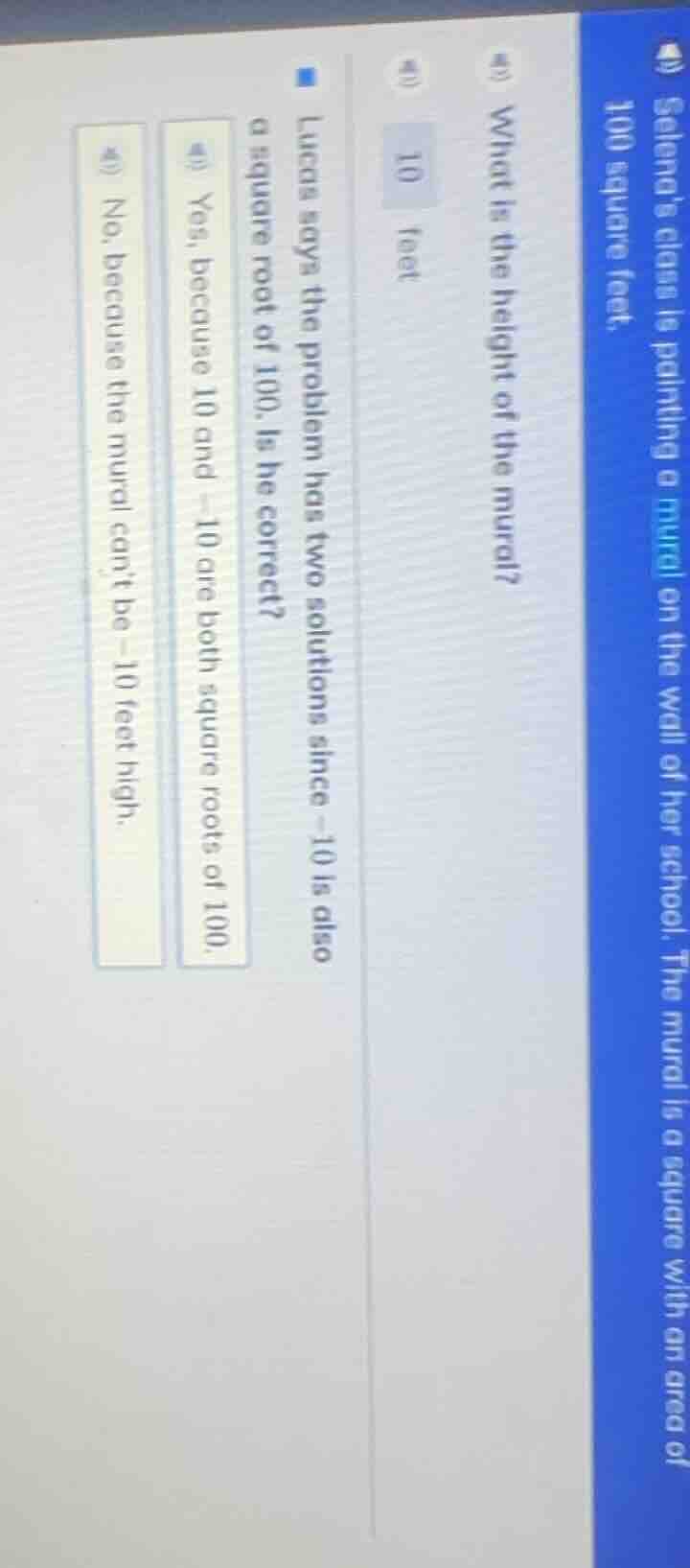
selena’s class is painting a mural on the wall of her school. the mural is a square with an area of 100 square feet.
a) what is the height of the mural?
10 feet
b) lucas says the problem has two solutions since -10 is also a square root of 100. is he correct?
yes, because 10 and -10 are both square roots of 100.
no, because the mural can’t be -10 feet high.
For the first sub - question (What is the height of the mural?):
Step1: Recall the formula for the area of a square
The area \(A\) of a square is given by the formula \(A = s^{2}\), where \(s\) is the side length (in this case, the height of the mural since it's a square - shaped mural).
We know that the area \(A = 100\) square feet. So we have the equation \(s^{2}=100\).
Step2: Solve for \(s\)
To find \(s\), we take the square root of both sides of the equation \(s^{2}=100\). The square root of a number \(x\) is a value \(y\) such that \(y^{2}=x\). For \(x = 100\), we know that \(10^{2}=100\) and \((- 10)^{2}=100\). But since the height of a mural (a length) cannot be negative, we take the positive square root. So \(s=\sqrt{100}=10\) feet.
Mathematically, the square root of a positive number \(a\) (where \(a>0\)) has two solutions: \(\sqrt{a}\) and \(-\sqrt{a}\) because \((\sqrt{a})^{2}=a\) and \((-\sqrt{a})^{2}=a\). For \(a = 100\), \(\sqrt{100}=10\) and \(-\sqrt{100}=- 10\), so 10 and - 10 are both square roots of 100. However, in the context of the height of a mural, height is a physical quantity that represents a length, and lengths cannot be negative. So even though - 10 is a square root of 100, it is not a valid solution for the height of the mural. So Lucas is not correct because the mural's height can't be - 10 feet (a negative length doesn't make sense in this context), even though - 10 is a square root of 100 mathematically.

Snap & solve any problem in the app
Get step-by-step solutions on Sovi AI
Photo-based solutions with guided steps
Explore more problems and detailed explanations
The height of the mural is 10 feet.