QUESTION IMAGE
Question
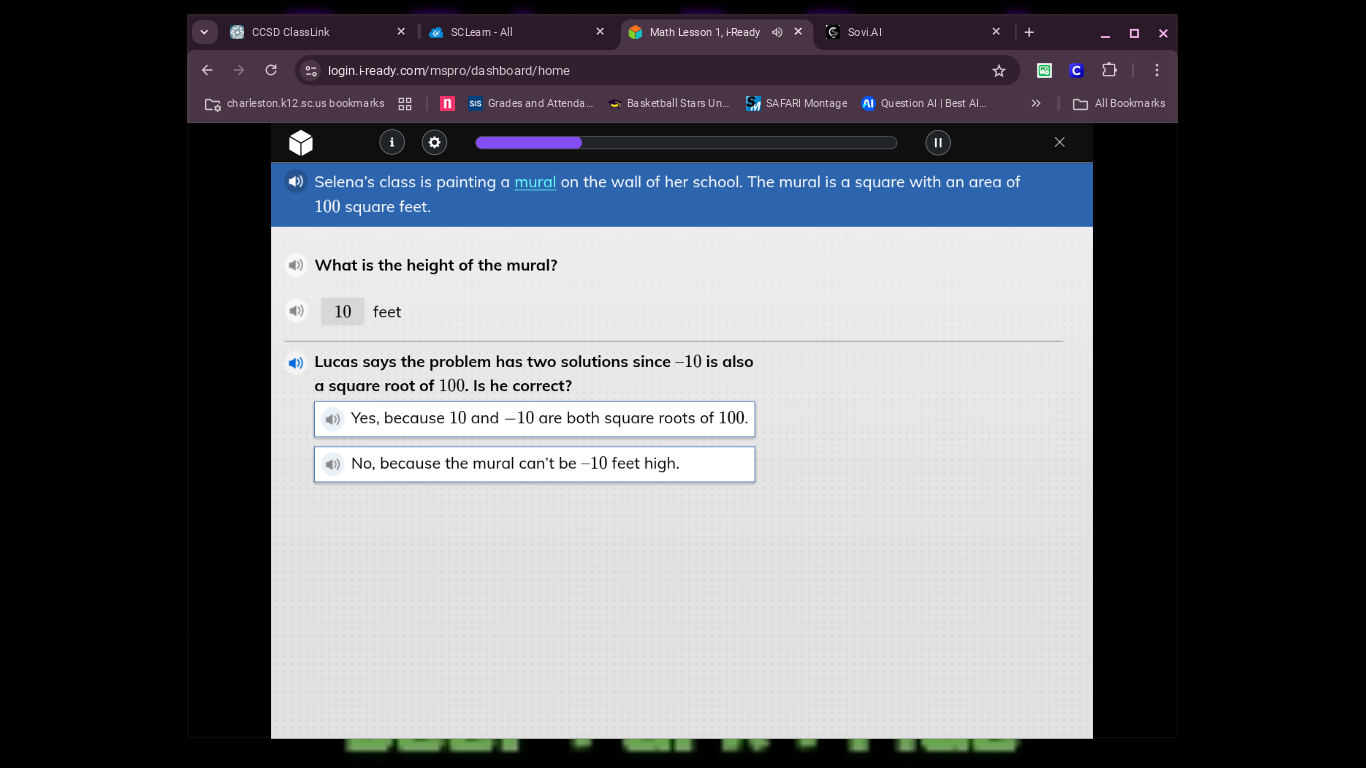
selenas class is painting a mural on the wall of her school. the mural is a square with an area of 100 square feet. what is the height of the mural? 10 feet lucas says the problem has two solutions since -10 is also a square root of 100. is he correct? yes, because 10 and -10 are both square roots of 100. no, because the mural cant be -10 feet high.
For the first sub - question (height of the mural):
Step1: Recall the area formula for a square
The area \(A\) of a square is given by the formula \(A = s^2\), where \(s\) is the side length (and since it's a square, the height is equal to the side length). We know that \(A = 100\) square feet.
Step2: Solve for the side length (height)
We need to find \(s\) such that \(s^2=100\). Taking the square root of both sides, we get \(s=\sqrt{100}\). Since the length (height) of a mural cannot be negative in this context, we take the positive square root. \(\sqrt{100} = 10\).
While it is true that both \(10\) and \(- 10\) are square roots of \(100\) (because \(10^2 = 100\) and \((- 10)^2=100\)), in the context of the height of a mural, we are dealing with a physical length. Lengths cannot be negative, so the height of the mural must be \(10\) feet (the positive square root). So Lucas is not correct because the height of the mural, being a physical quantity, cannot be negative.

Snap & solve any problem in the app
Get step-by-step solutions on Sovi AI
Photo-based solutions with guided steps
Explore more problems and detailed explanations
10 feet