QUESTION IMAGE
Question
self-assessment
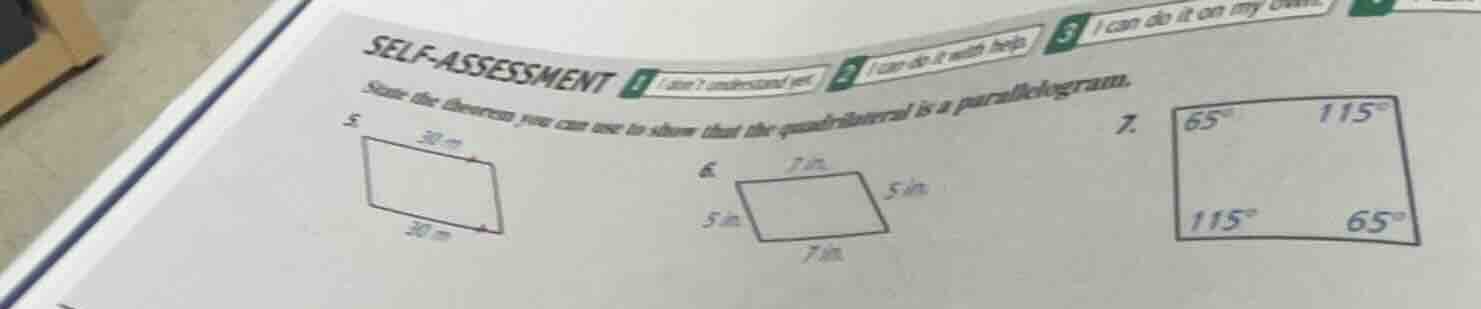
state the theorem you can use to show that the quadrilateral is a parallelogram.
5
diagram of a quadrilateral with two sides labeled 30 m
6.
diagram of a quadrilateral with sides labeled 7 in and 5 in
7.
diagram of a quadrilateral with angles labeled 65°, 115°, 115°, 65°
To determine the theorem to show each quadrilateral is a parallelogram, we analyze each:
Problem 5 (Quadrilateral with two sides of 30 m)
A parallelogram has both pairs of opposite sides congruent (equal in length). Here, the quadrilateral has two opposite sides labeled \( 30 \, \text{m} \) (assuming the other two opposite sides are also congruent, though visually implied).
Theorem:
If both pairs of opposite sides of a quadrilateral are congruent, then the quadrilateral is a parallelogram.
Problem 6 (Quadrilateral with sides \( 7 \, \text{in}, 5 \, \text{in}, 7 \, \text{in}, 5 \, \text{in} \))
The side lengths are \( 7 \, \text{in}, 5 \, \text{in}, 7 \, \text{in}, 5 \, \text{in} \), so both pairs of opposite sides are congruent ( \( 7 = 7 \) and \( 5 = 5 \) ).
Theorem:
If both pairs of opposite sides of a quadrilateral are congruent, then the quadrilateral is a parallelogram.
Problem 7 (Quadrilateral with angles \( 65^\circ, 115^\circ, 115^\circ, 65^\circ \))
A parallelogram has both pairs of opposite angles congruent and consecutive angles supplementary (sum to \( 180^\circ \)). Here:
- Opposite angles: \( 65^\circ = 65^\circ \) and \( 115^\circ = 115^\circ \).
- Consecutive angles: \( 65^\circ + 115^\circ = 180^\circ \) (supplementary).
Theorem:
If both pairs of opposite angles of a quadrilateral are congruent, or if consecutive angles are supplementary, then the quadrilateral is a parallelogram. (Either theorem applies here.)
Final Answers:
- Problem 5: Use the theorem: If both pairs of opposite sides are congruent, the quadrilateral is a parallelogram.
- Problem 6: Use the theorem: If both pairs of opposite sides are congruent, the quadrilateral is a parallelogram.
- Problem 7: Use the theorem: If both pairs of opposite angles are congruent (or consecutive angles are supplementary), the quadrilateral is a parallelogram.

Snap & solve any problem in the app
Get step-by-step solutions on Sovi AI
Photo-based solutions with guided steps
Explore more problems and detailed explanations
A parallelogram has both pairs of opposite angles congruent and consecutive angles supplementary (sum to \( 180^\circ \)). Here:
- Opposite angles: \( 65^\circ = 65^\circ \) and \( 115^\circ = 115^\circ \).
- Consecutive angles: \( 65^\circ + 115^\circ = 180^\circ \) (supplementary).
Theorem:
If both pairs of opposite angles of a quadrilateral are congruent, or if consecutive angles are supplementary, then the quadrilateral is a parallelogram. (Either theorem applies here.)
Final Answers:
- Problem 5: Use the theorem: If both pairs of opposite sides are congruent, the quadrilateral is a parallelogram.
- Problem 6: Use the theorem: If both pairs of opposite sides are congruent, the quadrilateral is a parallelogram.
- Problem 7: Use the theorem: If both pairs of opposite angles are congruent (or consecutive angles are supplementary), the quadrilateral is a parallelogram.