QUESTION IMAGE
Question
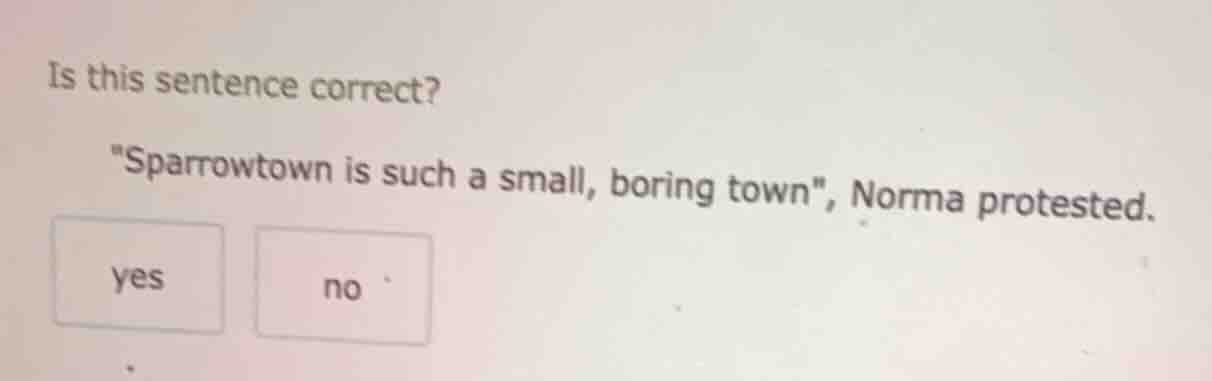
is this sentence correct? \sparrowtown is such a small, boring town\, norma protested. yes no
When using a direct quote followed by a speaker attribution, the punctuation inside the quote and the comma after the quote (before the speaker) need to be checked. The quote here has proper punctuation (the comma inside for the adjectives "small" and "boring") and the comma after the quote before "Norma protested" is correct. However, wait—actually, the quote is a declarative sentence, and when the attribution comes after, the comma inside the quote? Wait, no, the quote is "Sparrowtown is such a small, boring town", and then the attribution. Wait, the error is in the punctuation: the comma after the quote should be a period? No, no—wait, the quote is a complete sentence, so when the speaker is after, the quote should end with a period, and then a comma? Wait, no. Let's recall: When the speaker tag comes after the quote, the quote ends with a period (or other appropriate end punctuation), and then a comma before the speaker tag? No, no—if the quote is a complete sentence, and the speaker tag is "Norma protested", then the quote should end with a period, and then a comma? Wait, no, the correct format is: "Sparrowtown is such a small, boring town," Norma protested. Wait, the original has a comma inside the quote? No, the adjectives "small" and "boring" are separated by a comma, which is correct (compound adjective? No, they are coordinate adjectives, so comma is correct). But the quote ends with a comma? Wait, no—the quote is a declarative sentence, so it should end with a period. Wait, the original sentence is: "Sparrowtown is such a small, boring town", Norma protested. So the quote is in quotes, ends with a comma, then the speaker. But actually, when the speaker tag follows the quote, the quote should end with a comma (if it's a non - declarative or if it's part of the flow), but wait, the quote here is a declarative statement. Wait, no, the error is that the comma after the quote (before "Norma protested") should be a period? No, no—let's check grammar rules. When you have a direct quote followed by a speaker attribution, if the quote is a complete sentence, the quote ends with a period, and then a comma before the speaker? No, that's not right. Wait, no: the correct punctuation is that if the speaker tag comes after the quote, the quote ends with a comma (if it's a continuation) or a period. Wait, no, let's take an example: "I love this town," she said. Here, the quote is a complete sentence? No, "I love this town" is a complete sentence, and it ends with a comma? No, that's wrong. Wait, no, "I love this town," she said. Wait, no, the correct is "I love this town," she said. Wait, no, the period should be inside? No, no—when the speaker tag is after, the period goes inside the quote, and then a comma? No, I'm getting confused. Wait, the original sentence: "Sparrowtown is such a small, boring town", Norma protested. The problem is that the comma after the quote (outside the quotes) is incorrect. Wait, no, the quotes: the quote is "Sparrowtown is such a small, boring town", and then the attribution. But the quote is a complete sentence, so it should end with a period, and then a comma before the speaker? No, that's not. Wait, no, the correct way is: "Sparrowtown is such a small, boring town," Norma protested. So the comma is inside the quotes, not outside. In the given sentence, the comma is outside the quotes (after the closing quote), which is incorrect. So the sentence is incorrect.

Snap & solve any problem in the app
Get step-by-step solutions on Sovi AI
Photo-based solutions with guided steps
Explore more problems and detailed explanations
no