QUESTION IMAGE
Question
separated species
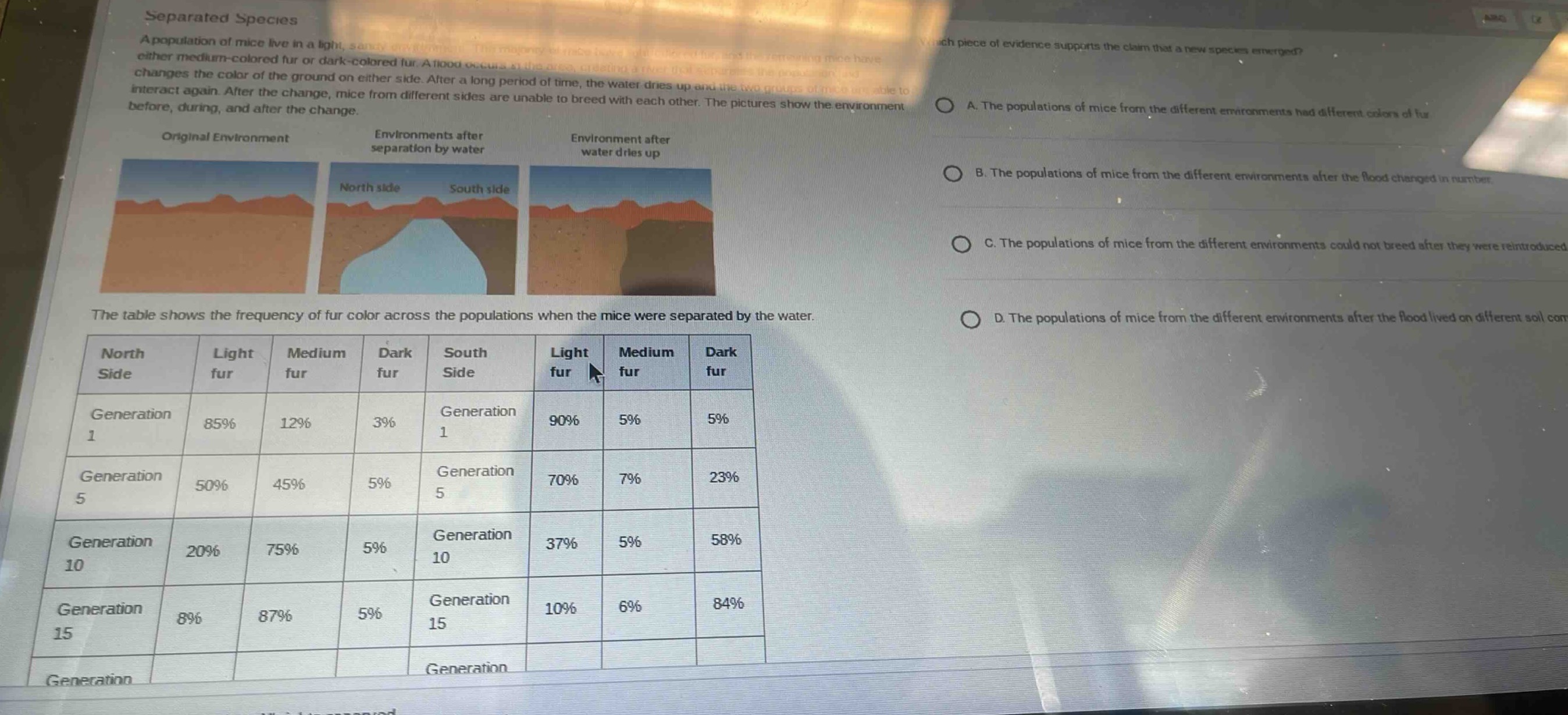
a population of mice live in a light, sandy environment. the majority of mice have light-colored fur, but the remaining mice have either medium - colored fur or dark - colored fur. a flood occurs in the area, creating a river that separates the population and changes the color of the ground on either side. after a long period of time, the water dries up and the two groups of mice are able to interact again. after the change, mice from different sides are unable to breed with each other. the pictures show the environment before, during, and after the change.
original environment environments after separation by water environment after water dries up
images of environments: original is light sandy, after separation north side is light sandy, south side is dark, after water dries up north is light sandy, south is dark
the table shows the frequency of fur color across the populations when the mice were separated by the water.
table with north side (light fur, medium fur, dark fur) and south side (light fur, medium fur, dark fur) across generations 1, 5, 10, 15. north side generation 1: 85%, 12%, 3%; generation 5: 50%, 45%, 5%; generation 10: 20%, 75%, 5%; generation 15: 8%, 87%, 5%. south side generation 1: 90%, 5%, 5%; generation 5: 70%, 7%, 23%; generation 10: 37%, 5%, 58%; generation 15: 10%, 6%, 84%.
which piece of evidence supports the claim that a new species emerged?
a. the populations of mice from the different environments had different colors of fur
b. the populations of mice from the different environments after the flood changed in number.
c. the populations of mice from the different environments could not breed after they were reintroduced.
d. the populations of mice from the different environments after the flood lived on different soil com
A key biological definition of distinct species is the inability of groups to interbreed and produce viable offspring. The other options (fur color differences, population number changes, different soil environments) represent adaptation or environmental differences, but only the failure to breed confirms reproductive isolation, the core marker of a new species emerging.

Snap & solve any problem in the app
Get step-by-step solutions on Sovi AI
Photo-based solutions with guided steps
Explore more problems and detailed explanations
C. The populations of mice from the different environments could not breed after they were reintroduced