QUESTION IMAGE
Question
seq set 2 directions (question 30): read and analyze the following documents before writing your essay in the separate essay booklet.
document 1
president franklin pierce appointed james guthrie as secretary of the treasury in 1853. guthrie was responsible for presenting detailed annual reports to congress about the nation’s economy.
boxed text: as soon as the great lakes were reached, the line of navigable water was extended through them nearly one thousand miles farther into the interior. the western states immediately commenced the construction of canals of their own, with this continuous water communication, from the mouth of the mississippi, with a view of connecting with these works their different points from the erie canal, which in this manner became the outlet almost the whole part of the west.
all these works took their direction from this canal has exerted to imagine its commerce, growth, and produce of the whole country, for it is impossible upon the what would have been the state of things without it.
but for this work the west would have had but few inducements incentives to the settler, who would have been without a market for his most essential wants and consequence the country would have supplied many of his have unsettled up to the that period, and, where now exist rich and populous communities, we should find an uncultivated wilderness.
the east would have been equally without the elements of growth. the canal has supplied it with cheap food, and has opened an outlet and created a market for the products of its manufactures and commerce....
source: james guthrie, secretary of the treasury, “the impact of the erie canal,” 1853
document 2
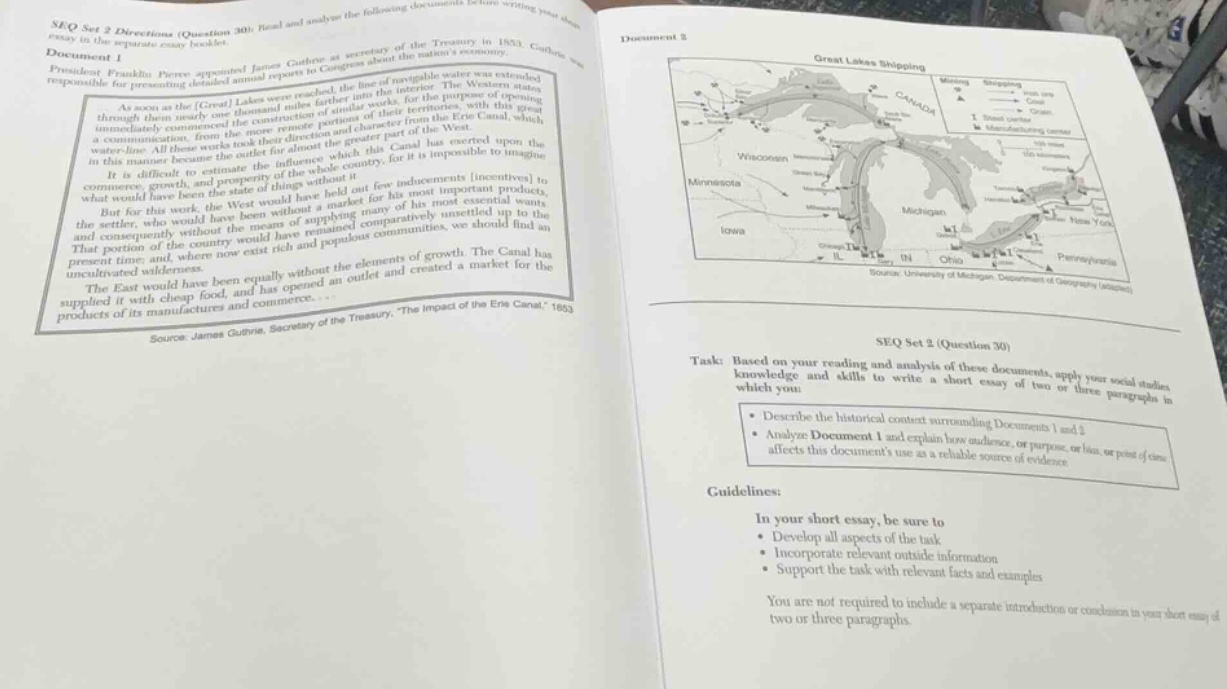
map: great lakes shipping, showing shipping routes, ports, etc. source: university of michigan, department of geography libraries
seq set 2 (question 30)
task: based on your reading and analysis of these documents, apply your social studies knowledge and skills to write a short essay of two or three paragraphs in which you:
- describe the historical context surrounding documents 1 and 2
- analyze document 1 and explain how audience, or purpose, or bias, or point of view affects this document’s use as a reliable source of evidence
guidelines:
in your short essay, be sure to
- develop all aspects of the task
- incorporate relevant outside information
- support the task with relevant facts and examples
you are not required to include a separate introduction or conclusion in your short essay of two or three paragraphs.
To address this, we analyze the historical context and source reliability:
Historical Context:
The documents relate to the Erie Canal (completed 1825) and Great Lakes shipping. The 1800s saw westward expansion, industrial growth, and transportation innovations (canals, later railroads) transforming U.S. commerce. Document 1 (1853) is a Treasury report, reflecting post - Erie Canal economic impacts: the canal connected the Great Lakes to the East, spurring Western settlement, trade (e.g., Western goods to East, Eastern manufactures to West), and urban growth (e.g., Buffalo, New York City). The map (Document 2) shows Great Lakes shipping routes, emphasizing regional trade networks.
Source Reliability (Document 1):
James Guthrie, as Secretary of the Treasury, wrote this to Congress (audience: legislators) to highlight the canal’s economic benefits (purpose: advocate for infrastructure or show economic progress). His position gives access to economic data, but bias exists—he may overstate benefits to justify government support for infrastructure. Outside info: The Erie Canal reduced transport costs, boosted New York’s economy, and shifted trade from rivers (e.g., Mississippi) to the Great Lakes/East Coast, accelerating industrialization and westward migration.

Snap & solve any problem in the app
Get step-by-step solutions on Sovi AI
Photo-based solutions with guided steps
Explore more problems and detailed explanations
To write the essay:
Paragraph 1: Historical Context
The mid - 19th century (1853, post - Erie Canal completion in 1825) was marked by U.S. westward expansion and industrial growth. The Erie Canal connected the Great Lakes to the Hudson River, creating a vital trade route. Western states (e.g., Michigan, Ohio) sent agricultural goods east, while Eastern cities (e.g., New York) supplied manufactures west. Great Lakes shipping (Document 2’s map) expanded this network, fueling urbanization (e.g., Chicago, Buffalo) and regional economies.
Paragraph 2: Document 1 Analysis
James Guthrie (Secretary of the Treasury, 1853) addressed Congress (audience) to emphasize the Erie Canal’s economic impact (purpose: demonstrate infrastructure’s value). His role provides authoritative economic insights, but bias may exist (overstating benefits to support government policy). For example, he claims the West “would have been without a market” without the canal—accurate, as the canal cut transport costs, but his position as a government official may exaggerate to justify funding. Outside evidence: The canal reduced freight costs by 90%, making Western farms profitable and boosting New York’s port as a national hub, confirming his claims’ core validity despite potential bias.