QUESTION IMAGE
Question
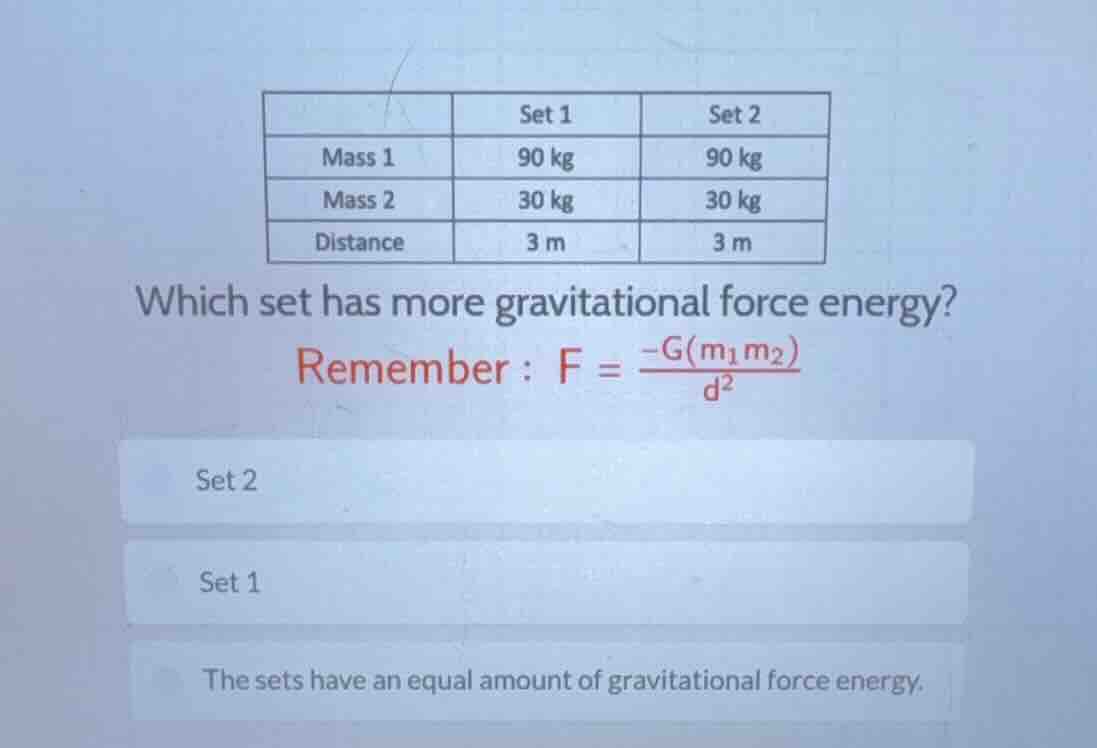
set 1\tset 2
mass 1\t90 kg\t90 kg
mass 2\t30 kg\t30 kg
distance\t3 m\t3 m
which set has more gravitational force energy?
remember : $f = \frac{-g(m_1m_2)}{d^2}$
set 2
set 1
the sets have an equal amount of gravitational force energy.
Step1: Analyze the formula for gravitational force
The formula for gravitational force is \( F = \frac{-G(m_1m_2)}{d^2} \). Here, \( G \) is the gravitational constant, \( m_1 \) and \( m_2 \) are the masses, and \( d \) is the distance between them. The negative sign indicates the nature of the force (attractive), but for comparing the magnitude of the force (or the "amount" of gravitational force energy, considering the magnitude), we can focus on the absolute value part \( \frac{G(m_1m_2)}{d^2} \).
Step2: Compare the values for Set 1 and Set 2
For Set 1: \( m_1 = 90\space kg \), \( m_2 = 30\space kg \), \( d = 3\space m \)
The magnitude of the force (ignoring the negative sign for comparison) is \( \frac{G(90\times30)}{3^2} \)
For Set 2: \( m_1 = 90\space kg \), \( m_2 = 30\space kg \), \( d = 3\space m \)
The magnitude of the force is \( \frac{G(90\times30)}{3^2} \)
Since both sets have the same values for \( m_1 \), \( m_2 \), and \( d \), the magnitude of the gravitational force (and thus the "gravitational force energy" considering the formula) will be the same for both sets.

Snap & solve any problem in the app
Get step-by-step solutions on Sovi AI
Photo-based solutions with guided steps
Explore more problems and detailed explanations
The sets have an equal amount of gravitational force energy.