QUESTION IMAGE
Question
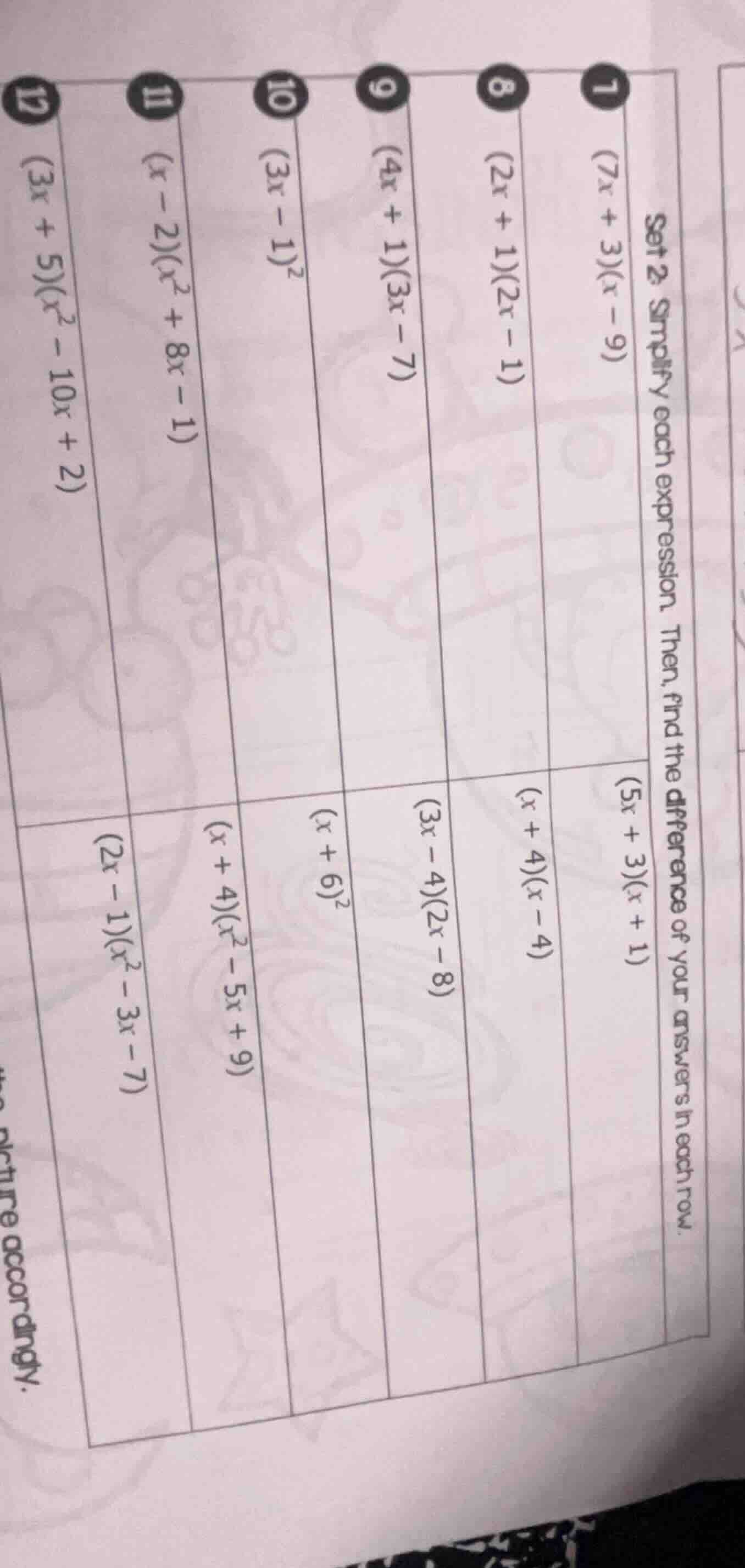
set 2: simplify each expression. then, find the difference of your answers in each row.
7 ((7x + 3)(x - 9)) ((5x + 3)(x + 1))
8 ((2x + 1)(2x - 1)) ((x + 4)(x - 4))
9 ((4x + 1)(3x - 7)) ((3x - 4)(2x - 8))
10 ((3x - 1)^2) ((x + 6)^2)
11 ((x - 2)(x^2 + 8x - 1)) ((x + 4)(x^2 - 5x + 9))
12 ((3x + 5)(x^2 - 10x + 2)) ((2x - 1)(x^2 - 3x - 7))
Let's solve these problems one by one. We'll start with row 7 (problem 7) and then do the corresponding bottom expression, then find the difference.
Problem 7 (Top: \((7x + 3)(x - 9)\); Bottom: \((5x + 3)(x + 1)\))
Step 1: Expand the top expression \((7x + 3)(x - 9)\)
Using the distributive property (FOIL method):
\[
\]
Step 2: Expand the bottom expression \((5x + 3)(x + 1)\)
Using the distributive property (FOIL method):
\[
\]
Step 3: Find the difference (Top - Bottom)
\[
\]
Problem 8 (Top: \((2x + 1)(2x - 1)\); Bottom: \((x + 4)(x - 4)\))
Step 1: Expand the top expression \((2x + 1)(2x - 1)\)
This is a difference of squares: \((a + b)(a - b) = a^2 - b^2\), where \(a = 2x\) and \(b = 1\):
\[
(2x + 1)(2x - 1) = (2x)^2 - 1^2 = 4x^2 - 1
\]
Step 2: Expand the bottom expression \((x + 4)(x - 4)\)
This is also a difference of squares: \((a + b)(a - b) = a^2 - b^2\), where \(a = x\) and \(b = 4\):
\[
(x + 4)(x - 4) = x^2 - 4^2 = x^2 - 16
\]
Step 3: Find the difference (Top - Bottom)
\[
\]
Problem 9 (Top: \((4x + 1)(3x - 7)\); Bottom: \((3x - 4)(2x - 8)\))
Step 1: Expand the top expression \((4x + 1)(3x - 7)\)
Using the distributive property:
\[
\]
Step 2: Expand the bottom expression \((3x - 4)(2x - 8)\)
Using the distributive property:
\[
\]
Step 3: Find the difference (Top - Bottom)
\[
\]
Problem 10 (Top: \((3x - 1)^2\); Bottom: \((x + 6)^2\))
Step 1: Expand the top expression \((3x - 1)^2\)
Using the formula \((a - b)^2 = a^2 - 2ab + b^2\), where \(a = 3x\) and \(b = 1\):
\[
(3x - 1)^2 = (3x)^2 - 2 \cdot 3x \cdot 1 + 1^2 = 9x^2 - 6x + 1
\]
Step 2: Expand the bottom expression \((x + 6)^2\)
Using the formula \((a + b)^2 = a^2 + 2ab + b^2\), where \(a = x\) and \(b = 6\):
\[
(x + 6)^2 = x^2 + 2 \cdot x \cdot 6 + 6^2 = x^2 + 12x + 36
\]
Step 3: Find the difference (Top - Bottom)
\[
\]
Problem 11 (Top: \((x - 2)(x^2 + 8x - 1)\); Bottom: \((x + 4)(x^2 - 5x + 9)\))
Step 1: Expand the top expression \((x - 2)(x^2 + 8x - 1)\)
Using the distributive property (multiply \(x\) and \(-2\) by each term in the quadratic):
\[
\begin{align*}
(x - 2)(x^2 + 8x - 1) &= x \cdot x^2 + x \cdot 8x + x \cdot (-1) - 2 \cdot x^2 - 2 \cdot 8x - 2 \cdot (-1) \\
&= x^3 + 8x^2 - x - 2x^2 - 16x + 2 \\
&= x^3 + (8x^2 - 2x^2) + (-x - 16x) + 2 \\
&= x^3 + 6x^2 - 17x + 2…

Snap & solve any problem in the app
Get step-by-step solutions on Sovi AI
Photo-based solutions with guided steps
Explore more problems and detailed explanations
Let's solve these problems one by one. We'll start with row 7 (problem 7) and then do the corresponding bottom expression, then find the difference.
Problem 7 (Top: \((7x + 3)(x - 9)\); Bottom: \((5x + 3)(x + 1)\))
Step 1: Expand the top expression \((7x + 3)(x - 9)\)
Using the distributive property (FOIL method):
\[
\]
Step 2: Expand the bottom expression \((5x + 3)(x + 1)\)
Using the distributive property (FOIL method):
\[
\]
Step 3: Find the difference (Top - Bottom)
\[
\]
Problem 8 (Top: \((2x + 1)(2x - 1)\); Bottom: \((x + 4)(x - 4)\))
Step 1: Expand the top expression \((2x + 1)(2x - 1)\)
This is a difference of squares: \((a + b)(a - b) = a^2 - b^2\), where \(a = 2x\) and \(b = 1\):
\[
(2x + 1)(2x - 1) = (2x)^2 - 1^2 = 4x^2 - 1
\]
Step 2: Expand the bottom expression \((x + 4)(x - 4)\)
This is also a difference of squares: \((a + b)(a - b) = a^2 - b^2\), where \(a = x\) and \(b = 4\):
\[
(x + 4)(x - 4) = x^2 - 4^2 = x^2 - 16
\]
Step 3: Find the difference (Top - Bottom)
\[
\]
Problem 9 (Top: \((4x + 1)(3x - 7)\); Bottom: \((3x - 4)(2x - 8)\))
Step 1: Expand the top expression \((4x + 1)(3x - 7)\)
Using the distributive property:
\[
\]
Step 2: Expand the bottom expression \((3x - 4)(2x - 8)\)
Using the distributive property:
\[
\]
Step 3: Find the difference (Top - Bottom)
\[
\]
Problem 10 (Top: \((3x - 1)^2\); Bottom: \((x + 6)^2\))
Step 1: Expand the top expression \((3x - 1)^2\)
Using the formula \((a - b)^2 = a^2 - 2ab + b^2\), where \(a = 3x\) and \(b = 1\):
\[
(3x - 1)^2 = (3x)^2 - 2 \cdot 3x \cdot 1 + 1^2 = 9x^2 - 6x + 1
\]
Step 2: Expand the bottom expression \((x + 6)^2\)
Using the formula \((a + b)^2 = a^2 + 2ab + b^2\), where \(a = x\) and \(b = 6\):
\[
(x + 6)^2 = x^2 + 2 \cdot x \cdot 6 + 6^2 = x^2 + 12x + 36
\]
Step 3: Find the difference (Top - Bottom)
\[
\]
Problem 11 (Top: \((x - 2)(x^2 + 8x - 1)\); Bottom: \((x + 4)(x^2 - 5x + 9)\))
Step 1: Expand the top expression \((x - 2)(x^2 + 8x - 1)\)
Using the distributive property (multiply \(x\) and \(-2\) by each term in the quadratic):
\[
\]
Step 2: Expand the bottom expression \((x + 4)(x^2 - 5x + 9)\)
Using the distributive property (multiply \(x\) and \(4\) by each term in the quadratic):
\[
\]
Step 3: Find the difference (Top - Bottom)
\[
\]
Problem 12 (Top: \((3x + 5)(x^2 - 10x + 2)\); Bottom: \((2x - 1)(x^2 - 3x - 7)\))
Step 1: Expand the top expression \((3x + 5)(x^2 - 10x + 2)\)
Using the distributive property:
\[
\]
Step 2: Expand the bottom expression \((2x - 1)(x^2 - 3x - 7)\)
Using the distributive property:
\[
\]
Step 3: Find the difference (Top - Bottom)
\[
\]
Final Answers (Differences)
- Problem 7: \(2x^2 - 68x - 30\)
- Problem 8: \(3x^2 + 15\)
- Problem 9: \(6x^2 + 7x - 39\)
- Problem 10: \(8x^2 - 18x - 35\)
- Problem 11: \(7x^2 - 6x - 34\)
- Problem 12: \(x^3 - 18x^2 - 33x + 3\)