QUESTION IMAGE
Question
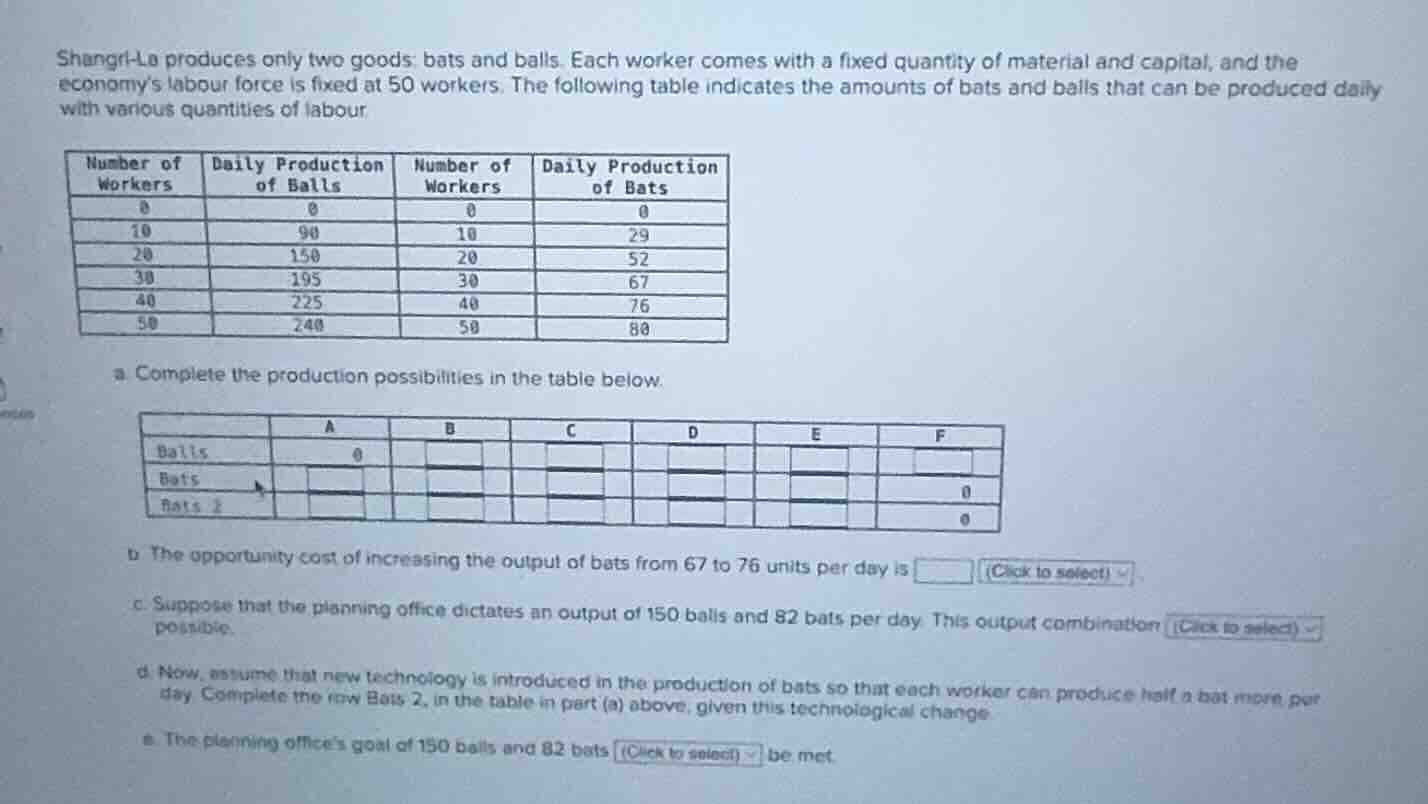
shangri - la produces only two goods: bats and balls. each worker comes with a fixed quantity of material and capital, and the economys labour force is fixed at 50 workers. the following table indicates the amounts of bats and balls that can be produced daily with various quantities of labour
| number of workers | daily production of balls | number of workers | daily production of bats |
|---|---|---|---|
| 10 | 90 | 10 | 29 |
| 20 | 150 | 20 | 52 |
| 30 | 195 | 30 | 67 |
| 40 | 225 | 40 | 76 |
| 50 | 240 | 50 | 80 |
a. complete the production possibilities in the table below.
| a | b | c | d | e | f | |
|---|---|---|---|---|---|---|
| bats | 0 | |||||
| bats 2 | 0 |
b. the opportunity cost of increasing the output of bats from 67 to 76 units per day is (click to select).
c. suppose that the planning office dictates an output of 150 balls and 82 bats per day. this output combination (click to select) possible.
d. now, assume that new technology is introduced in the production of bats so that each worker can produce half a bat more per day. complete the row bats 2, in the table in part (a) above, given this technological change.
e. the planning offices goal of 150 balls and 82 bats (click to select) be met
Step1: Fill Production Possibilities (Part a)
First, map workers to output:
- Point A: 0 balls → 50 workers on bats → 80 bats
- Point B: 90 balls (10 workers) → 40 workers on bats → 76 bats
- Point C: 150 balls (20 workers) → 30 workers on bats → 67 bats
- Point D: 195 balls (30 workers) → 20 workers on bats → 52 bats
- Point E: 225 balls (40 workers) → 10 workers on bats → 29 bats
- Point F: 240 balls (50 workers) → 0 bats
For Bats 2 (new tech): Each worker makes 0.5 more bats. New bat output = original + (workers × 0.5)
- Point A: 80 + (50×0.5) = 105 bats
- Point B: 76 + (40×0.5) = 96 bats
- Point C: 67 + (30×0.5) = 82 bats
- Point D: 52 + (20×0.5) = 62 bats
- Point E: 29 + (10×0.5) = 34 bats
- Point F: 0 + (0×0.5) = 0 bats
Step2: Calculate Opportunity Cost (Part b)
Increasing bats from 67 to 76: Shift from 30→40 workers on bats, so balls drop from 195 to 225? No, reverse: Bats 67 (30 workers) → 76 (40 workers): Balls go from 195 to 225? No, workers on balls go from 20→10, so balls drop from 195 to 90? No, correct: To get 9 more bats (76-67), we lose 225-195=30 balls. Opportunity cost = 30 balls.
Step3: Evaluate Output Feasibility (Part c)
150 balls needs 20 workers, leaving 30 workers for bats (max 67 bats). 82 bats > 67, so impossible.
Step4: Evaluate New Tech Feasibility (Part e)
150 balls needs 20 workers, leaving 30 workers for bats. New bat output for 30 workers: 67 + (30×0.5) = 82 bats, so feasible.

Snap & solve any problem in the app
Get step-by-step solutions on Sovi AI
Photo-based solutions with guided steps
Explore more problems and detailed explanations
Part a
| A | B | C | D | E | F | |
|---|---|---|---|---|---|---|
| Bats | 80 | 76 | 67 | 52 | 29 | 0 |
| Bats 2 | 105 | 96 | 82 | 62 | 34 | 0 |
Part b
30 balls
Part c
impossible
Part e
can