QUESTION IMAGE
Question
short answer questions
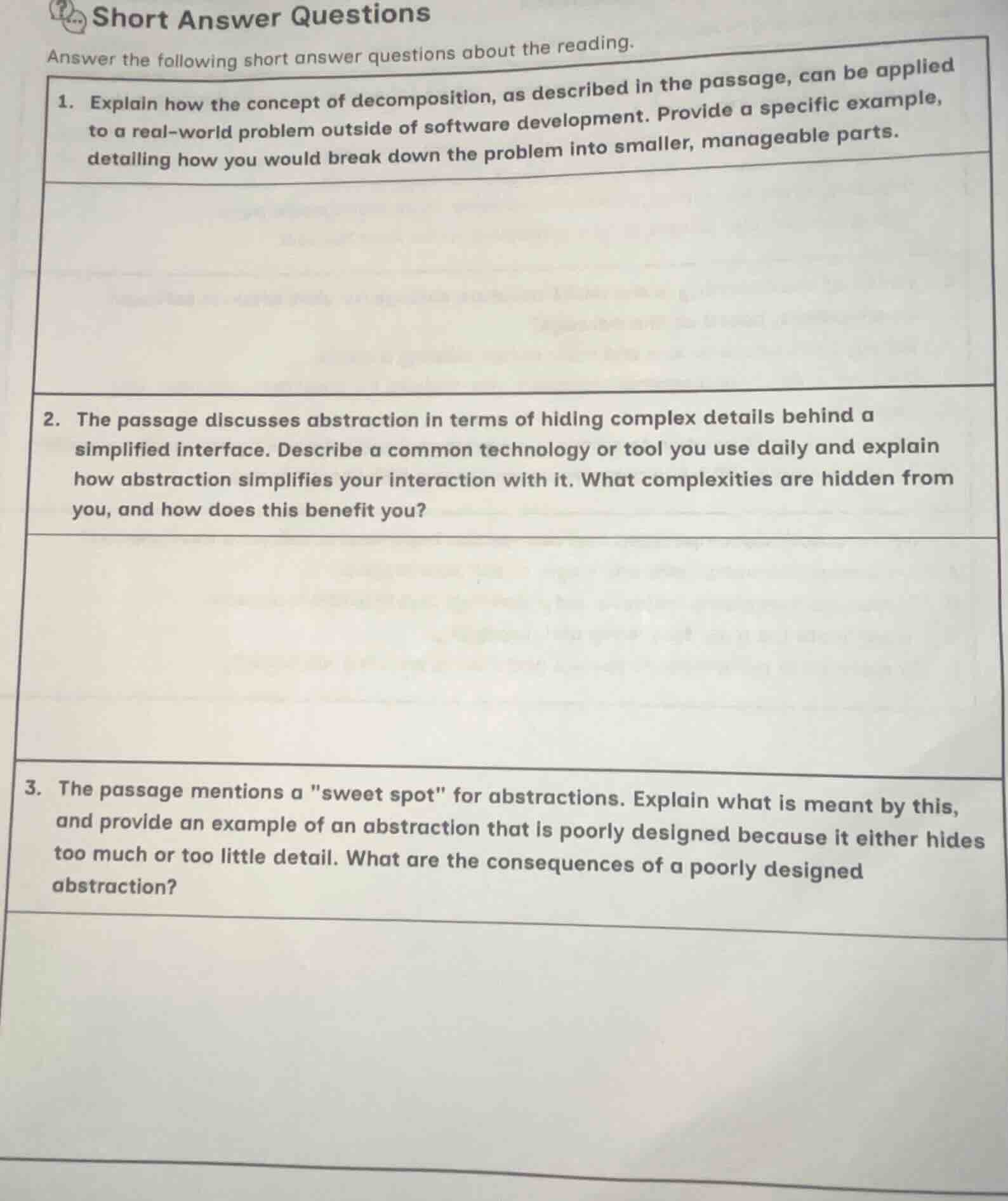
answer the following short answer questions about the reading.
- explain how the concept of decomposition, as described in the passage, can be applied to a real - world problem outside of software development. provide a specific example, detailing how you would break down the problem into smaller, manageable parts.
- the passage discusses abstraction in terms of hiding complex details behind a simplified interface. describe a common technology or tool you use daily and explain how abstraction simplifies your interaction with it. what complexities are hidden from you, and how does this benefit you?
- the passage mentions a \sweet spot\ for abstractions. explain what is meant by this, and provide an example of an abstraction that is poorly designed because it either hides too much or too little detail. what are the consequences of a poorly designed abstraction?
Question 1
Decomposition means breaking a large problem into smaller, manageable tasks. For example, planning a wedding: break it into sub - tasks like venue selection (research venues, compare costs, book), catering (choose cuisine, find caterers, set menu), attire (select dress/suit, order, alter), and guest management (create list, send invites, track RSVPs). Each sub - task is simpler to handle, and completing them contributes to the overall goal.
Take a smartphone. Abstraction simplifies interaction: the touchscreen interface hides complex hardware/software details (like CPU operations, memory management, network protocols). Users tap icons to make calls, send texts, or use apps, without knowing about code execution or signal processing. This benefits users by making the phone easy to use (no need for technical knowledge) and saves time (no need to configure low - level settings manually).
The “sweet spot” for abstraction is the optimal balance of hiding details: enough to simplify, but not so much that useful info is lost. A poorly designed example: a car’s dashboard with too little detail (only speed, no fuel level) – drivers can’t know when to refuel. Or too much detail (shows every engine sensor value) – overwhelms non - mechanics. Consequences: too little detail causes functional issues (e.g., running out of fuel); too much detail causes user confusion, inefficiency, or errors.

Snap & solve any problem in the app
Get step-by-step solutions on Sovi AI
Photo-based solutions with guided steps
Explore more problems and detailed explanations
Decomposition is applied by breaking a large problem (e.g., planning a wedding) into smaller tasks: venue selection (research, compare, book), catering (cuisine choice, find caterers, set menu), attire (select, order, alter), guest management (list, invites, RSVPs). Each sub - task is manageable, and completing them achieves the overall goal.