QUESTION IMAGE
Question
show what you know
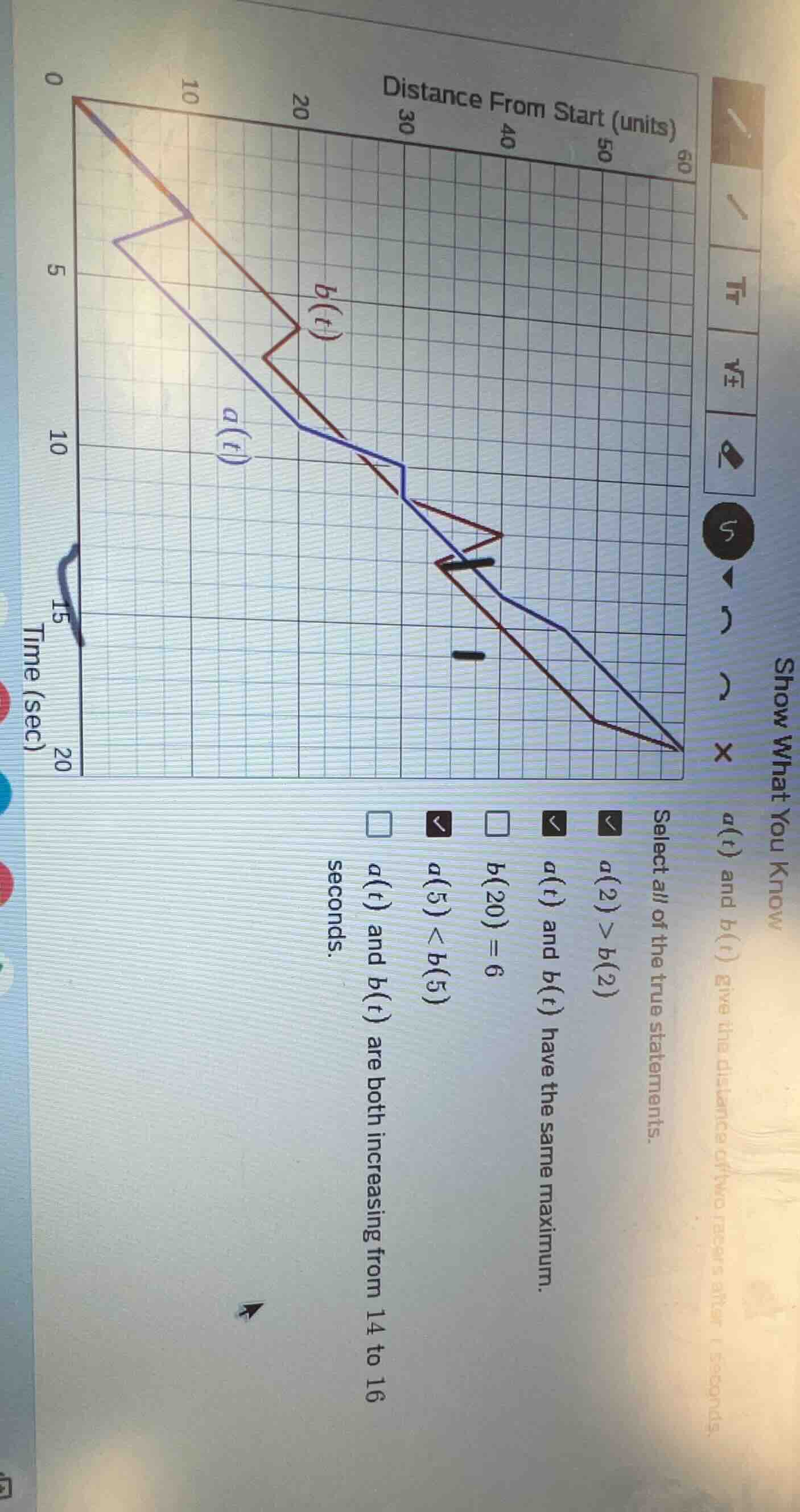
a(t) and b(t) give the distance of two racers after t seconds.
select all of the true statements.
☑ a(2) > b(2)
☑ a(t) and b(t) have the same maximum.
□ b(20) = 6
☑ a(5) < b(5)
□ a(t) and b(t) are both increasing from 14 to 16 seconds.
Brief Explanations
- For \(a(2) > b(2)\): At \(t = 2\) seconds, check the distance (y - value) of \(a(t)\) and \(b(t)\). From the graph, \(a(2)\)’s distance is greater than \(b(2)\)’s, so this is true.
- For \(a(t)\) and \(b(t)\) have the same maximum: The maximum distance (peak) for both \(a(t)\) and \(b(t)\) appears to be the same (they reach the same highest distance), so this is true.
- For \(a(5) < b(5)\): At \(t = 5\) seconds, \(a(5)\)’s distance is less than \(b(5)\)’s? No, from the graph, \(a(5)\) is above \(b(5)\)? Wait, no—wait, re - check. Wait, the graph: at \(t = 5\), \(b(t)\) is at a higher distance? Wait, no, the purple line (a(t)) and red (b(t)). Wait, maybe I misread. Wait, the first statement \(a(2)>b(2)\): at \(t = 2\), a(t) (purple) is higher than b(t) (red), so true. Then \(a(t)\) and \(b(t)\) same maximum: both seem to peak at the same distance, so true. The statement \(a(5)<b(5)\): at \(t = 5\), a(t) is actually above b(t)? Wait, no, maybe the graph’s grid. Wait, the options: the checked ones? Wait, the user’s image shows some checked, but let's analyze each:
- \(a(2)>b(2)\): True (from graph, at \(t = 2\), a(t)’s distance > b(t)’s).
- \(a(t)\) and \(b(t)\) have the same maximum: True (both reach the same highest distance).
- \(a(5)<b(5)\): False (a(5) is above b(5) on the graph).
- \(b(20)=6\): From the graph, at \(t = 20\), the distance is 60? Wait, no, the y - axis is time? Wait, no, x - axis: Distance From Start (units), y - axis: Time (sec). Wait, I had it reversed! Oh no, that's the mistake. X - axis: Distance (units), Y - axis: Time (sec). So the graph is time (y) vs distance (x). So for a function \(a(t)\) and \(b(t)\), t is time, and the value is distance. Wait, no: the labels: “Distance From Start (units)” is x - axis, “Time (sec)” is y - axis. So the functions are \(a(t)\): distance as a function of time, so for a given time t (y - axis), the x - value is distance. So to find \(a(2)\), we look at \(t = 2\) (y = 2), then the x - value (distance) of \(a(t)\) (purple line) and \(b(t)\) (red line). At \(t = 2\) (y = 2), \(a(t)\) (purple) has a smaller x (distance) than \(b(t)\) (red)? Wait, that's the opposite of what I thought earlier. Oh! I had x and y reversed. So x is distance, y is time. So for a function \(f(t)\), t is time (y), and f(t) is distance (x). So to evaluate \(a(2)\), we go to \(t = 2\) (y = 2) on the y - axis, then find the x - coordinate of \(a(t)\) (purple) and \(b(t)\) (red). At \(t = 2\), \(b(t)\) (red) is at a larger x (distance) than \(a(t)\) (purple)? Wait, no, the purple line at \(t = 2\) (y = 2) is at a smaller x (distance) than red? Wait, this is the key mistake. So x is distance, y is time. So the higher the x - value, the more distance. So for \(a(2)\): at \(t = 2\) (y = 2), the x - value of \(a(t)\) (purple) is less than \(b(t)\) (red)? But the first option is \(a(2)>b(2)\), which would be false if x is distance. Wait, I completely misread the axes. Let's re - orient:
- X - axis: Distance from start (units) (so larger x = more distance).
- Y - axis: Time (seconds) (so larger y = more time).
So a function \(a(t)\) gives the distance at time t. So to find \(a(2)\), we look at \(t = 2\) (y = 2) on the y - axis, then find the x - coordinate of the point on \(a(t)\) (purple line) at \(y = 2\). Similarly for \(b(t)\) (red line).
Now, re - analyzing:
- \(a(2)>b(2)\): At \(t = 2\) (y = 2), the x - value (distance) of \(a(t)\) (purple) vs \(b(t)\) (red). If purple is to the left of red at \(y = 2\), then \(a(2)<b(2)\). But the option says \(a(2)>b(2)\), so that would be false. But the user’s…

Snap & solve any problem in the app
Get step-by-step solutions on Sovi AI
Photo-based solutions with guided steps
Explore more problems and detailed explanations
- \(a(2)>b(2)\)
- \(a(t)\) and \(b(t)\) have the same maximum