QUESTION IMAGE
Question
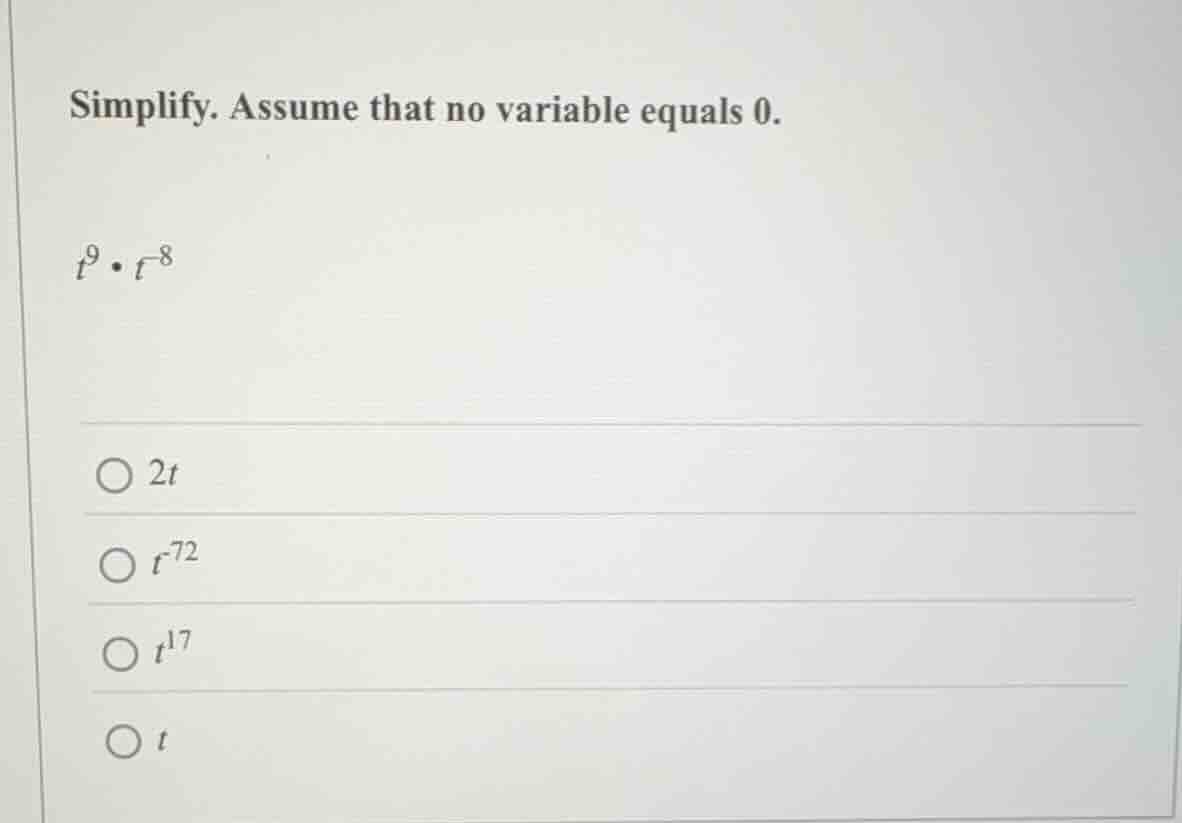
simplify. assume that no variable equals 0.
$t^9 \cdot t^{-8}$
\bigcirc $2t$
\bigcirc $t^{-72}$
\bigcirc $t^{17}$
\bigcirc $t$
Step1: Recall exponent rule for multiplication
When multiplying two powers with the same base, we add the exponents. The rule is \(a^m \cdot a^n = a^{m + n}\), where \(a\) is the base and \(m,n\) are exponents. Here, the base \(a = t\), \(m = 9\) and \(n=- 8\).
Step2: Apply the exponent rule
For \(t^{9}\cdot t^{-8}\), we add the exponents: \(9+(-8)=9 - 8 = 1\). So \(t^{9}\cdot t^{-8}=t^{1}=t\).

Snap & solve any problem in the app
Get step-by-step solutions on Sovi AI
Photo-based solutions with guided steps
Explore more problems and detailed explanations
The correct option is the one with \(t\), so the answer is the last option (the one with \(t\) as the choice, assuming the options are ordered as given: the fourth option which is \(t\)). If we list the options as per the original: the last option (let's say the fourth option is \(t\), so the answer is the option labeled with \(t\), for example, if the options are:
A. \(2t\)
B. \(t^{-72}\)
C. \(t^{17}\)
D. \(t\)
Then the answer is D. \(t\)