QUESTION IMAGE
Question
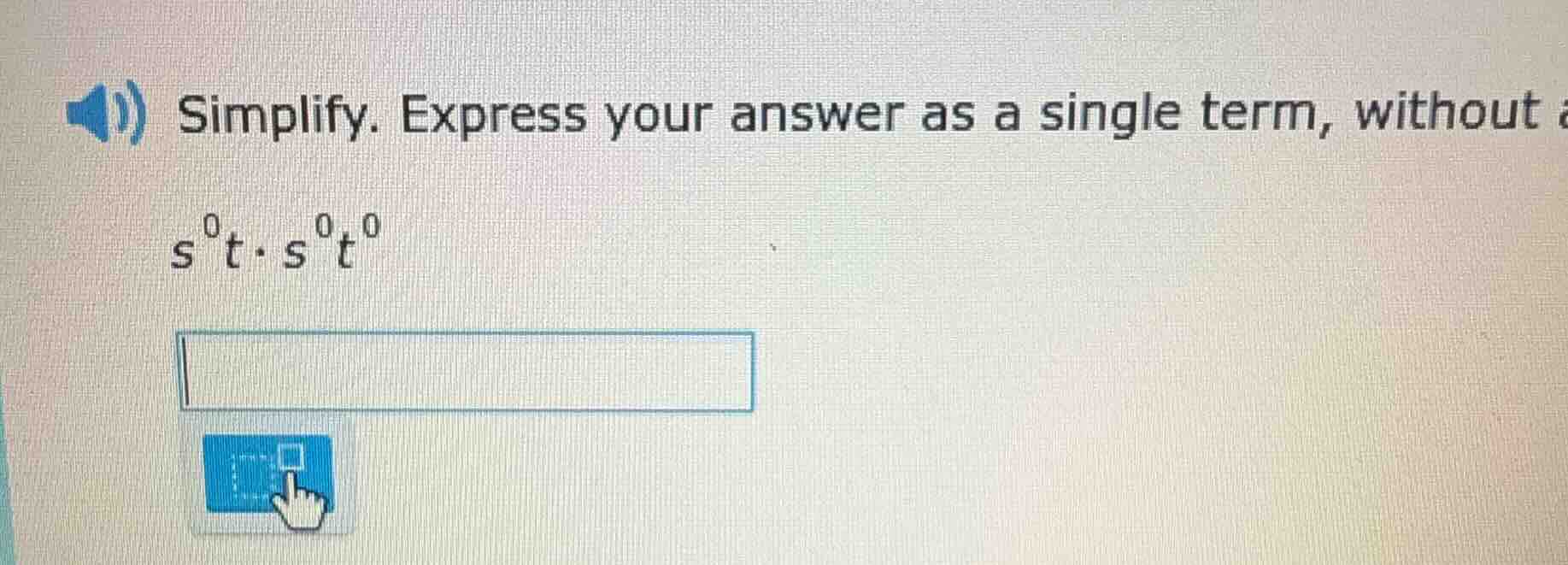
simplify. express your answer as a single term, without
s^0tcdot s^0t^0
Step1: Apply zero - exponent rule
Recall the zero - exponent rule: For any non - zero number \(a\), \(a^{0}=1\). So, \(s^{0} = 1\) (assuming \(s
eq0\)) and \(t^{0}=1\) (assuming \(t
eq0\)).
The expression \(s^{0}t\cdot s^{0}t^{0}\) can be rewritten by substituting the values from the zero - exponent rule.
\(s^{0}t\cdot s^{0}t^{0}=(1\times t)\cdot(1\times1)\)
Step2: Multiply the terms
Multiply the coefficients (the numbers) and the variables separately. The coefficients here are \(1\) (from \(s^{0}\)) and \(1\) (from \(s^{0}\)) and \(1\) (from \(t^{0}\)), and the variable term is \(t\).
\((1\times t)\cdot(1\times1)=1\times1\times t\times1=t\)

Snap & solve any problem in the app
Get step-by-step solutions on Sovi AI
Photo-based solutions with guided steps
Explore more problems and detailed explanations
\(t\)