QUESTION IMAGE
Question
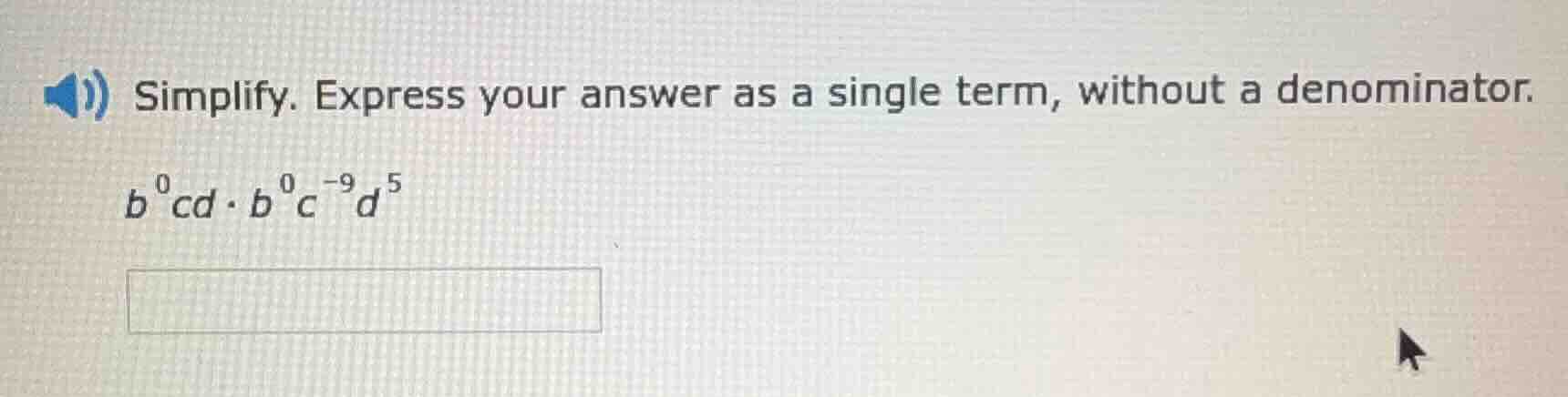
simplify. express your answer as a single term, without a denominator.
$b^{0}cd \cdot b^{0}c^{-9}d^{5}$
Step1: Apply the zero - exponent rule
Recall that any non - zero number to the power of 0 is 1, i.e., \(a^{0}=1\) for \(a
eq0\). So for the bases \(b\) in the expression \(b^{0}cd\cdot b^{0}c^{-9}d^{5}\), we have \(b^{0} = 1\) and \(b^{0}=1\). The expression becomes \(1\times c\times d\times1\times c^{-9}\times d^{5}\).
Step2: Apply the product rule for exponents (\(a^{m}\cdot a^{n}=a^{m + n}\)) to the bases \(c\) and \(d\)
For the base \(c\): We have \(c^{1}\cdot c^{-9}\). Using the product rule \(a^{m}\cdot a^{n}=a^{m + n}\), where \(a = c\), \(m = 1\) and \(n=-9\), we get \(c^{1+( - 9)}=c^{-8}\).
For the base \(d\): We have \(d^{1}\cdot d^{5}\). Using the product rule \(a^{m}\cdot a^{n}=a^{m + n}\), where \(a = d\), \(m = 1\) and \(n = 5\), we get \(d^{1 + 5}=d^{6}\).
Step3: Rewrite negative exponents as positive exponents (optional, but since we want no denominator, we can use the rule \(a^{-n}=\frac{1}{a^{n}}\) in reverse? Wait, no. Wait, we want to express without a denominator. Wait, actually, \(c^{-8}=\frac{1}{c^{8}}\) but we want to write it without a denominator. Wait, no, the problem says "express your answer as a single term, without a denominator". Wait, maybe we made a mistake. Wait, let's re - do step 2.
Wait, the original expression is \(b^{0}cd\cdot b^{0}c^{-9}d^{5}\). Let's group the like bases:
Group the \(b\) terms: \(b^{0}\cdot b^{0}=b^{0 + 0}=b^{0}=1\)
Group the \(c\) terms: \(c^{1}\cdot c^{-9}=c^{1+( - 9)}=c^{-8}\)
Group the \(d\) terms: \(d^{1}\cdot d^{5}=d^{1 + 5}=d^{6}\)
Now, we know that \(c^{-8}=\frac{1}{c^{8}}\), but we want to write it without a denominator. Wait, no, the problem says "without a denominator", but if we have a negative exponent, we can write it as a positive exponent in the numerator? Wait, no, \(a^{-n}=\frac{1}{a^{n}}\), so to write without a denominator, we can use the rule \(a^{-n}=\frac{1}{a^{n}}\) and then if we want to have no denominator, we can write the term with negative exponents. Wait, the problem says "express your answer as a single term, without a denominator". So terms with negative exponents are allowed as long as there is no denominator. So combining all the terms:
Since \(b^{0}=1\), the product of the \(b\) terms is 1. The product of the \(c\) terms is \(c^{-8}\), and the product of the \(d\) terms is \(d^{6}\). So the entire expression is \(1\times c^{-8}\times d^{6}=c^{-8}d^{6}\). Wait, but maybe we can write it as \(d^{6}c^{-8}\) or using the rule \(a^{-n}=\frac{1}{a^{n}}\) in reverse? No, wait, let's check the problem again.
Wait, maybe I messed up the exponent rules. Let's start over.
Original expression: \(b^{0}cd\cdot b^{0}c^{-9}d^{5}\)
First, \(b^{0}=1\), so substitute:
\(1\times c\times d\times1\times c^{-9}\times d^{5}\)
Now, multiply the coefficients (which are 1 and 1, so 1), multiply the \(c\) terms: \(c^{1}\times c^{-9}=c^{1+( - 9)}=c^{-8}\)
Multiply the \(d\) terms: \(d^{1}\times d^{5}=d^{1 + 5}=d^{6}\)
So the simplified form is \(c^{-8}d^{6}\) or \(d^{6}c^{-8}\). But the problem says "without a denominator". Since \(c^{-8}=\frac{1}{c^{8}}\), but if we write it as \(d^{6}c^{-8}\), there is no denominator. So that's acceptable.
Wait, but maybe the problem expects us to use the rule \(a^{-n}=\frac{1}{a^{n}}\) and then combine? No, the problem says "without a denominator", so having a negative exponent is okay as long as there is no fraction bar.
So the final simplified form is \(c^{-8}d^{6}\) or \(d^{6}c^{-8}\). But let's check the steps again.
Alternative approach:
\(b^{0}cd\cdot b^{0}c^{-9}d^{5}=(b^{0}\cdot b^{0})\cdot(c\cdot…

Snap & solve any problem in the app
Get step-by-step solutions on Sovi AI
Photo-based solutions with guided steps
Explore more problems and detailed explanations
\(c^{-8}d^{6}\) (or \(d^{6}c^{-8}\))