QUESTION IMAGE
Question
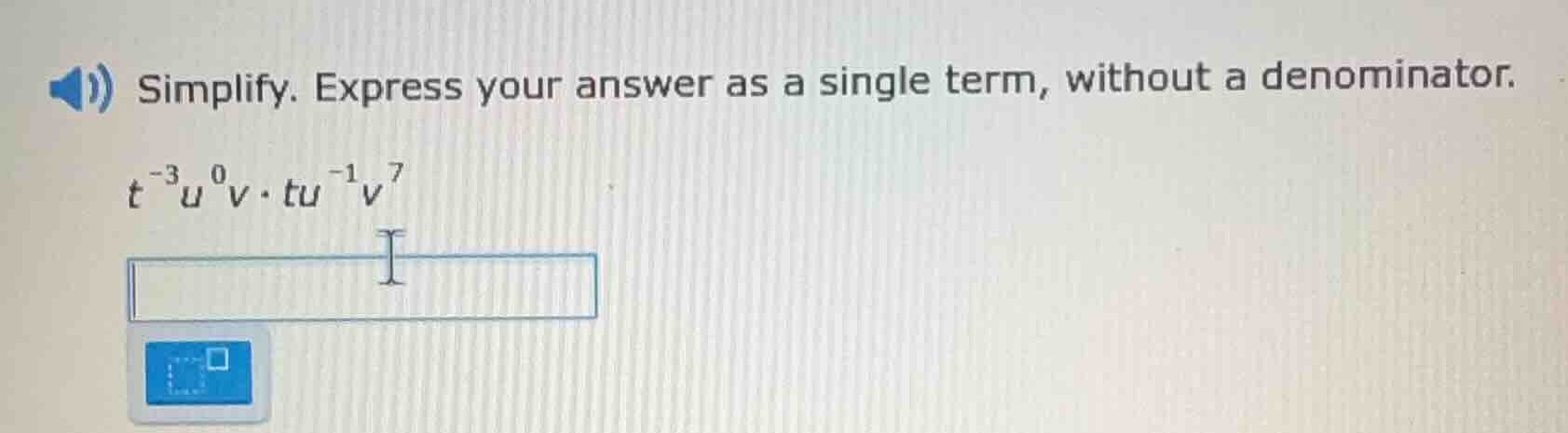
simplify. express your answer as a single term, without a denominator.
$t^{-3}u^{0}v\cdot tu^{-1}v^{7}$
Step1: Use exponent rules for multiplication (same base, add exponents)
For \( t \): \( t^{-3} \cdot t^{1} = t^{-3 + 1} \)
For \( u \): \( u^{0} \cdot u^{-1} = u^{0 + (-1)} \)
For \( v \): \( v^{1} \cdot v^{7} = v^{1 + 7} \)
Step2: Simplify each exponent
\( t^{-3 + 1} = t^{-2} \)
\( u^{0 + (-1)} = u^{-1} \)
\( v^{1 + 7} = v^{8} \)
Step3: Rewrite negative exponents (to eliminate denominator, use \( a^{-n} = \frac{1}{a^n} \), but we want single term without denominator, so express as positive exponents in numerator? Wait, no—wait, the problem says "without a denominator", so we can use \( a^{-n} = \frac{1}{a^n} \) but to have no denominator, we can write \( t^{-2}u^{-1}v^{8} \) as \( \frac{v^{8}}{t^{2}u^{1}} \)? Wait, no, wait—wait, maybe I made a mistake. Wait, the original expression is \( t^{-3}u^{0}v \cdot tu^{-1}v^{7} \). Let's re - do:
Wait, \( u^{0}=1 \), so first, \( t^{-3} \times 1\times v\times t\times u^{-1}\times v^{7} \)
Now, for \( t \): \( t^{-3} \times t^{1}=t^{-3 + 1}=t^{-2} \)
For \( u \): \( 1\times u^{-1}=u^{-1} \)
For \( v \): \( v^{1}\times v^{7}=v^{8} \)
Now, to write without a denominator, we can use the rule \( a^{-n}=\frac{1}{a^{n}} \), but if we want a single term without a denominator, we can express negative exponents as numerator terms? Wait, no—actually, a term without a denominator means we can have negative exponents in the numerator. Wait, the problem says "without a denominator", so we can leave negative exponents in the numerator. Wait, but let's check again.
Wait, \( t^{-2}u^{-1}v^{8} \) is a single term without a denominator (because the denominator is 1, implicitly). Wait, but maybe I messed up the exponent rules. Let's re - calculate:
\( t^{-3}u^{0}v\cdot tu^{-1}v^{7} \)
Multiply coefficients (but there are no coefficients other than 1 for \( u^{0}=1 \))
For \( t \): \( t^{-3} \times t^{1}=t^{-3 + 1}=t^{-2} \)
For \( u \): \( u^{0} \times u^{-1}=u^{0-1}=u^{-1} \)
For \( v \): \( v^{1} \times v^{7}=v^{8} \)
So combining, we get \( t^{-2}u^{-1}v^{8} \). But if we want to write without a denominator (i.e., no fraction bar), we can use the rule \( a^{-n}=\frac{1}{a^{n}} \), but actually, a term with negative exponents in the numerator is still a single term without a denominator (because the denominator is 1). Wait, maybe the problem allows negative exponents in the numerator. So the simplified form is \( t^{-2}u^{-1}v^{8} \), or we can write it as \( \frac{v^{8}}{t^{2}u} \), but the problem says "without a denominator". So we should use negative exponents in the numerator. So \( t^{-2}u^{-1}v^{8} \) can be written as \( \frac{v^{8}}{t^{2}u} \), but that has a denominator. Wait, I think I made a mistake. Wait, let's re - evaluate the exponent addition:
\( t^{-3} \times t^{1}=t^{-3 + 1}=t^{-2} \)
\( u^{0} \times u^{-1}=u^{0-1}=u^{-1} \)
\( v^{1} \times v^{7}=v^{8} \)
Now, to have no denominator, we can express this as \( v^{8}t^{-2}u^{-1} \), which is a single term without a denominator (since it's just a product of terms with exponents, and the denominator is 1). Alternatively, if we want positive exponents, we have to have a denominator, but the problem says "without a denominator", so we can keep the negative exponents in the numerator.
Wait, maybe the problem expects us to use \( a^{-n}=\frac{1}{a^{n}} \) but to write it as a single term, so \( t^{-2}u^{-1}v^{8}=\frac{v^{8}}{t^{2}u} \), but that has a denominator. Wait, no—maybe I misread the problem. Wait, the original expression is \( t^{-3}u^{0}v\cdot tu^{-1}v^{7} \). Let's compute again:
First, multiply the coeffic…

Snap & solve any problem in the app
Get step-by-step solutions on Sovi AI
Photo-based solutions with guided steps
Explore more problems and detailed explanations
\( t^{-2}u^{-1}v^{8} \) (or \( \frac{v^{8}}{t^{2}u} \) is wrong, wait no—wait, the problem says "without a denominator", so we can have negative exponents in the numerator. So the correct single - term without denominator is \( t^{-2}u^{-1}v^{8} \), which can also be written as \( \frac{v^{8}}{t^{2}u} \) but that has a denominator. Wait, I think I made a mistake. Wait, the rule for negative exponents: \( a^{-n}=\frac{1}{a^{n}} \), so to have no denominator, we need to have all exponents non - negative? No, the problem says "without a denominator", which means we can have a single term (a product) without a fraction bar. So \( t^{-2}u^{-1}v^{8} \) is a single term (a product of \( t^{-2} \), \( u^{-1} \), and \( v^{8} \)) without a denominator (since it's not a fraction). So the answer is \( t^{-2}u^{-1}v^{8} \), or we can re - arrange the terms: \( v^{8}t^{-2}u^{-1} \).
Wait, another way: \( t^{-3}u^{0}v\cdot tu^{-1}v^{7}=t^{-3 + 1}u^{0-1}v^{1 + 7}=t^{-2}u^{-1}v^{8} \)
Yes, so the simplified form as a single term without a denominator is \( t^{-2}u^{-1}v^{8} \)