QUESTION IMAGE
Question
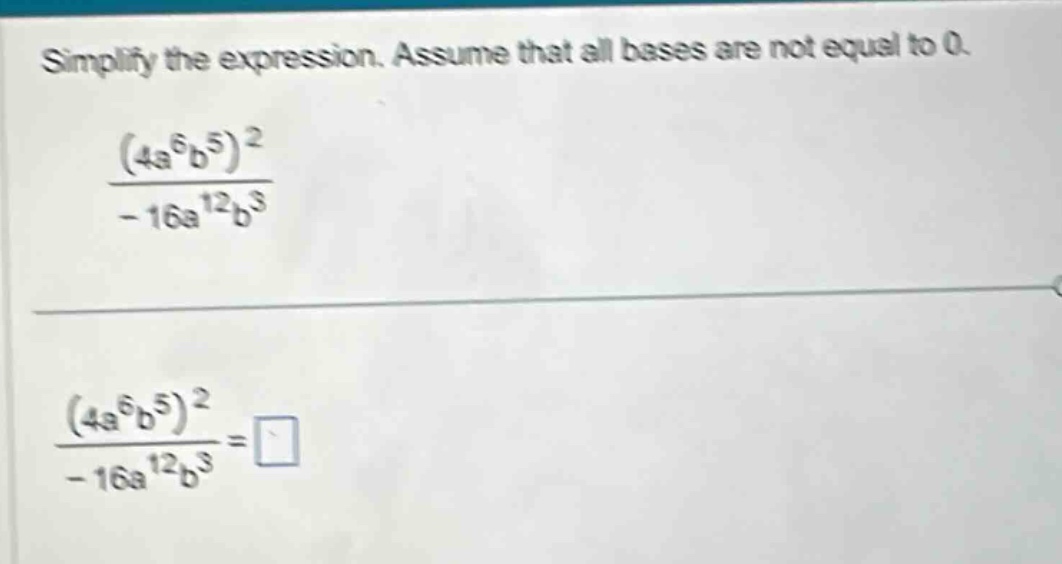
simplify the expression. assume that all bases are not equal to 0.\\(\frac{(4a^{6}b^{5})^{2}}{-16a^{12}b^{3}}\\)\\(\frac{(4a^{6}b^{5})^{2}}{-16a^{12}b^{3}}=square\\)
Step1: Expand the numerator using power of a product rule
The power of a product rule states that \((xy)^n = x^n y^n\) and \((x^m)^n=x^{mn}\). So, \((4a^{6}b^{5})^{2}=4^{2}\times(a^{6})^{2}\times(b^{5})^{2}=16a^{12}b^{10}\)
Step2: Substitute the expanded numerator into the fraction
Now the fraction becomes \(\frac{16a^{12}b^{10}}{- 16a^{12}b^{3}}\)
Step3: Simplify the coefficients and use the quotient rule for exponents
The quotient rule for exponents is \(\frac{x^m}{x^n}=x^{m - n}\) (when \(x
eq0\)). First, simplify the coefficients: \(\frac{16}{-16}=- 1\). Then for the \(a\) terms: \(\frac{a^{12}}{a^{12}}=a^{12 - 12}=a^{0}=1\) (since \(a
eq0\)). For the \(b\) terms: \(\frac{b^{10}}{b^{3}}=b^{10 - 3}=b^{7}\)
Step4: Multiply the simplified parts together
Multiply the coefficient, the \(a\) term, and the \(b\) term: \(-1\times1\times b^{7}=-b^{7}\)

Snap & solve any problem in the app
Get step-by-step solutions on Sovi AI
Photo-based solutions with guided steps
Explore more problems and detailed explanations
\(-b^{7}\)