QUESTION IMAGE
Question
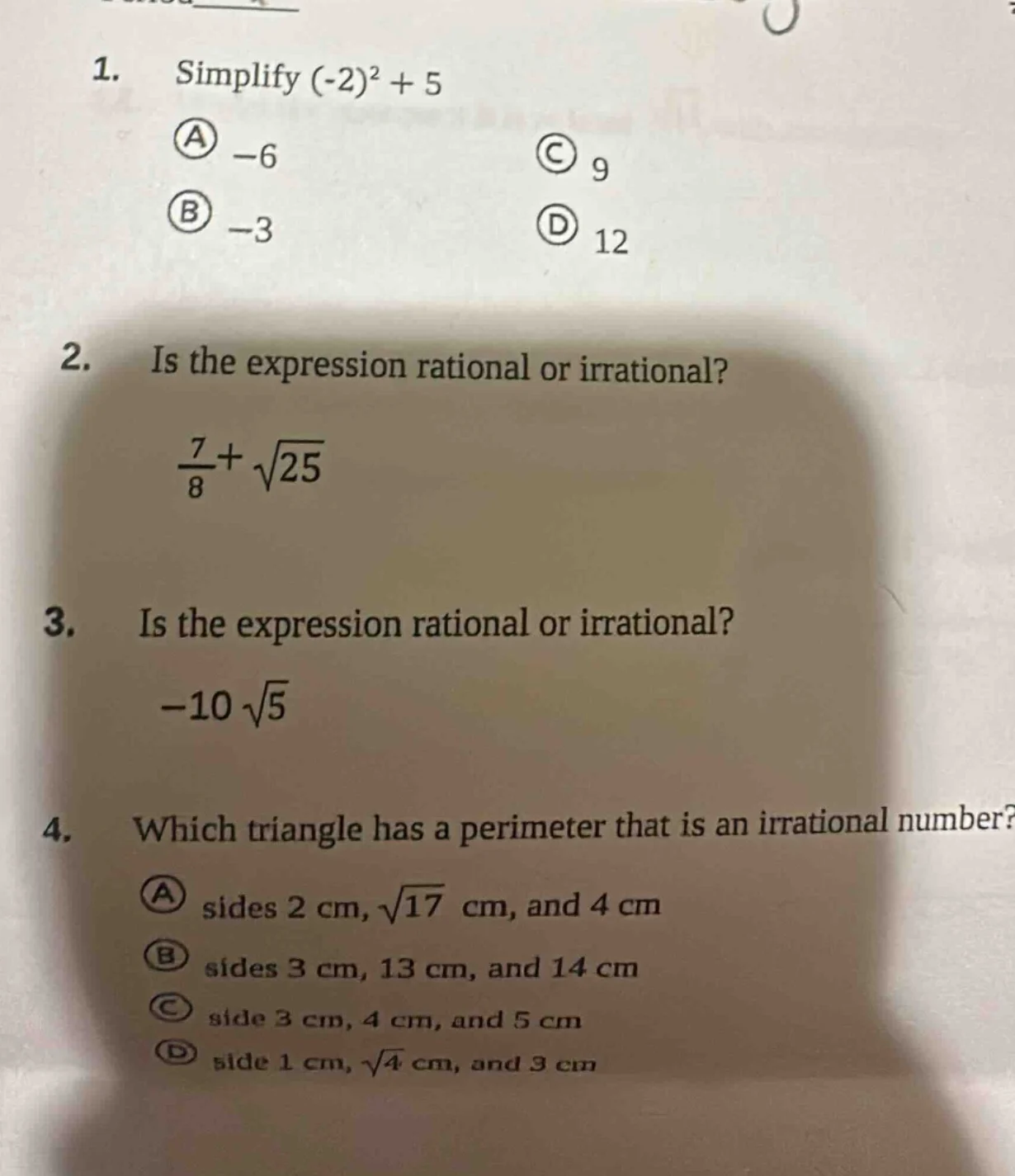
- simplify $(-2)^2 + 5$
a $-6$ c $9$
b $-3$ d $12$
- is the expression rational or irrational?
$\frac{7}{8}+\sqrt{25}$
- is the expression rational or irrational?
$-10\sqrt{5}$
- which triangle has a perimeter that is an irrational number?
a sides 2 cm, $\sqrt{17}$ cm, and 4 cm
b sides 3 cm, 13 cm, and 14 cm
c side 3 cm, 4 cm, and 5 cm
d side 1 cm, $\sqrt{4}$ cm, and 3 cm
Step1: Evaluate the squared term
$(-2)^2 = 4$
Step2: Add the constant term
$4 + 5 = 9$
Brief Explanations
- $\frac{7}{8}$ is a rational number (fraction of integers).
- $\sqrt{25} = 5$, which is a rational number (integer).
- The sum of two rational numbers is rational.
Brief Explanations
- $\sqrt{5}$ is an irrational number (cannot be written as a fraction of integers).
- Multiplying an irrational number by a non-zero rational number (-10) results in an irrational number.
Step1: Calculate perimeter of Option A
$2 + \sqrt{17} + 4 = 6 + \sqrt{17}$
$\sqrt{17}$ is irrational, so the sum is irrational.
Step2: Calculate perimeter of Option B
$3 + 13 + 14 = 30$ (rational integer)
Step3: Calculate perimeter of Option C
$3 + 4 + 5 = 12$ (rational integer)
Step4: Calculate perimeter of Option D
$\sqrt{4}=2$, so $1 + 2 + 3 = 6$ (rational integer)

Snap & solve any problem in the app
Get step-by-step solutions on Sovi AI
Photo-based solutions with guided steps
Explore more problems and detailed explanations
C. 9
---