QUESTION IMAGE
Question
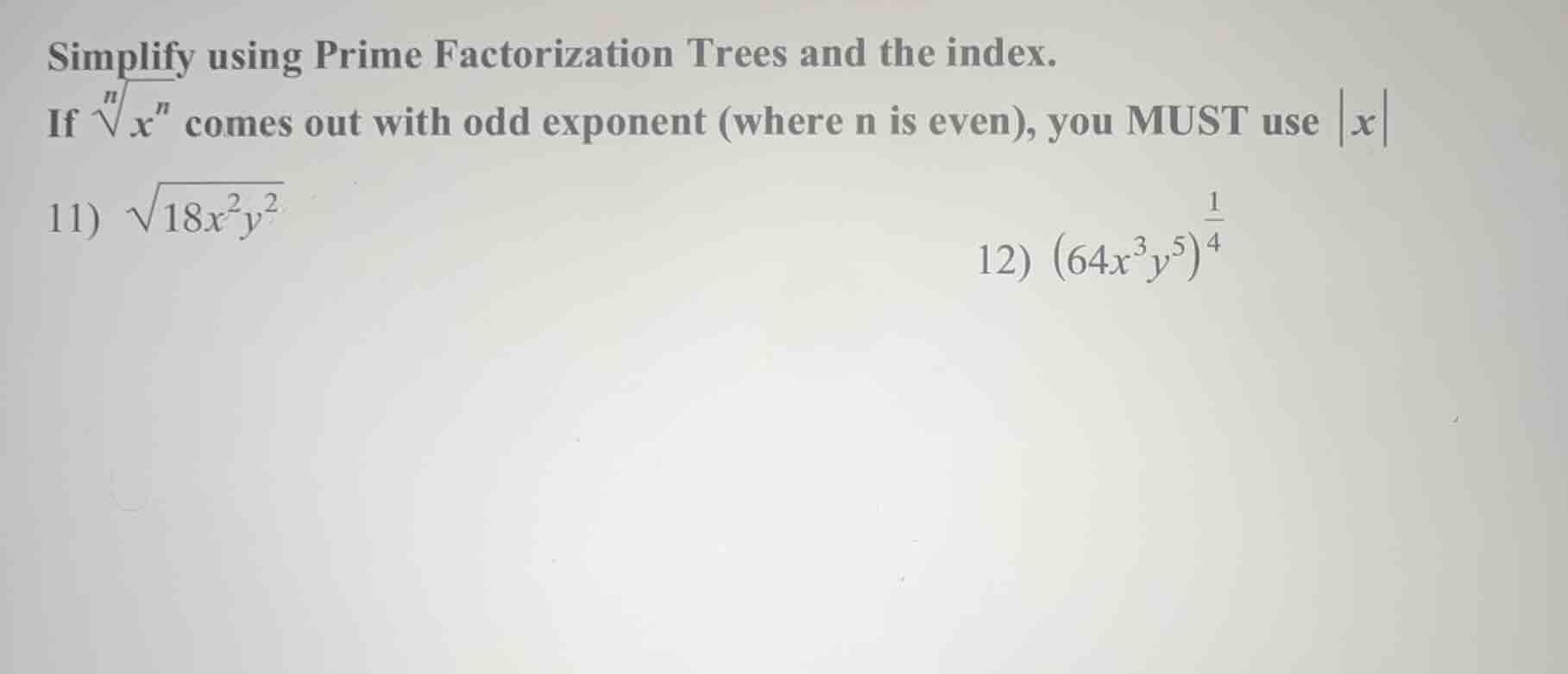
simplify using prime factorization trees and the index.
if $sqrtn{x^n}$ comes out with odd exponent (where n is even), you must use $|x|$
- $sqrt{18x^2y^2}$
- $(64x^3y^5)^{\frac{1}{4}}$
Problem 11: $\boldsymbol{\sqrt{18x^2y^2}}$
Step 1: Prime Factorize 18
Prime factorize 18: $18 = 2\times9 = 2\times3^2$. So, $\sqrt{18x^2y^2}=\sqrt{2\times3^2\times x^2\times y^2}$.
Step 2: Apply Square Root Property
For a square root (index 2, even), we use the property $\sqrt{a^2}=|a|$ if the exponent of $a$ in the radicand is odd, and $\sqrt{a^2}=a$ if even. Here, exponents of 3, $x$, $y$ are 2 (even), exponent of 2 is 1 (odd).
So, $\sqrt{3^2}=3$, $\sqrt{x^2}=|x|$, $\sqrt{y^2}=|y|$, and $\sqrt{2}$ remains as is.
Combining these, we get $3|x||y|\sqrt{2}$. Since multiplication of absolute values is commutative, we can write it as $3\sqrt{2}|x||y|$ or $3|x||y|\sqrt{2}$.
Step 1: Prime Factorize 64
Prime factorize 64: $64 = 2^6$. So, $(64x^3y^5)^{\frac{1}{4}}=(2^6x^3y^5)^{\frac{1}{4}}$.
Step 2: Apply Exponent Rule $(a^m b^n)^p = a^{mp}b^{np}$
Apply the exponent rule:
- For 2: $2^{6\times\frac{1}{4}} = 2^{\frac{6}{4}} = 2^{\frac{3}{2}}=\sqrt{2^3}=2\sqrt{2}$ (or keep as $2^{\frac{3}{2}}$).
- For $x$: $x^{3\times\frac{1}{4}} = x^{\frac{3}{4}}=\sqrt[4]{x^3}$.
- For $y$: $y^{5\times\frac{1}{4}} = y^{\frac{5}{4}} = y^{\frac{4 + 1}{4}} = y^{1+\frac{1}{4}} = y\sqrt[4]{y}$.
Step 3: Combine Terms
Combining the results for 2, $x$, and $y$:
$2^{\frac{3}{2}}x^{\frac{3}{4}}y^{\frac{5}{4}} = 2\sqrt{2}\cdot\sqrt[4]{x^3}\cdot y\sqrt[4]{y}=2y\sqrt{2}\cdot\sqrt[4]{x^3y}$.
Or, in radical form without simplifying the fractional exponents further:
$(2^6x^3y^5)^{\frac{1}{4}} = 2^{\frac{6}{4}}x^{\frac{3}{4}}y^{\frac{5}{4}} = 2^{\frac{3}{2}}x^{\frac{3}{4}}y^{\frac{5}{4}} = \sqrt{2^3} \cdot \sqrt[4]{x^3} \cdot \sqrt[4]{y^5} = 2\sqrt{2} \cdot \sqrt[4]{x^3} \cdot y\sqrt[4]{y} = 2y\sqrt{2}\sqrt[4]{x^3y}$.
Alternatively, using absolute value for even index (4 is even) when exponents are odd in the radicand (but here we have fractional exponents, so we can express in radical form with absolute value if needed, but since the original exponent of $x$ is 3 (odd) and $y$ is 5 (odd) in the base, when raising to $\frac{1}{4}$ (even index equivalent in radical), we need to check:
Wait, actually, the rule is for $\sqrt[n]{x^m}$ where $n$ is even. Here, $(a)^{\frac{1}{4}}=\sqrt[4]{a}$, so $a = x^3y^5$. The exponents of $x$ (3) and $y$ (5) in $a$: when taking 4th root (even index), for $x^3$, since 3 is odd, $\sqrt[4]{x^3}=|x|^{\frac{3}{4}}$? Wait, no, the correct property is $\sqrt[n]{x^m}=|x|^{\frac{m}{n}}$ if $n$ is even and $m$ is odd (because $x^m$ under even root: to make it defined for all real $x$, we use absolute value when the exponent of $x$ in the radicand is odd, and the index is even). Wait, actually, for real numbers, if we consider $x$ and $y$ as real numbers, then:
- $\sqrt[4]{x^3}=|x|^{\frac{3}{4}}$ (since 4 is even, 3 is odd: $\sqrt[4]{x^3}=|x|^{\frac{3}{4}}$ because $x^3$ can be negative if $x$ is negative, and 4th root of negative is not real, so we need $|x|^{\frac{3}{4}}$ to ensure it's real for all real $x$? Wait, no, actually, if $x$ is negative, $x^3$ is negative, and 4th root of negative is not real. So, to have a real result, we need $x^3\geq0$ (i.e., $x\geq0$) or we use absolute value? Wait, maybe the problem assumes $x$ and $y$ are non-negative? The original problem statement says "using Prime Factorization Trees and the index" and the note about odd exponent with even $n$: maybe in the context of the problem, we can proceed with the exponent rules without absolute value if we assume $x,y\geq0$, or include absolute value for real numbers.
Assuming we need to consider real numbers (so include absolute value when necessary):
- For $x^3$: exponent 3 (odd), index 4 (even). So $\sqrt[4]{x^3}=|x|^{\frac{3}{4}}$.
- For $y^5$: exponent 5 (odd), index 4 (even). So $\sqrt[4]{y^5}=|y|^{\frac{5}{4}}=|y|^{1+\frac{1}{4}}=|y|\cdot|y|^{\frac{1}{4}}=|y|\sqrt[4]{|y|}$ (but $|y|^{\frac{5}{4}}=|y|\cdot|y|^{\frac{1}{4}}$ since $\frac{5}{4}=1+\frac{1}{4}$). Wait, maybe better to keep as exponents:
From step 2, we had:
$2^{\frac{3}{2}}x^{\frac{3}{4}}y^{\frac{5}{4}}$.
For real numbers, since 4 is even, and exponents of $x$ (3) and $y$ (5) in the base are odd, we need to write:
$2^{\frac{3}{2}}|x|^{\frac{3}{4}}|y|^{\frac{5}{4}}$.
Simplify $|y|^{\frac{5}{4}} = |y|^{1+\frac{1}{4}} = |y|\cdot|y|^{\frac{1}{4}} = |y|\sqr…

Snap & solve any problem in the app
Get step-by-step solutions on Sovi AI
Photo-based solutions with guided steps
Explore more problems and detailed explanations
$3\sqrt{2}|x||y|$