QUESTION IMAGE
Question
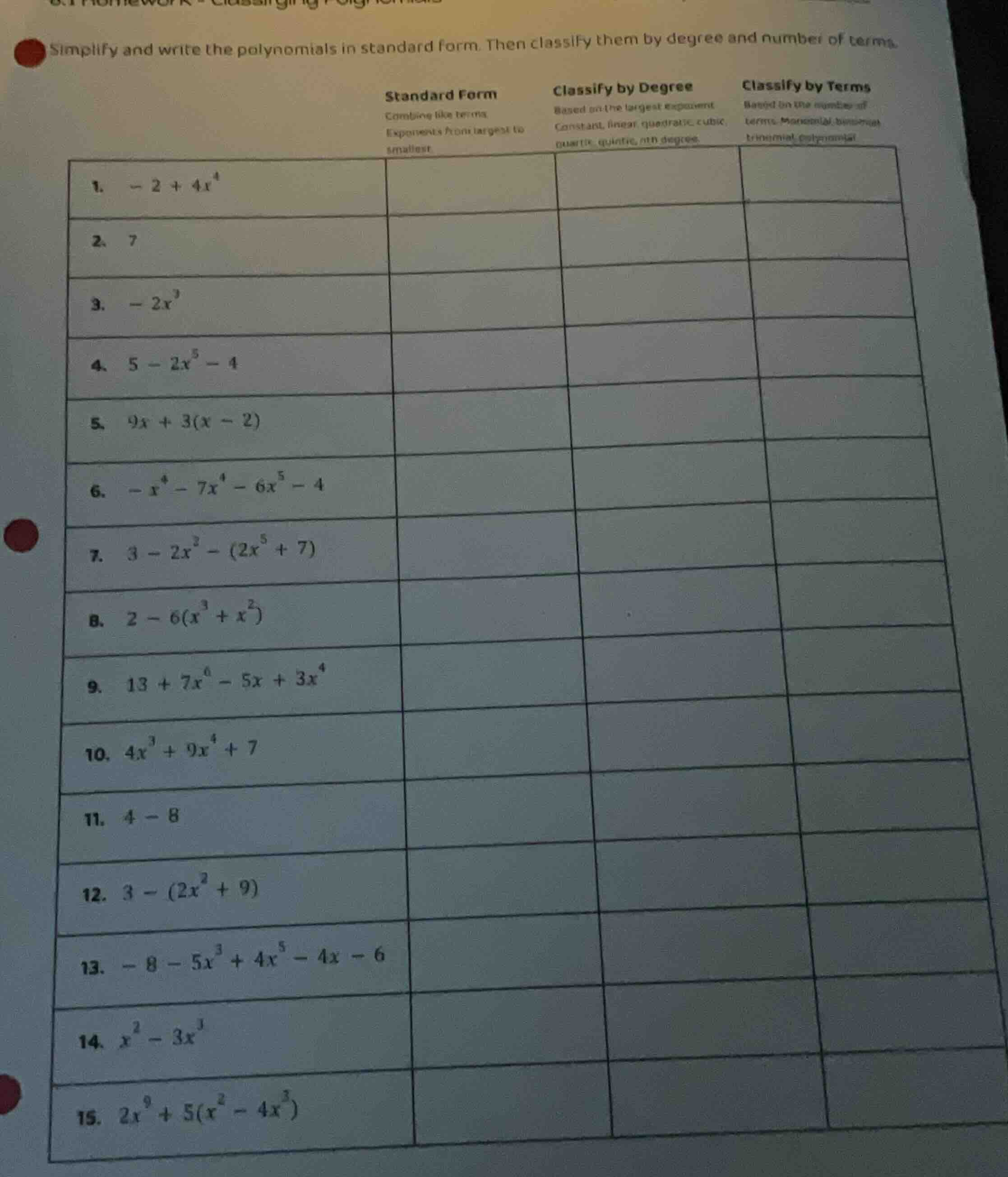
simplify and write the polynomials in standard form. then classify them by degree and number of terms.
standard form
combine like terms
exponents from largest to smallest
classify by degree
based on the largest exponent
constant, linear, quadratic, cubic, quartic, quintic, nth degree
classify by terms
based on the number of terms: monomial, binomial, trinomial, polynomial
- $-2 + 4x^4$
- $7$
- $-2x^3$
- $5 - 2x^5 - 4$
- $9x + 3(x - 2)$
- $-x^4 - 7x^4 - 6x^5 - 4$
- $3 - 2x^2 - (2x^5 + 7)$
- $2 - 6(x^3 + x^2)$
- $13 + 7x^6 - 5x + 3x^4$
- $4x^3 + 9x^4 + 7$
- $4 - 8$
- $3 - (2x^2 + 9)$
- $-8 - 5x^3 + 4x^5 - 4x - 6$
- $x^2 - 3x^3$
- $2x^9 + 5(x^2 - 4x^3)$
Step1: Rearrange by exponent size
$4x^4 - 2$
Step2: Identify degree (largest exponent)
Largest exponent: $4$ (quartic)
Step3: Count terms
2 terms (binomial)
---
Step1: No simplification needed
$7$
Step2: Identify degree (constant)
Largest exponent: $0$ (constant)
Step3: Count terms
1 term (monomial)
---
Step1: No simplification needed
$-2x^3$
Step2: Identify degree (largest exponent)
Largest exponent: $3$ (cubic)
Step3: Count terms
1 term (monomial)
---
Step1: Combine constant terms
$5-4-2x^5 = 1-2x^5$
Step2: Rearrange by exponent size
$-2x^5 + 1$
Step3: Identify degree (largest exponent)
Largest exponent: $5$ (quintic)
Step4: Count terms
2 terms (binomial)
---
Step1: Distribute the 3
$9x + 3x - 6$
Step2: Combine like terms
$12x - 6$
Step3: Identify degree (largest exponent)
Largest exponent: $1$ (linear)
Step4: Count terms
2 terms (binomial)
---
Step1: Combine like $x^4$ terms
$-x^4-7x^4-6x^5-4 = -8x^4-6x^5-4$
Step2: Rearrange by exponent size
$-6x^5 - 8x^4 - 4$
Step3: Identify degree (largest exponent)
Largest exponent: $5$ (quintic)
Step4: Count terms
3 terms (trinomial)
---
Step1: Distribute the negative sign
$3-2x^2-2x^5-7$
Step2: Combine constant terms
$3-7-2x^2-2x^5 = -4-2x^2-2x^5$
Step3: Rearrange by exponent size
$-2x^5 - 2x^2 - 4$
Step4: Identify degree (largest exponent)
Largest exponent: $5$ (quintic)
Step5: Count terms
3 terms (trinomial)
---
Step1: Distribute the -6
$2-6x^3-6x^2$
Step2: Rearrange by exponent size
$-6x^3 - 6x^2 + 2$
Step3: Identify degree (largest exponent)
Largest exponent: $3$ (cubic)
Step4: Count terms
3 terms (trinomial)
---
Step1: Rearrange by exponent size
$7x^6 + 3x^4 - 5x + 13$
Step2: Identify degree (largest exponent)
Largest exponent: $6$ (6th degree)
Step3: Count terms
4 terms (polynomial)
---
Step1: Rearrange by exponent size
$9x^4 + 4x^3 + 7$
Step2: Identify degree (largest exponent)
Largest exponent: $4$ (quartic)
Step3: Count terms
3 terms (trinomial)
---
Step1: Combine constant terms
$4-8 = -4$
Step2: Identify degree (constant)
Largest exponent: $0$ (constant)
Step3: Count terms
1 term (monomial)
---
Step1: Distribute the negative sign
$3-2x^2-9$
Step2: Combine constant terms
$3-9-2x^2 = -6-2x^2$
Step3: Rearrange by exponent size
$-2x^2 - 6$
Step4: Identify degree (largest exponent)
Largest exponent: $2$ (quadratic)
Step5: Count terms
2 terms (binomial)
---
Step1: Combine constant terms
$-8-6-5x^3+4x^5-4x = -14-5x^3+4x^5-4x$
Step2: Rearrange by exponent size
$4x^5 - 5x^3 - 4x - 14$
Step3: Identify degree (largest exponent)
Largest exponent: $5$ (quintic)
Step4: Count terms
4 terms (polynomial)
---
Step1: Rearrange by exponent size
$-3x^3 + x^2$
Step2: Identify degree (largest exponent)
Largest exponent: $3$ (cubic)
Step3: Count terms
2 terms (binomial)
---
Step1: Distribute the 5
$2x^9 + 5x^2 - 20x^3$
Step2: Rearrange by exponent size
$2x^9 - 20x^3 + 5x^2$
Step3: Identify degree (largest exponent)
Largest exponent: $9$ (9th degree)
Step4: Count terms
3 terms (trinomial)

Snap & solve any problem in the app
Get step-by-step solutions on Sovi AI
Photo-based solutions with guided steps
Explore more problems and detailed explanations
| # | Standard Form | Classify by Degree | Classify by Terms |
|---|---|---|---|
| 2 | $7$ | Constant | Monomial |
| 3 | $-2x^3$ | Cubic | Monomial |
| 4 | $-2x^5 + 1$ | Quintic | Binomial |
| 5 | $12x - 6$ | Linear | Binomial |
| 6 | $-6x^5 - 8x^4 - 4$ | Quintic | Trinomial |
| 7 | $-2x^5 - 2x^2 - 4$ | Quintic | Trinomial |
| 8 | $-6x^3 - 6x^2 + 2$ | Cubic | Trinomial |
| 9 | $7x^6 + 3x^4 - 5x + 13$ | 6th Degree | Polynomial |
| 10 | $9x^4 + 4x^3 + 7$ | Quartic | Trinomial |
| 11 | $-4$ | Constant | Monomial |
| 12 | $-2x^2 - 6$ | Quadratic | Binomial |
| 13 | $4x^5 - 5x^3 - 4x - 14$ | Quintic | Polynomial |
| 14 | $-3x^3 + x^2$ | Cubic | Binomial |
| 15 | $2x^9 - 20x^3 + 5x^2$ | 9th Degree | Trinomial |