QUESTION IMAGE
Question
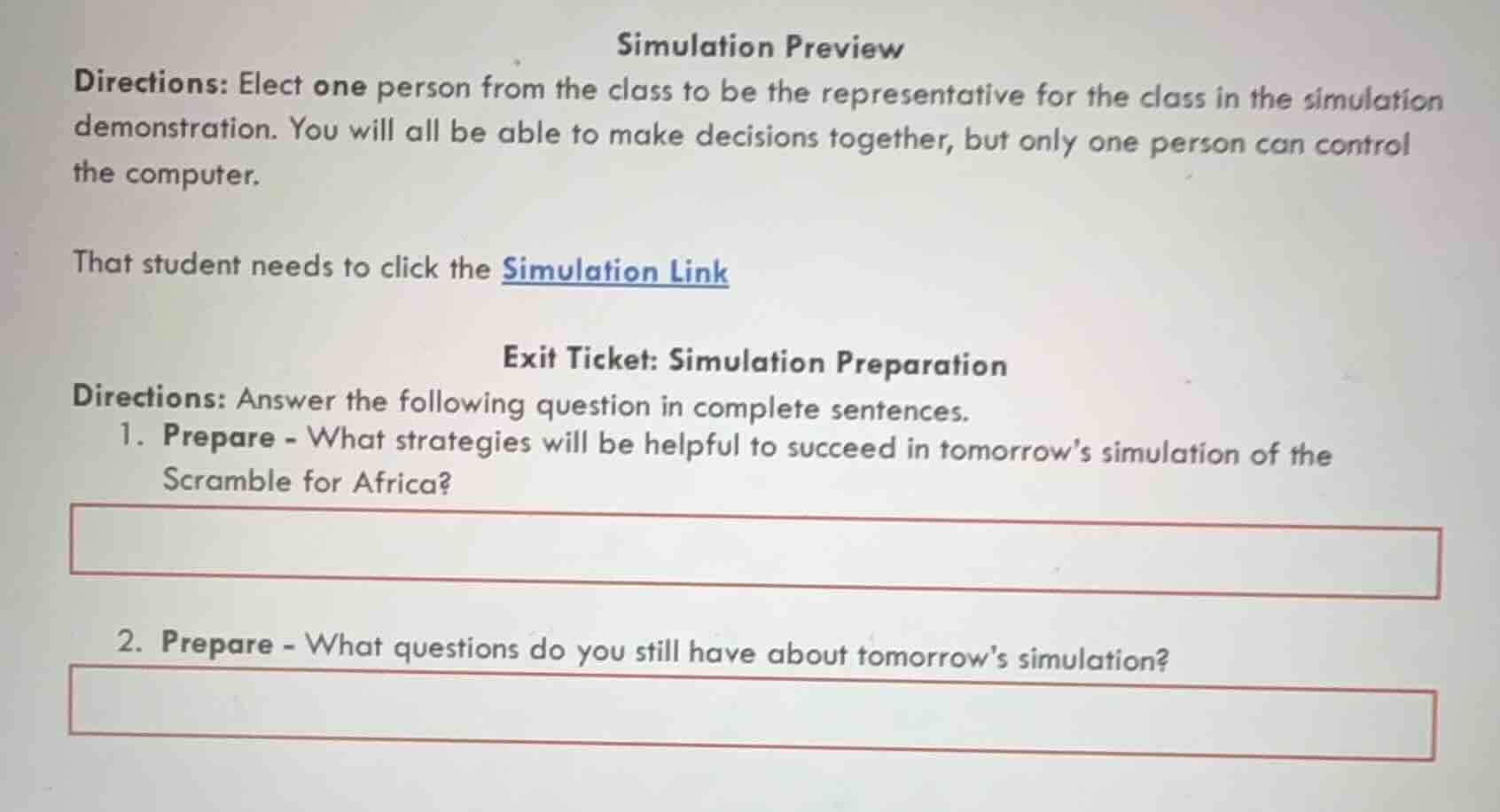
simulation preview
directions: elect one person from the class to be the representative for the class in the simulation demonstration. you will all be able to make decisions together, but only one person can control the computer.
that student needs to click the simulation link
exit ticket: simulation preparation
directions: answer the following question in complete sentences.
- prepare - what strategies will be helpful to succeed in tomorrows simulation of the scramble for africa?
- prepare - what questions do you still have about tomorrows simulation?
Brief Explanations
- For the first question, effective strategies center on understanding historical context, coordinating as a group, and prioritizing clear goals. First, researching the actual motivations and actions of European powers during the Scramble for Africa will let the group make historically grounded, strategic choices. Second, setting clear, shared goals (like securing resource-rich territories or forming temporary alliances with other groups) will keep the team aligned during decision-making. Third, designating a note-taker to track group decisions and simulation progress will prevent miscommunication and help adjust strategies quickly if needed.
- For the second question, common clarifying questions focus on simulation mechanics, rules, and outcomes. Examples include questions about how territory claims are validated, whether there are penalties for breaking alliances, how success in the simulation is measured, and if there are time limits for each decision phase.

Snap & solve any problem in the app
Get step-by-step solutions on Sovi AI
Photo-based solutions with guided steps
Explore more problems and detailed explanations
- To succeed in the Scramble for Africa simulation, first, we will research the key motives and actions of European imperial powers in the actual historical event to make informed, contextually accurate decisions. Second, we will establish clear shared goals as a class, such as prioritizing control of resource-dense regions and agreeing on when to form temporary alliances with other participating groups. Third, we will assign a secondary note-taker to track our decisions, opponent moves, and simulation updates, so we can adjust our strategy quickly if our initial approach is not working.
- I still have a few questions: First, how will territory claims be officially recognized and resolved if two groups attempt to claim the same region at the same time? Second, are there specific penalties or consequences for breaking alliances we form with other groups during the simulation? Third, what specific criteria will be used to determine which group or class is the "winner" of the simulation?